The Great Institutional Flush
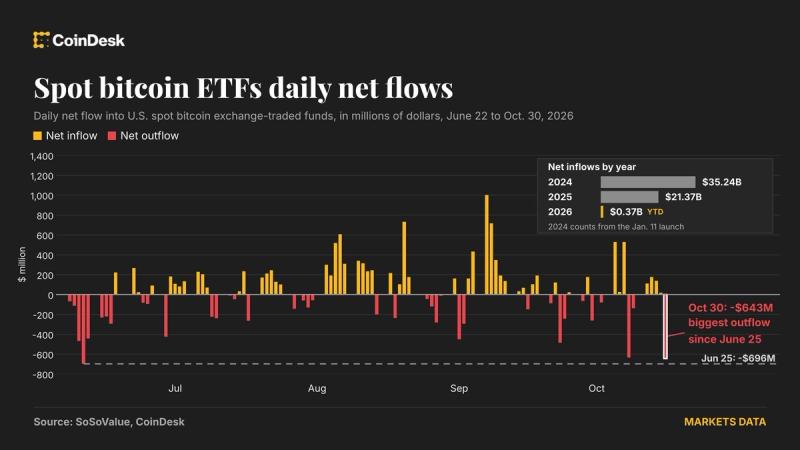
Last Friday, the U.S. spot Bitcoin ETF market saw $643 million walk out the door in a single session. To put that in perspective, we haven't seen a mass exit of this scale since the summer doldrums of late June. It wasn't a random dip; it was a direct reaction to the massive security breach at Binance that shook the industry just twenty-four hours prior. If you were looking for proof that institutional money still views crypto as a high-risk experiment rather than a permanent fixture, this is your smoking gun.
For those of us building in this space, this isn't just another number on a chart. It’s a reality check on the narrative of the "institutional wall of money." Yes, the money is here. But as these outflows show, that money is twitchy. The moment the largest exchange in the world took a hit, the suit-and-tie crowd hit the sell button. They aren't HODLers; they are risk managers. And right now, their risk models are screaming.
The Fragility of the On-Ramp
We spent years begging for ETFs because we thought they would bring stability. The theory was that regulated products would dampen the volatility caused by offshore exchanges. What we’re seeing now is the exact opposite. The ETFs have become a high-speed exit ramp. Instead of stabilizing the market, they’ve created a direct pipeline for traditional finance to dump their positions the second they see a headline they don't like.
The Binance hack was significant, not just in dollar value, but in what it represents. Binance is the liquidity engine of the entire ecosystem. When that engine starts smoking, the ETF investors don't stick around to see if the fire department arrives. They leave. This $643 million outflow tells us that the bridge between Wall Street and crypto is still a one-way street during a crisis.
What This Means for the Founder Class
If you’re building a decentralized application or a new protocol, you need to understand that your valuation is currently pegged to the sentiment of people who don't actually care about your tech. They care about their quarterly reports. When a major centralized entity like Binance gets compromised, the contagion isn't just technical; it's psychological. The "trusted" institutions are showing us that their trust is paper-thin.
We have to stop building for the next ETF inflow and start building for resilience. The more we rely on these centralized bottlenecks—whether they are massive exchanges or massive fund managers—the more we subject our industry to these violent swings. The goal was decentralization, but we’ve accidentally built a system where a single hack in one corner of the world can trigger a half-billion-dollar liquidation in a New York brokerage account.
The Gap Between Price and Value
It’s easy to get discouraged when you see these numbers. $643 million is a lot of capital to lose in twenty-four hours. But we need to separate price action from industry progress. The Binance hack is a failure of centralized security, not a failure of Bitcoin. Yet, the ETF market doesn't make that distinction. To the average fund manager, Bitcoin is just a ticker symbol that occasionally gets hacked.
This is where the opportunity lies for builders. We are currently in a transition period where the market is trying to price in institutional participation without institutional understanding. The people selling on Friday were likely the same people who bought the top three weeks ago. They are chasing momentum, not participating in a revolution. As long as this gap exists, we will continue to see these massive flushes.
The Liquidity Trap
One thing that isn't being talked about enough is the liquidity trap these outflows create. When $643 million leaves the ETFs, the authorized participants have to sell the underlying Bitcoin to rebalance. This creates a feedback loop of selling pressure that hits the spot markets, which then causes more panic in the ETFs. It’s a cycle that punishes long-term builders and rewards short-term speculators.
- Institutional loyalty is a myth: Capital will flee at the first sign of structural risk.
- Centralization is still the single point of failure: A hack on one exchange shouldn't dictate the price of a global asset, but it does.
- We need better infra: The reliance on a few massive custodians and exchanges is our biggest weakness.
The biggest takeaway here is that we are still in the 'early' phase, despite what the marketing teams tell you. If a single hack can trigger a record outflow, the foundation isn't as solid as we thought.
A Founder’s Path Forward
So, what do we do? We stop watching the ETF flows as if they are a barometer of our success. The money coming through these products is fickle. It’s "hot money" dressed up in a BlackRock or Fidelity wrapper. Our job is to build the tools that make these centralized failures irrelevant. We need better self-custody solutions, more robust decentralized exchanges, and a narrative that moves away from 'Bitcoin as a stock' and back to 'Bitcoin as an alternative system.'
Don't be distracted by the $643 million exit. The people who left on Friday weren't here to build; they were here to harvest. Let them leave. The real work happens when the hype dies down and the fair-weather investors go back to their bonds and index funds. The market is flushing out the weak hands, and while it hurts the price in the short term, it clears the way for those of us who are actually staying to build something that doesn't break when a single exchange gets compromised.
We’ve seen these cycles before. The names change—Mt. Gox, FTX, Binance—but the lesson remains the same. If you don't control the infrastructure, you don't control your future. The ETF outflows are just a reminder that Wall Street hasn't learned that lesson yet. We have.
Read the original at The Block →