The Great Institutional Flinch
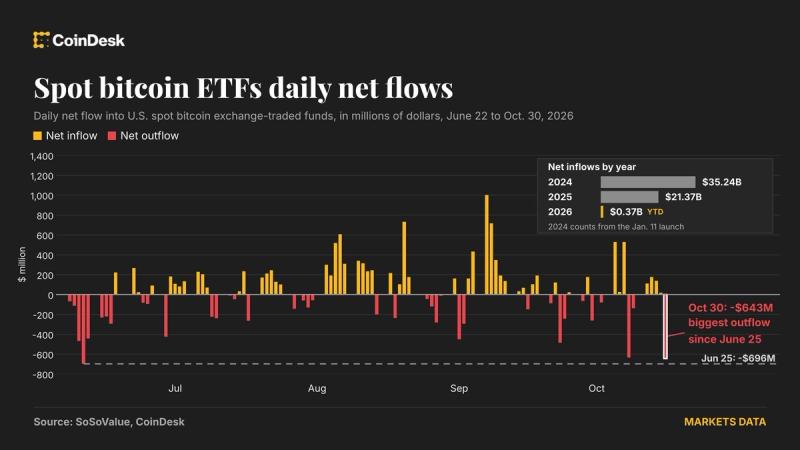
Friday wasn't just another red day on the charts. It was a wake-up call for everyone who thought institutional money had developed a thick skin. Following the news of the Binance security breach, Bitcoin ETFs saw a staggering $643 million leave the building in a single trading session. This marks the most significant exodus we have seen since late June, and it has effectively erased almost all the gains these funds managed to claw back throughout 2026.
For those of us building in the trenches, this volatility isn't surprising, but the scale of the retreat is worth examining. We have spent the last two years hearing that the 'adults' have entered the room. The narrative was that ETFs would provide a stabilization layer, a way for pension funds and wealth managers to hold Bitcoin without the heart-attack-inducing swings of the spot markets. Friday proved that when the primary plumbing of the crypto world gets a leak, the institutional exits get crowded very fast.
The Fragility of ETF Sentiment
Wall Street loves a winner, but it hates uncertainty even more. The Binance hack acted as a massive catalyst for de-risking. When the world's largest exchange shows vulnerability, the reflex for a fund manager isn't to buy the dip—it is to protect the quarterly report. We are seeing a clear decoupling between the long-term thesis of decentralized finance and the short-term behavior of traditional finance products.
The $643 million outflow tells us that the 'sticky' money might not be as adhesive as we hoped. A large portion of these flows are likely coming from momentum traders who used the ETF wrapper to catch a ride on what they thought was a boring, upward-sloping line. Now that 2026 is sitting at a 'barely green' status, the psychological safety of the trade has vanished. If the year turns red, expect the exit gates to stay open.
What This Means for Builders
If you are a founder or a developer, you might be wondering why you should care about what BlackRock or Fidelity investors are doing. You should care because these flows dictate the venture capital environment and the general appetite for risk in the ecosystem. When ETFs bleed, the secondary markets tighten up, and the 'crypto winter' talk starts echoing through the boardrooms again.
However, there is a silver lining for the builder-first crowd. This flush-out removes the tourists. We are entering a phase where the price action is driven by actual utility and systemic health rather than just ETF inflows. If your project relies on 'Bitcoin going up' as its primary growth strategy, you are in trouble. If you are building infrastructure that makes hacks like the one at Binance less impactful or helps decentralize liquidity, your value proposition just doubled.
The Exchange Vulnerability Problem
We have to be honest about the Binance situation. Even though the ETFs are segregated and held by regulated custodians, the price of the underlying asset is still heavily influenced by the health of offshore exchanges. This is a massive irony that the industry hasn't solved. We have highly regulated US products tethered to the price action of an international exchange that just suffered a major exploit.
This disconnect is exactly what skeptics point to when they say the market is rigged or fragile. As long as a single point of failure in the global exchange landscape can trigger a half-billion-dollar flight from US-regulated funds, we haven't truly achieved maturity. We are still in the 'experimental' phase, no matter how many suits are at the table.
Looking Ahead to the Rest of 2026
The year is now a toss-up. To see 2026 turn nearly flat after the optimism we started with is a heavy blow to the 'up only' crowd. We are looking at a market that is searching for a bottom and a reason to trust the infrastructure again. The Binance hack didn't just take funds; it took the momentum that had been building for months.
For the rest of the year, I expect to see a lot of sideways movement. The institutional appetite will likely stay muted until there is a clear post-mortem on the hack and a sense that the contagion has been contained. The ETF flows are the new barometer for market health, and right now, the barometer is screaming for a storm shelter.
The Founder's Takeaway
Stop watching the ETF flow charts every morning. It is a distraction. The reality is that $643 million leaving the market is a rounding error in the grand scheme of global finance, even if it feels like a catastrophe in our bubble. The mission remains the same: build systems that don't rely on the benevolence of a few centralized giants.
Institutional money is flighty. It comes for the gains and leaves at the first sign of friction. If you want to build something that lasts, focus on the users who stay when the ETFs turn red. Those are the people who actually understand the value of what we are doing. The rest are just here for the trade, and as we saw on Friday, they aren't afraid to leave the party early.
Read the original at CoinDesk →