The Phantom Order Problem
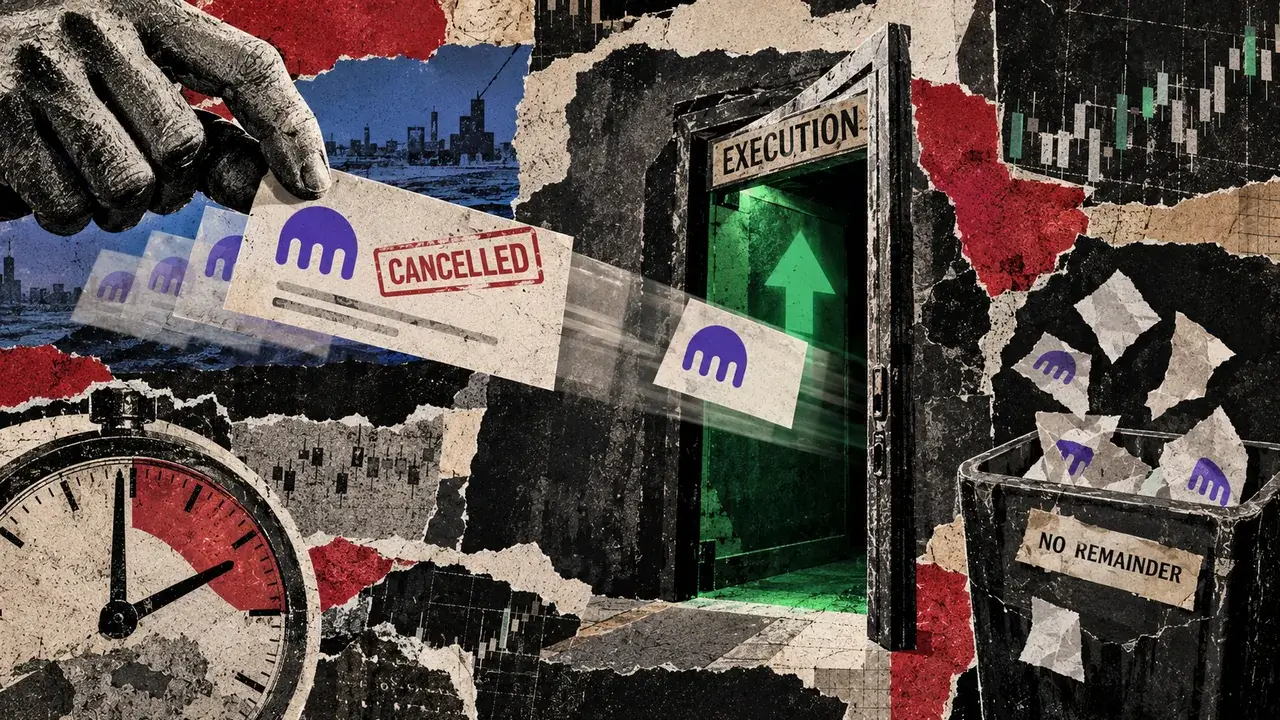
As a builder, you're taught that 'cancel' is a definitive state. You send a command, the database updates, and the liability disappears. But in the high-velocity world of crypto futures, Kraken is reminding us that deterministic outcomes are often a luxury. Their recent expansion of the Maker Protection feature across more contracts introduces a scenario that should make any high-frequency developer sweat: the order that fills even after you think it’s dead.
This isn't a bug in the traditional sense. It is a feature designed to prevent 'toxic flow' and stop market makers from getting picked off by latency arbitrage. However, for the average founder building on top of these APIs, it introduces a layer of non-deterministic behavior that can wreak havoc on automated treasury management or bot strategies. If a cancel command doesn't actually stop a fill, your state management just became a lot more complicated.
The Mechanics of Maker Protection
The core of the issue lies in how Kraken handles the transition between the matching engine and the ledger. When Maker Protection is active, the exchange is prioritizing the integrity of the order book over the immediate finality of a user's cancel request. Specifically, if a limit order is in the process of being matched while a cancel request hits the server, the exchange may allow the fill to complete rather than voiding the transaction.
Kraken’s latest update, which rolled out on October 8, brings a wider range of futures contracts under this rule. Effectively, it means that an unfilled remainder of an order is discarded, but the portion that was 'in flight' at the moment of cancellation is still fair game for execution. From a liquidity provider's perspective, this is a safety net. From a builder's perspective, it’s a race condition that is now sanctioned by the exchange’s ruleset.
Why Builders Should Care
If you are building a trading interface or a DeFi-CeFi bridge, you rely on the API returning a successful status code for a cancellation. When the API says 'canceled,' you likely update your UI to show the funds are back in the wallet and stop tracking the position. But if that order fills seconds later because of Maker Protection, your application is now out of sync with reality. You have a 'ghost position' that your system isn't monitoring, which is a fast track to liquidation.
This underscores a growing trend in centralized exchange architecture. As these platforms try to compete with the speed of decentralized high-frequency trading, they are shifting the burden of risk onto the user’s software. They are choosing to protect the market's stability at the cost of the developer's sanity. You can no longer assume that a successful status response from a REST or WebSocket endpoint is the end of the story.
The Skeptic's View on 'Protection'
Let's be honest about what 'Maker Protection' actually does. It protects the exchange and its largest liquidity providers from losing money to fast-moving price action. While Kraken frames this as a way to ensure a healthy market, it also adds a layer of opacity. It makes the order book less of a transparent ledger and more of a 'best effort' suggestion. For founders who are trying to build trust with their own users, explaining why a 'canceled' order resulted in a loss is a difficult conversation.
I’ve seen this before in legacy finance, but in crypto, we usually pride ourselves on better tech. This feels like a step backward toward the ambiguity of dark pools. If we can't trust the basic state of an order, we are forced to build increasingly complex defensive code—heartbeats, polling, and constant reconciliation—just to ensure our systems aren't lying to us.
Operational Risks and Strategy Shifts
For those running bots or automated market-making tools, this change requires a total rethink of how you handle order lifecycles. You can't just fire-and-forget a cancel command. You now need a post-cancel verification loop. You have to wait for the next account update to confirm that no shares were actually bought or sold during that millisecond window where the cancel and the fill overlapped.
This also impacts how you calculate your leverage and margin. If your system thinks an order was canceled, it might try to open a new position with that 'available' margin. If the old order fills anyway, you could find yourself over-leveraged or hitting margin calls you didn't anticipate. It’s a cascading failure waiting to happen for any team that hasn't accounted for this specific Kraken rule expansion.
A Founder’s Takeaway
The lesson here isn't to stop using Kraken, but to stop trusting that exchange APIs work like simple databases. The bridge between the web2 interface of an API and the high-speed matching engine of a futures exchange is filled with edge cases like this. If you’re building in this space, you need to assume that every action you take has a 'pending' state that could result in an outcome you didn't intend.
We are seeing more exchanges move toward these types of 'flexible' execution rules to manage volatility. As a builder, your job is to build systems that are resilient to this ambiguity. Don't trust the cancel confirmation; trust the balance update. If your architecture doesn't account for the 'fill-after-cancel' scenario, you aren't building for the real-world crypto market—you're building for a simulation that doesn't exist anymore.
The most dangerous assumption in crypto is believing that a successful API response equals a final state.
As Kraken rolls this out to more contracts, expect other exchanges to follow suit. They all face the same pressure to maintain liquidity during high volatility. Your stack needs to be ready for a world where 'no' sometimes means 'maybe,' and where the order you thought you killed is still very much alive.
Read the original at CryptoSlate →