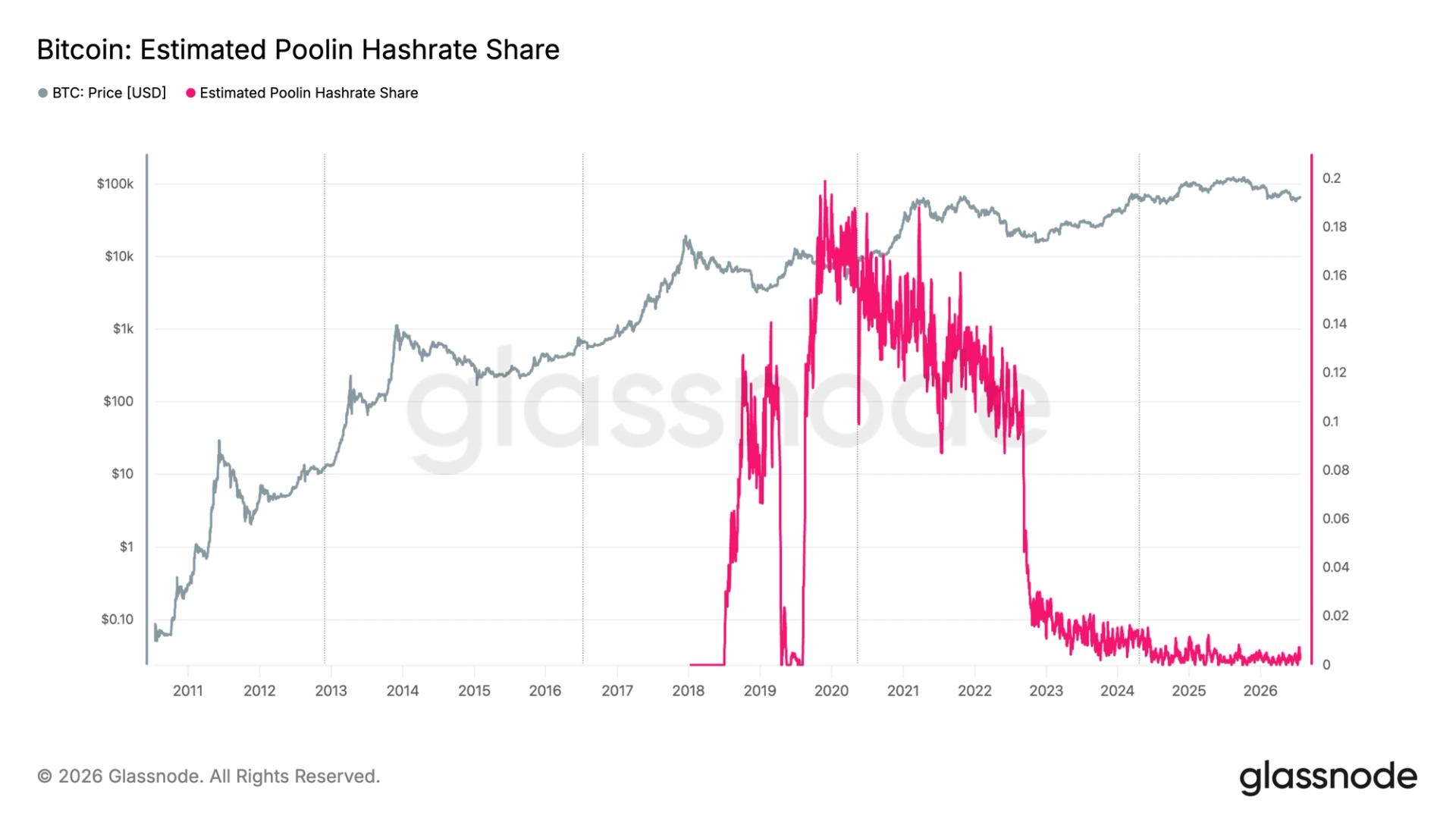
In this industry, we tend to mistake size for safety. We see a company controlling nearly 20% of a network and we think they are too big to fail. We assume they have the smartest engineers and the most robust risk management because, if they didn’t, how could they have gotten so big?
Poolin just proved that assumption wrong. The Singapore-based mining pool, which once sat at the very top of the Bitcoin food chain, has officially filed for bankruptcy. They owe about $173 million. They are selling off the furniture and the servers. It is the end of an era, and it’s a messy one.
The Fall of a Giant
To understand why this matters to builders, you have to realize what Poolin represented. At their peak, they were the heartbeat of the Bitcoin hashrate. They weren't just a service provider; they were a systemic layer of the network. When you control a fifth of the world’s mining power, you are the house.
But the house wasn't built on a rock. Their trouble started publicly a couple of years ago when they froze withdrawals citing "liquidity issues." In crypto, that is usually a euphemism for "we lost your money." They tried to pivot. They issued IOU tokens—Mars (MARS) and Apollo (APL)—to represent what they owed to miners. It was a classic move: trying to print your way out of a hole. It didn't work. The market didn't buy it, and the miners didn't want IOUs; they wanted their Bitcoin.
Now, those miners are looking at a total loss while the legal process grinds through the details of $173 million in liabilities. This isn't just a bad business cycle. It's a failure of the custodial model in an industry that was built to move away from trust.
The Liability Trap
Here is the reality for founders: Poolin didn't fail because mining is hard. Mining is definitely hard, but it's predictable if you manage your expenses. Poolin failed because they started acting like a bank without the oversight or the capital reserves that banks are supposed to have. They took deposits from miners—earnings that should have been passed through immediately—and they used that liquidity for other things.
When the market turned, they were caught over-leveraged. As a builder, the lesson here is about where you draw the line between your service and your users' assets. If you are building a platform where you hold user funds even for a few seconds, you are taking on massive risk. Most founders aren't prepared for the psychological weight of that risk until the volatility hits.
- Operational Risk: Using customer funds as your own working capital is a death sentence.
- Transparency: Once you stop being open about your balance sheet, the smart money leaves first.
- The Token Mistake: You cannot fix a hardware or liquidity problem by issuing more software tokens.
What This Means for the Network
The silver lining here is that Bitcoin doesn't care. While Poolin was dying, the hashrate just migrated. Other pools like Foundry or AntPool picked up the slack. The network stayed secure. This is the beauty of decentralization—the failures are localized to the middle-men, not the protocol itself.
But for the people building the middle-men services, this is a wake-up call. We are seeing a purge of the "Old Guard" companies that grew too fast during the 2020-2021 hype cycles. These companies were built for a world where Bitcoin only went up and electricity was cheap. We don't live in that world anymore.
The era of the 'too big to fail' mining pool is over. Efficiency and transparency are the only things that keep the lights on now.
Advice for Modern Founders
If you are building in the infrastructure space today, you need to be skeptical of your own growth. Don't chase hashrate or user numbers at the expense of your balance sheet. Poolin’s mistake was thinking they could weather any storm because they were the biggest. In crypto, being the biggest just makes you a bigger target for market volatility.
Stop trying to be a full-service financial institution if your core value is infrastructure. If you provide a mining pool, provide a mining pool. If you provide an AI compute farm, provide compute. Don't start offering yield on customer deposits unless you want to end up in a bankruptcy court in Singapore.
The Pivot That Failed
I want to look specifically at their attempt to issue those IOU tokens. It’s a recurring theme in this space. When a project fails, the founders often try to "token-ize" their debt. They tell the community, "Hold this new asset, and we'll pay you back when things get better."
This is almost always a mistake. It destroys the last shred of trust you have. If you owe people money, you owe them the currency they gave you. Creating a new synthetic asset to cover a hole in your pocket just signals to the world that you’ve run out of real ideas. Builders need to realize that you can’t code your way out of a fundamental debt problem.
The Long Tail
The liquidation of Poolin’s assets will take time. We’ll see stories about their hardware being sold for pennies on the dollar and legal fees eating up whatever cash is left. The miners who supported them for years are the ones who will ultimately pay the price for management’s mismanagement.
For the rest of us, it’s a reminder to look under the hood of the providers we use. Don't just look at the dashboard and the clean UI. Ask where the money goes the second it leaves the miner's rig. If the answer involves the pool holding onto it for 'convenience,' you might want to look for a different pool.
The Takeaway
Poolin’s bankruptcy is a $173 million lesson in the dangers of the custodial business model. If you are building in this space, focus on non-custodial solutions. If you can’t touch the money, you can’t lose the money. Size is no longer a metric for success—solvency is. Let’s build things that don't need a bankruptcy lawyer to explain where the Bitcoin went.
Read the original at CoinDesk →