The $5 Billion Wall
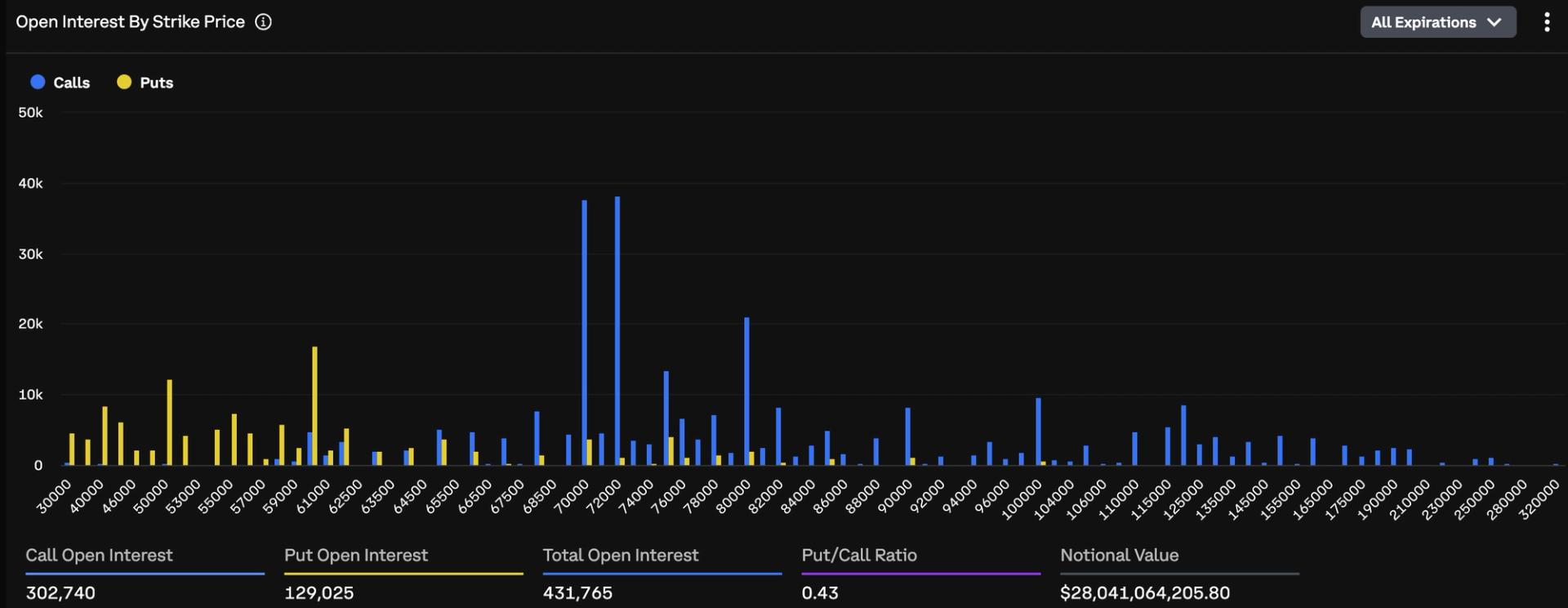
In the world of crypto derivatives, we often chase signal through a mountain of noise. Right now, on the Deribit exchange, that signal is screaming at a specific frequency. We are looking at a $5 billion cluster of open interest sitting parked at the $70,000 and $72,000 price targets. For those who don't spend their days staring at order books, this means a massive amount of capital is betting that Bitcoin isn't just going to reach its previous highs, but sustain a move past them.
As a builder, I tend to look at these numbers with a healthy dose of skepticism. When everyone leans one way, the boat has a tendency to tip. However, the sheer size of this call-to-put ratio suggests that the market isn't just hopeful; it is positioned for a specific type of breakout. We are seeing call options—bets that the price goes up—far outnumbering puts. This isn't just retail gambling; this is institutional positioning trying to front-run a supply crunch.
The Psychology of the Strike Price
Why $70,000? It is the psychological barrier that has acted as a ceiling for what feels like an eternity in crypto time. When traders pile into strikes just above the current market price, they create a gravity well. This is often called a 'gamma magnet.' As the price approaches these strikes, market makers who sold those options have to buy the underlying Bitcoin to hedge their positions. This creates a feedback loop that can accelerate a price move faster than organic spot buying ever could.
But there is a flip side. If the price fails to break these levels by the expiry date, all that premium evaporates. The builders in this space need to understand that these financial products are sophisticated tools, but they also represent a lot of 'paper' value that can vanish in a weekend flush. When I talk to founders, I tell them to watch these levels not because the price is guaranteed to hit them, but because they represent the collective 'hope' of the market leaders. And in crypto, hope is often the predecessor to a volatility spike.
What It Means for the Ecosystem
The existence of a $5 billion cluster tells us two things about the current state of crypto infrastructure. First, the liquidity is getting deeper. We aren't in the 2017 Wild West anymore where a few hundred million could break the system. We are seeing multi-billion dollar clusters form on specialized derivatives platforms, which shows that the sophisticated pipes are finally built. This is good for long-term stability, even if it feels chaotic in the short term.
Second, it shows that the 'buy the dip' mentality has evolved into 'bet on the breakout.' For a long time, the options market was used primarily for downside protection—hedging your bags just in case things went south. Seeing this much weight on the call side tells me that the fear of missing out (FOMO) has moved upstream. It is no longer just retail buying on Coinbase; it is the big money using leverage to ensure they are compensated for a move back to all-time highs.
The Founder Perspective: Signal vs. Noise
If you are building an AI-driven trading bot, a DeFi protocol, or a consumer app, you might think the options market doesn't affect you. You'd be wrong. Capital flows are the lifeblood of the builder economy. When the options market gets this top-heavy, it dictates the cost of capital. If a massive liquidation event happens because we can't pierce $72,000, the venture capital and treasury funds that back your projects will suddenly get very conservative again.
I’ve seen this cycle repeat. We get a massive buildup in open interest, the headlines turn incredibly bullish, and then a minor macro event triggers a cascade. I am not saying a crash is coming—the fundamentals of Bitcoin's adoption are stronger than ever—but I am saying that $5 billion is a lot of leverage to be sitting on a single price point. As a founder, you want to be building for the reality where Bitcoin is $100,000, but you need to survive the reality where it dips back to $55,000 to shake out the weak hands sitting in this $5 billion cluster.
The Role of Institutional Hedging
It is worth noting that not all of this $5 billion is speculative. A portion of it is likely sophisticated hedging. As more ETFs and public companies hold Bitcoin on their balance sheets, they use options to manage their risk. However, the imbalance between calls and puts is too wide to be purely defensive. This is an offensive posture. The market is effectively saying it expects the road to $72,000 to be paved with aggressive buying.
For the AI developers reading this: this data is a goldmine. Looking at the delta and theta decay of these specific clusters provides a roadmap for volatility. If you are building predictive models, these clusters are your high-probability zones. They are the battlegrounds where the whales will fight to keep the price above or below those thresholds to either collect premium or force a breakout.
Takeaway for the Week
Don't get blinded by the $5 billion figure. Large numbers are meant to grab headlines. Instead, look at the concentration. The fact that the market is so focused on $70,000 and $72,000 suggests we are approaching a resolution to the range-bound trading we've seen lately. Either we break through and these options print money, or the failure to reach them causes a rapid deleveraging.
My advice? Keep building, keep your overhead low, and don't let the derivatives market dictate your roadmap. These numbers show that interest is higher than ever, but as founders, we have to be the ones who stay grounded when the leverage starts flying. The bullish story is there, but the real builders know the best work happens when you ignore the price and focus on the product.
The market can stay irrational longer than you can stay solvent, but it can't ignore a massive liquidity cluster forever. One way or another, $72,000 is the number to watch.
Read the original at CoinDesk →