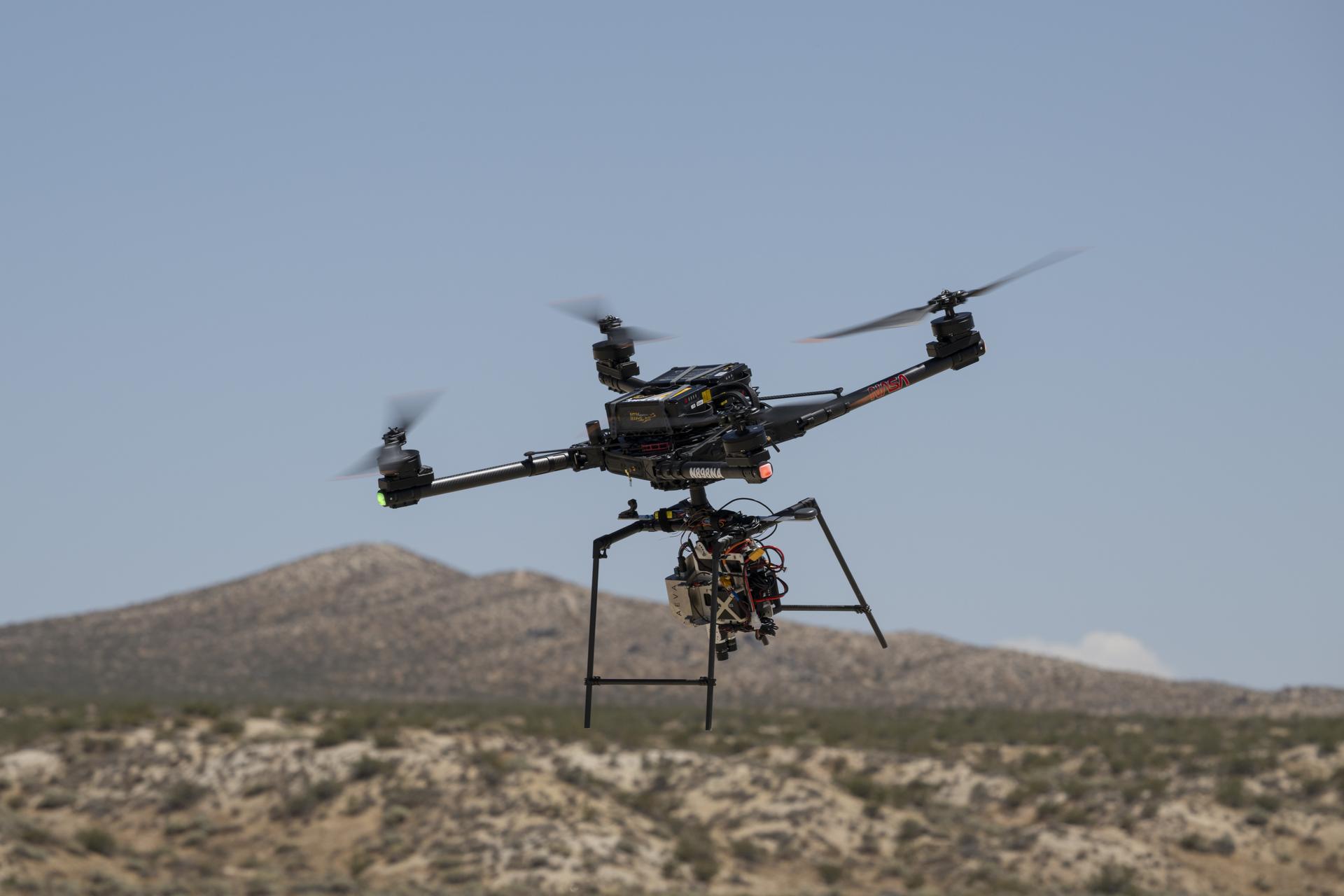
We talk a lot about automation in the context of LLMs and code generation, but the real-world stakes are often much higher. NASA recently ran a test flight at the Armstrong Flight Research Center that caught my eye. They took an Alta-X drone, strapped a highly specialized payload to it, and simulated a lunar descent. The goal was to see if a machine could handle the split-second decisions required to land on a rock 238,000 miles away without a human joystick involved.
The SPLICE Architecture
The system is called SPLICE, which stands for Safe and Precise Landing – Integrated Capabilities Evolution. In plain English, it is an integrated suite of sensors and software designed to solve the “landing problem.” Historically, landing on the Moon or Mars involved a lot of luck and massive target zones. You aimed for a giant flat spot and hoped you didn't hit a boulder the size of a house that was too small for orbital cameras to see.
SPLICE changes the math by using Hazard Detection Lidar and advanced algorithms. During the August 27 flight test, the drone wasn't just flying a pre-programmed path; it was processing data to find a safe spot in real-time. This is essentially edge computing at its most critical. If the algorithm fails, a billion-dollar mission turns into a new crater.
Why Builders Should Care About Edge Autonomy
For those of us building in the AI space, the SPLICE experiment is a masterclass in constrained optimization. Unlike a server rack in Ohio, a spacecraft has a very limited power budget and thermal overhead. You cannot just throw more GPUs at the problem. You have to write lean code that can process high-fidelity sensor data with zero latency.
The tech stack NASA is building here is a precursor to what we will eventually see in terrestrial autonomous logistics. If you can navigate a descent to the lunar south pole amidst jagged shadows and craters, navigating a delivery drone through a suburban neighborhood becomes a solved problem. We are seeing the “trickle-down” effect of aerospace engineering hitting the commercial sector.
Moving Beyond GPS
One of the most interesting aspects of this test is the move away from Earth-centric navigation. On Earth, we have the luxury of GPS. On the Moon, you have nothing. You are flying blind unless your onboard systems can build a map of the terrain as you fall toward it. This is called relative navigation.
The Alta-X drone used for the test is a heavy-lift workhorse, but for this experiment, it acted as a proxy for a lunar lander. By mimicking the descent profile of a real spacecraft, the NASA team was able to prove that their guidance, navigation, and control (GNC) systems could handle the transition from high-altitude approach to a gentle touchdown. This isn't just about soft landings; it is about precision. Previous missions were happy to land within a few kilometers of a target. Future missions, specifically those supporting the Artemis program, need to land within meters of pre-positioned supplies.
The Founder Perspective: Reliability Over Hype
As a founder, I look at these NASA tests as a reminder that reliability is a feature, not an afterthought. In the startup world, we are taught to “move fast and break things.” If you break things in space, you don't get a Series B; you get a congressional hearing. The SPLICE project has been in development for years, iterating slowly, testing components in isolation, and finally bringing them together for this integrated flight test.
There is a lesson there for AI builders. We are currently in a cycle where everyone is rushing to ship wrappers around APIs. NASA is doing the opposite. They are building a vertical stack from the sensor hardware up to the logic gates. They own the data, the processing, and the execution. This level of vertical integration is what creates a defensible moat in any high-stakes industry.
The Road Ahead for Planetary Exploration
This successful flight test doesn't mean the job is done. It means the tech is ready for the next level of validation. NASA plans to keep pushing these capabilities because the moon is just a starting point. The real goal is Mars, where the atmosphere is thin enough to be a nuisance but not thick enough to be an easy brake. Landing on Mars requires even faster autonomous decision-making because the communication delay to Earth is measured in minutes, not seconds.
When the SPLICE system eventually makes it onto a lunar lander, it will be the culmination of thousands of hours of simulated and terrestrial testing. It represents a shift from “guided” flight to “intelligent” flight. The spacecraft isn't just following a map; it is observing its environment and reacting to it.
The Takeaway
The future of robotics isn't found in a cloud-based brain; it's in the edge-case autonomy being forged in projects like SPLICE. For builders, the message is clear: the most valuable AI applications are those that can operate reliably in disconnected, high-stakes environments. If you want to see where the next decade of computer vision and real-time processing is going, stop looking at chatbots and start looking at how we are landing on other planets.
The successful flight of the Alta-X with the SPLICE payload proves that autonomous precision is no longer theoretical; it is a functional requirement for the next generation of exploration.
Read the original at NASA Breaking News →