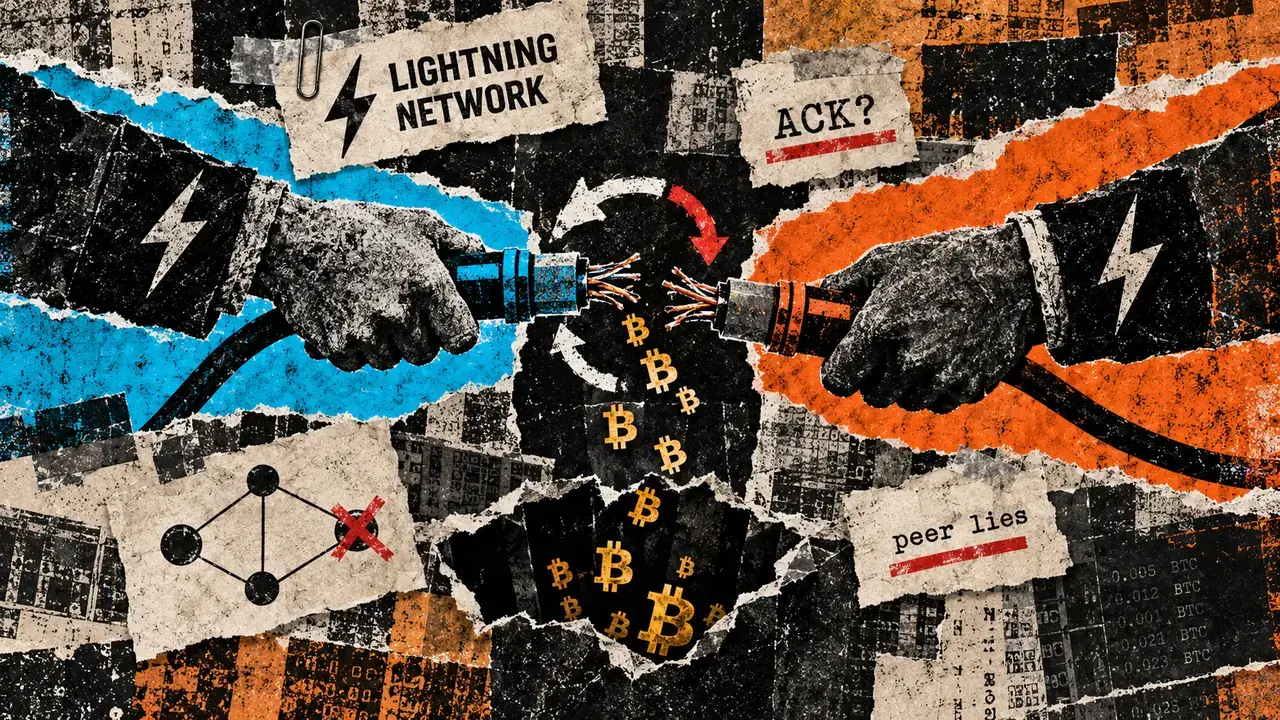
Building on Bitcoin isn't for the faint of heart. We talk a lot about the upside of the Lightning Network, but we rarely talk about the sheer complexity of maintaining a peer-to-peer state machine where one party is constantly looking for a reason to lie. Recently, the team behind the Lightning Development Kit, or LDK, released a set of critical patches that every builder in this space needs to pay attention to.
This isn't just another routine update. It deals with a specific scenario where a node reconnects to a peer, and that peer decides to misreport the state of their shared channel to siphon off Bitcoin. If you haven't updated to v0.2.7 or v0.1.13, your users' funds are essentially sitting in a room with an unlocked door.
The Reconnect Lie
To understand why this matters, you have to look at how Lightning actually functions. Unlike the base layer of Bitcoin, where the blockchain is the final source of truth for every transaction, Lightning relies on a series of off-chain agreements between two people. When you open a channel, you are essentially signing a contract that says, we both agree this is how much money we each have right now.
The problem arises during a reconnection. In a perfect world, when two nodes drop their connection and find each other again, they should be able to pick up exactly where they left off. However, this gap in communication is a prime opportunity for a malicious peer to provide false information about the most recent state of the channel. If the LDK-based app doesn't have the proper checks in place to verify that what the peer is saying matches its own internal records, it might accept a state that favors the attacker.
This isn't a failure of the Bitcoin protocol itself. It is a failure of the logic used to manage the channel's state. It is a reminder that in the world of Layer 2, you are only as secure as the code you use to talk to your neighbors.
Losing Bitcoin by Omission
What makes this specific vulnerability dangerous for founders is that it exploits a lack of verification. The patch addresses a theft path where the peer simply lies about the balance or the status of pending transactions upon reconnecting. If the app is unpatched, it might allow the peer to broadcast a transaction that reflects an older, more favorable balance for them, essentially stealing the difference from your user.
For those of us building products, this is the nightmare scenario. You spend months on UI, marketing, and onboarding, only to have a technical oversight in a dependency wipe out user confidence. The LDK is one of the most popular tools for integrating Lightning into mobile apps and non-custodial wallets precisely because it handles the heavy lifting. But even the best tools have edges that need sharpening.
The LSPS2 Payment Flaw
Beyond the reconnect issue, the v0.2.7 update also tackles a flaw related to LSPS2. This is a standard designed to improve how payments flow through service providers, particularly for mobile users who aren't always online. The bug involved a discrepancy in payment amounts that could, in theory, lead to funds being misrouted or lost.
This highlights a recurring theme in the developer community: the more we try to make Lightning user-friendly through service layers and standards, the more surface area we create for bugs to hide. Standards are great for interoperability, but they require rigorous implementation. If you are using LDK to handle liquid services or simplified payment flows, this fix is just as important as the one for the reconnect lie.
What This Means for Builders
If you are a founder or an engineer working with LDK, the takeaway is simple: update now. But the broader lesson is about how we handle dependencies in the crypto space. We often treat libraries like LDK as black boxes that just work. We forget that these are evolving pieces of software navigating a highly adversarial environment.
When you build on Bitcoin, you are building on a foundation of skepticism. The Lightning Network extends that foundation, but it adds a layer of social and technical coordination that is much more fragile than the base layer's Proof of Work. Your app needs to be built with the assumption that every peer it connects to is a potential adversary.
Real decentralization means you can't rely on a central authority to fix your mistakes. You have to be the first line of defense for your users.
The Founder Perspective
I’ve seen plenty of projects rush to market with a slick interface while ignoring the plumbing. In the AI and crypto crossover space, there is a lot of hype about agents making autonomous payments. If those agents are running on unpatched infrastructure, they aren't just efficient; they are liabilities. Imagine an AI agent losing its entire treasury because it reconnected to a malicious node and believed a lie about its balance.
Honesty in this industry starts with acknowledging that our tools are imperfect. LDK is a fantastic project, and the fact that they are identifying and patching these issues quickly is a sign of a healthy ecosystem. However, that health only translates to security if the developers using the tool take the time to implement the updates.
The Takeaway
Don't let the technical jargon of v0.2.7 and v0.1.13 distract you from the reality of the situation. This is a fix for a theft vulnerability. If you are running an LDK-based app, your users are at risk until you deploy this patch. In the world of Bitcoin, there are no chargebacks and no customer support lines to call when a peer robs you. The code is the only law that matters, so make sure yours is up to date.
The Lightning Network is a massive leap forward for Bitcoin's utility, but it requires a level of developer vigilance that most Web2 builders aren't used to. Stay skeptical, stay updated, and keep building with the lights on.
Read the original at CryptoSlate →