We have reached a stage in the market cycle where the "diversified crypto portfolio" is starting to look like a liability for corporate balance sheets. For a long time, the narrative for public companies was simple: if you are going to touch crypto, you buy a basket. You get some Bitcoin for the store of value, some Ethereum for the smart contract utility, and maybe a few altcoins to catch the retail hype. It looked smart on a spreadsheet, but the operational reality is proving to be a headache.
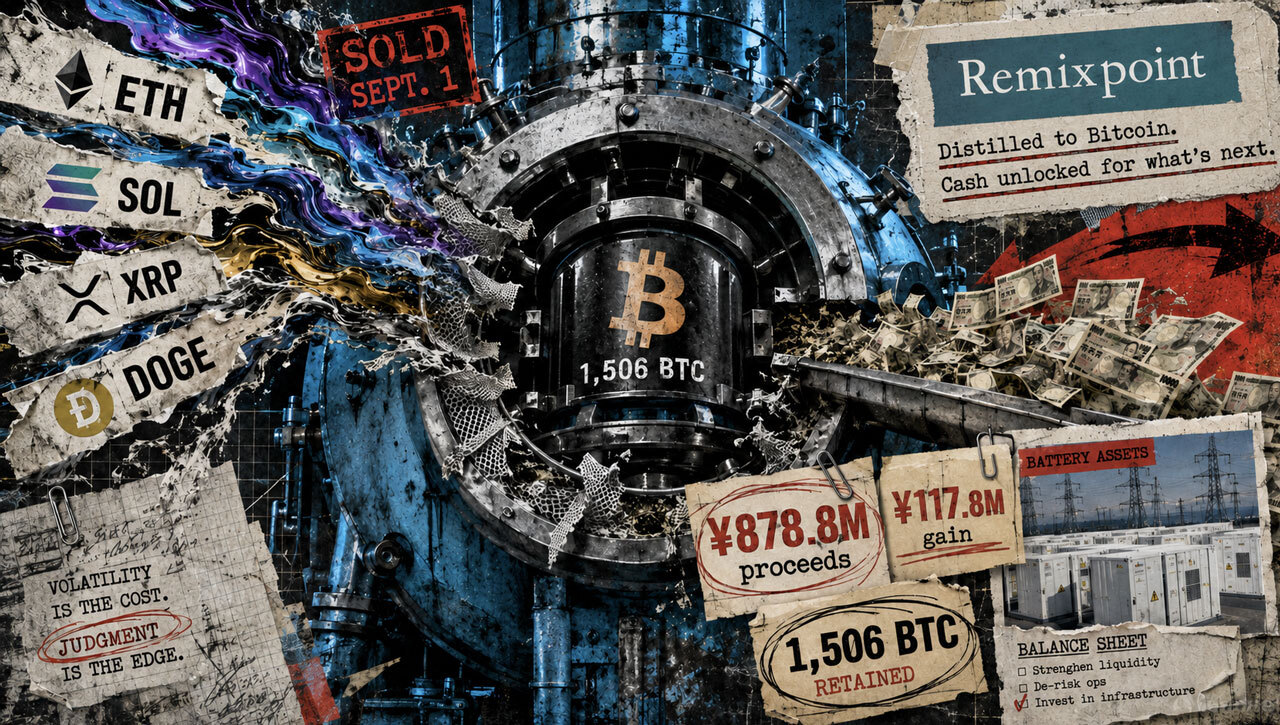
Remixpoint, a publicly traded Japanese firm that operates across energy and automotive sectors, recently decided they were done with the experiment. They cleared their books of Ethereum (ETH), Solana (SOL), XRP, and Dogecoin (DOGE). They didn't sell because they were underwater—in fact, they booked a profit of about 117.8 million yen. They sold because they realized that for a corporation, Bitcoin is the only asset that makes sense as a treasury reserve.
The Complexity of Multi-Asset Treasuries
From a founder's perspective, managing a treasury is about risk mitigation, not chasing the next 100x pump. When you hold multiple volatile assets, you aren't just managing price risk; you are managing regulatory risk, technical risk, and accounting overhead. Every time a new token is added to a balance sheet, the audit requirements get heavier and the tax implications get more convoluted.
By consolidating their holdings into roughly 1,506 BTC, Remixpoint is following the blueprint laid out by MicroStrategy. They are simplifying their narrative for shareholders. It is much easier to explain a single, decentralized commodity than it is to explain why you are holding a bag of Dogecoin or a platform token that might be deemed a security depending on which way the wind blows in any given jurisdiction.
Why Altcoins are Losing the Treasury War
Ethereum and Solana are incredible pieces of technology. As builders, we use them to deploy dApps and manage state. But being a great developer platform does not automatically make an asset a great treasury reserve. The "utility" argument for holding ETH on a balance sheet often falls flat when compared to the simple, hard-cap economics of Bitcoin.
For a company like Remixpoint, the volatility of altcoins introduces a layer of noise that distracts from their core business operations. When you hold XRP or DOGE, your quarterly reports become a rollercoaster of explaining market sentiment shifts that have nothing to do with your company's performance. Bitcoin has achieved a level of institutional acceptance and regulatory clarity—especially in Japan—that the rest of the market simply hasn't reached yet.
The Impact on Developers and Builders
You might think this is bad news for the ecosystems of the tokens being sold, but I see it differently. This is a maturing of the space. We are finally starting to see a separation between "money" and "infrastructure."
Bitcoin is winning the "money" war for corporations. This frees up Ethereum, Solana, and others to be what they were meant to be: execution layers. If you are building on these platforms, you shouldn't be worried that a Japanese energy company sold their tokens. You should be focused on whether people are actually using your tools. The liquidity for these assets should come from usage and ecosystem growth, not from being parked in a corporate vault where they sit idle.
The Japanese Market Signal
Japan has historically been one of the most conservative yet structured markets for crypto. The fact that a Japanese firm is leaning this hard into a Bitcoin-only strategy suggests that the regulatory framework there is becoming increasingly favorable for BTC as a recognized financial asset. For builders looking to expand internationally, this is a signal that the "Bitcoin as an asset class" conversation is settled in major markets.
However, we should stay skeptical of the "maxi" narrative. Just because a treasury goes Bitcoin-only doesn't mean the rest of the industry is dying. It means the "store of value" use case has a clear winner, and everyone else is now competing on a different battlefield: utility, speed, and cost.
What This Means for Your Strategy
If you are a founder managing a small treasury or a startup's runway, there are three takeaways from the Remixpoint move:
- Simplify your balance sheet: Unless you are a VC firm or a hedge fund, your treasury should not be a speculative playground. Complexity costs time and money.
- Focus on liquidity: Bitcoin remains the most liquid asset in the space. When you need to pivot or cover expenses, you want an asset you can move in size without crushing the price.
- Watch the narrative shift: We are moving toward a world where Bitcoin is the reserve, and everything else is the application. Build accordingly.
Remixpoint walked away with a profit and a cleaner story. They aren't trying to be a crypto fund anymore; they are a company that uses Bitcoin to protect its capital. That is a distinction more founders need to start making. Stop trying to pick the winners of the next bull run with your company's survival funds. Pick the asset that has already won the institutional trust race.
Read the original at Decrypt →