The Great Altcoin Purge
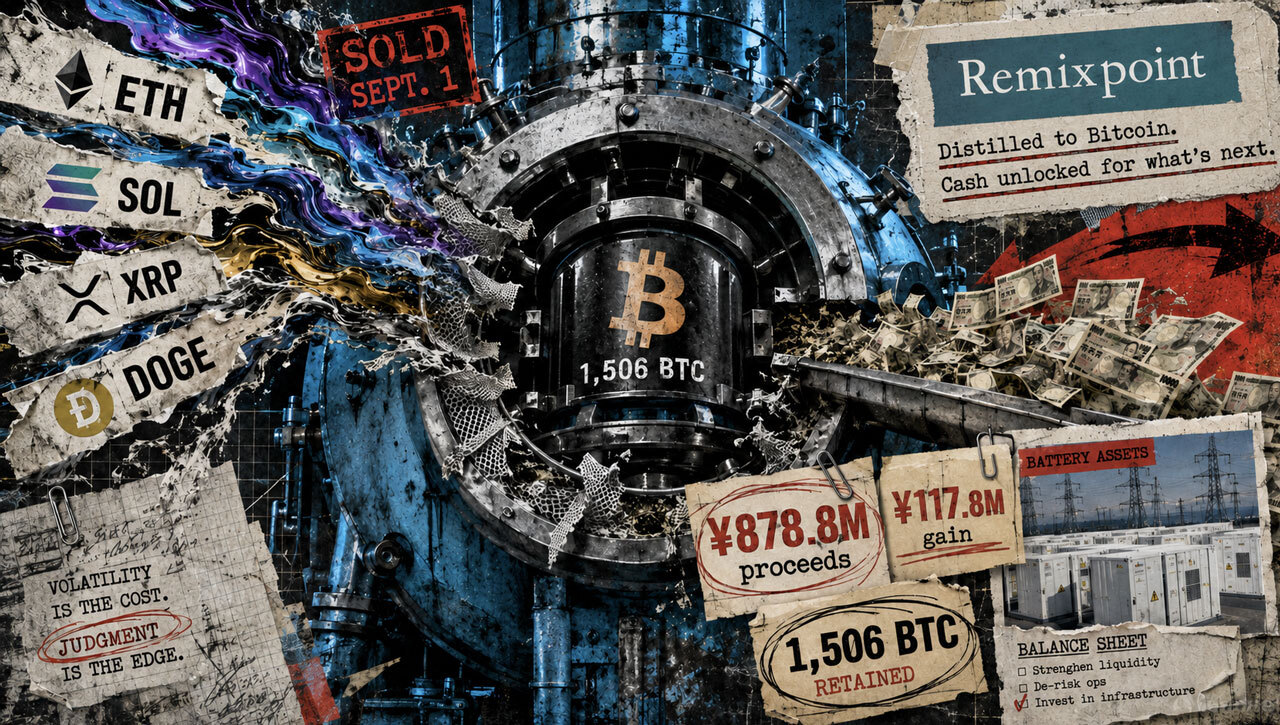
In the world of corporate treasury management, there is a massive difference between being a trader and being a holder. Metaplanet, a Tokyo-listed firm that has quickly become the MicroStrategy of Japan, recently made a move that highlights this divide. They decided to liquidate their entire holdings of Ethereum, Solana, and XRP. The interesting part? They didn't sell because they were losing money. In fact, they booked a decent profit.
Metaplanet offloaded these assets for roughly 878.8 million yen. While most retail investors would be thrilled with a profitable exit, Metaplanet isn't playing the same game. By cleaning out their altcoin closet, they have consolidated their digital strategy into a single, singular focus: Bitcoin. As of their latest filing, their Bitcoin holdings sit at a valuation of roughly $121 million.
Why Profit Isn't Always the Point
For a founder or a builder, seeing a company sell winners like Solana or Ethereum might seem counterintuitive. If an asset is performing well, why cut it? The answer lies in the complexity of corporate balance sheets. Managing a diverse basket of volatile assets introduces accounting friction, regulatory hurdles, and narrative confusion. By stripping away the altcoins, Metaplanet is signaling to its shareholders that they aren't a crypto hedge fund; they are a Bitcoin company.
This is a tactical retreat from complexity. Ethereum and Solana represent platform risk and utility-driven speculation. Bitcoin, in the eyes of firms like Metaplanet, represents a base layer of value. When you are trying to convince conservative Japanese institutional investors to back a crypto-heavy strategy, "we own the digital gold" is a much easier sell than "we are yield farming on Solana."
The Logistics of the Exit
Metaplanet's exit was calculated. They didn't dump these assets in a panic. They recognized that while ETH, SOL, and XRP had provided gains, those gains were distractions from their primary objective. The cash generated from these sales isn't necessarily going right back into more Bitcoin immediately, either. Management has indicated that the capital might be deployed for general corporate purposes or other strategic moves.
This is a sober reminder for builders: cash flow is king, but clarity is queen. Metaplanet is prioritizing a clean balance sheet over the potential upside of an altcoin rally. For a company that has seen its stock price fluctuate wildly based on its Bitcoin acquisitions, removing the noise of smaller, more volatile assets helps stabilize the investor narrative.
The Founder's Perspective on Treasury
If you are building a startup, you probably shouldn't be gambling your runway on altcoins. Metaplanet’s move mirrors what we see in the most successful tech companies—eventually, you have to choose your standard. Diversification is for wealth preservation; concentration is for wealth creation. Metaplanet has chosen to concentrate.
There is also a hidden regulatory layer here. Japan has historically been one of the most stringent environments for crypto assets. While the tide is turning, holding a basket of different tokens requires significantly more compliance overhead than holding Bitcoin alone. By narrowing their focus, they likely reduced their legal and accounting bill by a significant margin.
What This Means for the Market
When a major player sells out of Ethereum and Solana, people tend to get nervous. But this isn't a vote of no confidence in those ecosystems. It's a statement about what constitutes a "reserve asset." Metaplanet is following the playbook written by Michael Saylor: treat Bitcoin as the primary treasury reserve and everything else as a speculative venture.
For the broader market, this move suggests that the institutional appetite for altcoins as balance sheet assets is still relatively weak compared to Bitcoin. We are seeing a bifurcation in the industry. On one side, you have the builders and users who need ETH and SOL to power applications. On the other, you have the treasury managers who just want a hard asset that won't be inflated away.
- Bitcoin remains the only crypto asset with true institutional consensus as a reserve.
- Altcoin profits are being used to shore up fiat reserves or cycle back into BTC.
- Corporate clarity is becoming more valuable than portfolio diversification.
A Skeptical Look at the Future
We should be careful not to deify these moves. Metaplanet is under immense pressure to perform. By tethering their entire identity to Bitcoin, they have effectively turned their stock into a proxy for the BTC price. If Bitcoin enters a multi-year bear market, Metaplanet doesn't have the buffer of a diversified business to lean on. They are all-in.
However, from a builder's standpoint, there is something respectable about the honesty of this move. They aren't pretending to be experts in DeFi or NFT infrastructure. They are playing a macro currency game. For them, ETH and SOL were just trades. BTC is the destination.
The move to sell profitable altcoin positions isn't a sign of weakness; it's a sign of a company finding its specific lane in an increasingly crowded market.
The Takeaway for Builders
If you're running a project, don't get distracted by the green candles in your secondary tokens. Profit is good, but focus is better. Metaplanet's decision to liquidate their winners to maintain their core position is a masterclass in staying on mission. Whether you agree with their Bitcoin-only maximalism or not, you have to respect the discipline required to sell a winning trade just to simplify your story.
Expect more international firms to follow this lead. As the regulatory environment clarifies, companies will stop "dabbing" in crypto and start making definitive choices about which assets they will actually stand behind.
Read the original at CryptoSlate →