We talk a lot about decentralization in the crypto space, but we rarely see it actually get tested in a way that hurts the founders' feelings. Most of the time, the lead developer or the charismatic founder says jump, and the community asks how high. Solana just had one of those rare moments where the script got flipped.
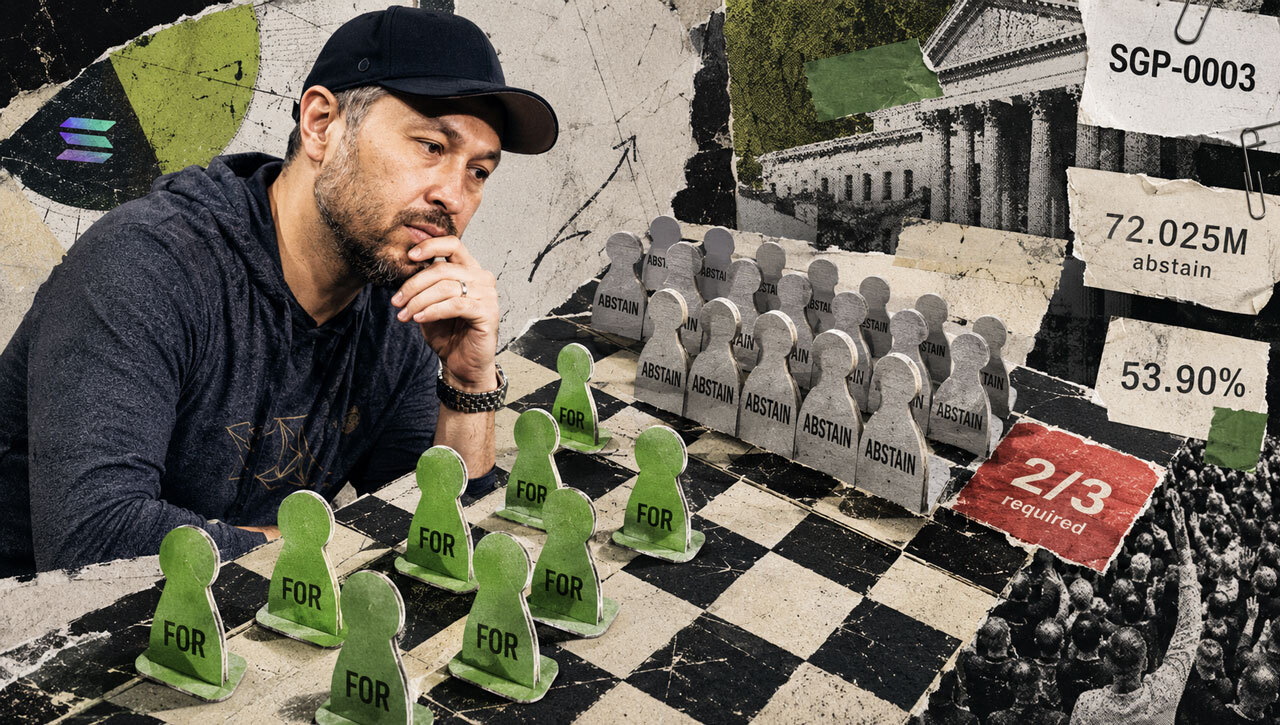
A recent vote regarding how transaction fees are handled on the network failed to reach the required supermajority. While a simple majority of voters were on board with the change, the threshold for implementation wasn't met. This might sound like dry governance drama, but for those of us building in this ecosystem, it is a massive signal about who actually holds the keys to the kingdom.
The Illusion of Founder Control
Anatoly Yakovenko is the face of Solana. He is the guy who pushed for Proof of History when everyone else was stuck on traditional scaling. In many ways, his influence is the gravity that keeps the Solana orbit stable. But this fee vote showed that even Anatoly cannot simply decree a change and expect the network to follow.
The proposal aimed to tweak the distribution of priority fees. Currently, Solana burns half of its transaction fees and sends the other half to validators. The proposed change wanted to send 100% of priority fees directly to validators. The logic was simple: give validators more incentive to play fair and secure the network. Anatoly supported the move. A lot of the big players supported the move. But the vote failed.
This is a reality check for anyone who thinks these networks are just private companies dressed up as protocols. If this were a traditional tech company, Anatoly would have signed a memo, and the change would have been pushed to production by Monday. In a decentralized network, the founder is just another stakeholder with a loud microphone.
The Rise of the Validator Class
What this vote really reveals is the rising power of the validator class. In the early days of any L1, validators are usually just fans or early supporters. As the network matures and billions of dollars in TVL start flowing through the pipes, these validators turn into sophisticated businesses. They have their own balance sheets, their own risks, and their own opinions on how the protocol should reward them.
The fact that a supermajority was required—and not met—means that a significant minority of the network's voting power decided they weren't ready for this change. They chose the status quo over the founder's vision. For builders, this is both a blessing and a curse. It means the network is stable and resistant to sudden, whimsical changes. It also means that progress can be agonizingly slow if you can't get the guys running the hardware to agree with you.
What This Means for Builders
If you are building an app on Solana, you need to understand that your relationship isn't just with the Solana Foundation or Anatoly. Your real partners are the validators and the stakers. They are the ones who ultimately decide the economic rules of the road. If a fee structure change affects how your users pay for transactions, you can't just look at the roadmap and assume it's a done deal.
We are entering an era where "social layer" politics are just as important as the code. You have to lobby. You have to convince the people who hold the stake that your proposed changes benefit the long-term health of the network, not just your specific project.
- Governance is a feature, not a bug, but it adds friction to the development cycle.
- Founders can propose, but they cannot dispose. The power sits with the capital.
- Validator alignment is the new "developer relations."
The Myth of the Benevolent Dictator
There is a comforting myth in crypto that every chain has a benevolent dictator. Vitalik for Ethereum, Anatoly for Solana, Hoskinson for Cardano. We like having a single person to blame or praise. But this failed vote is a cracks-in-the-armor moment. It proves that the governance mechanisms are actually working, even if the result isn't what the leadership wanted.
As a founder, I find this encouraging. It means the network I am building on isn't subject to the whims of a single person who might have a bad day or a change of heart. It means there is a distributed consensus that is harder to corrupt. However, it also means we have to be prepared for gridlock. The more decentralized a network becomes, the harder it is to make big, sweeping changes to its core economics.
The measure of a network's decentralization isn't how much the founder talks; it's how often the founder loses a vote.
Solana just proved it is more decentralized than its critics like to admit. By failing to pass a measure that the leadership clearly wanted, the network demonstrated that the power rests with the people running the nodes. That is a win for the long-term credibility of the chain, even if it feels like a short-term hurdle for the development roadmap.
The Takeaway for the Rest of Us
Don't be fooled by the headlines that call this a "failure." In the context of protocol evolution, a failed vote is a successful test of the system's integrity. It shows that the guardrails are in place. If you're building in AI or crypto, you should be looking for these signs of friction. Friction is proof that no one person has total control.
The next time you see a founder promising a massive change to a protocol's economics, check the governance rules first. See what the validators think. Because at the end of the day, the guy with the most followers on X isn't the one who decides when the code gets updated. The people with the stake do.
Read the original at CryptoSlate →