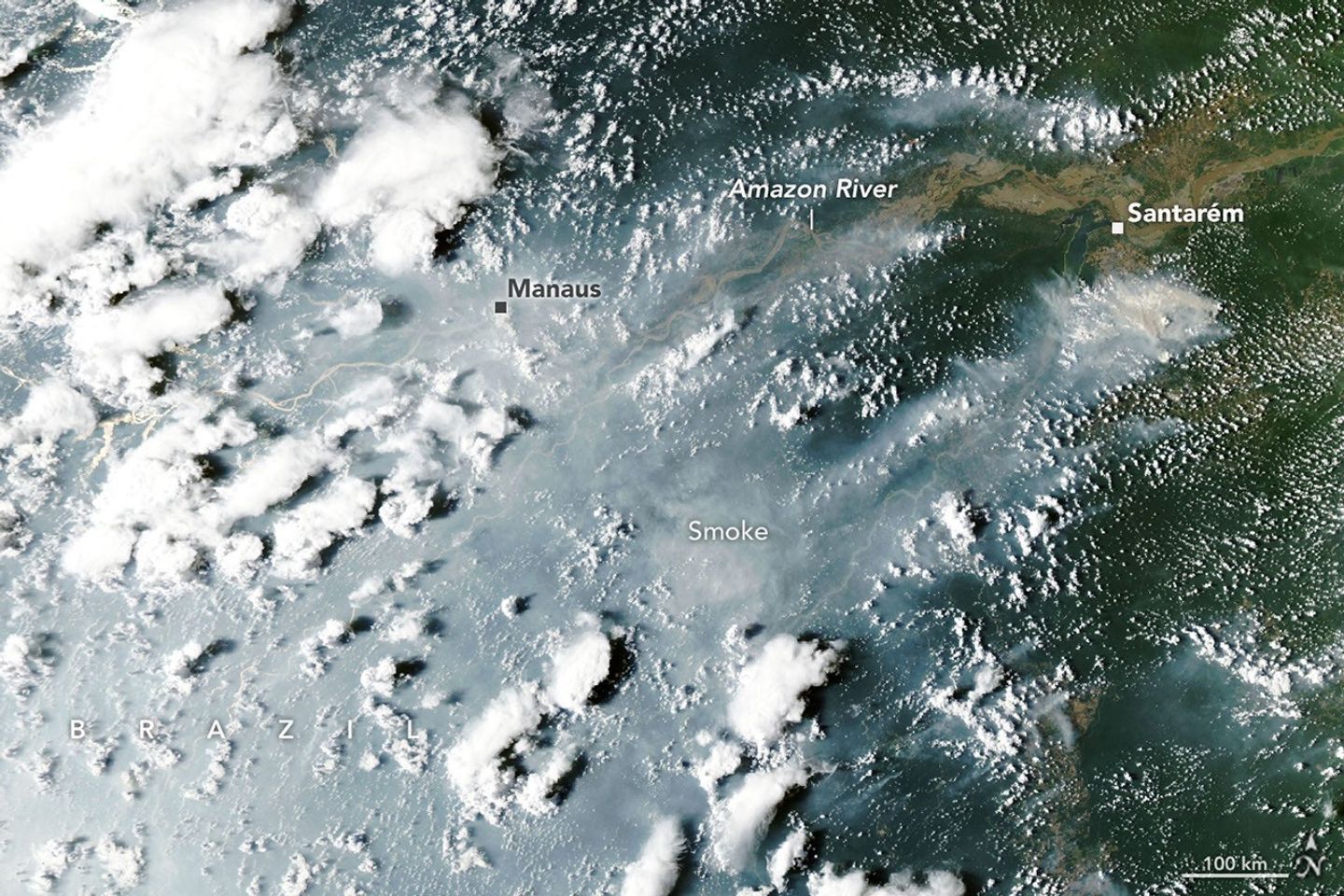
We have all seen the headlines about the Amazon rainforest. They usually fall into two categories: existential dread or political finger-pointing. But if you look at the recent data coming from NASA regarding the arrival of fire season in the central and eastern Amazon, there is a much more nuanced story for those of us building in the tech and crypto space.
The current situation is driven by the El Niño cycle. It creates a predictable, yet devastating, cascade of fire that starts in equatorial Asia and eventually makes its way to South America. For builders, this isn't just about environmentalism; it is about the failure of current monitoring systems and the massive opportunity for decentralized physical infrastructure networks (DePIN) and AI-driven predictive modeling.
The Predictability Problem
NASA scientists have pointed out that this fire cycle is relatively rhythmic. When the Pacific waters warm, the rainfall patterns shift. Asia dries out first, then the Amazon follows. We have the satellite imagery to see it happening, yet we are consistently behind the curve in preventing the damage. This is a data latency problem.
As a founder, I look at this and see a massive inefficiency. We are relying on centralized government agencies to process satellite data and issue warnings that often arrive too late for local communities to act. If we want to actually protect these global assets, we need real-time, ground-level data that doesn't rely on a single source of truth.
Why Builders Should Care
You might be wondering what forest fires have to do with your next dApp or AI agent. The answer is proof of impact. The current carbon credit market is, frankly, a mess. It is filled with double-counting, lack of transparency, and "ghost" forests that burned down years ago but are still being traded as offsets.
The arrival of fires in the Amazon highlights the need for verifiable environmental data. If we can't prove a forest is still standing, the entire economic model of conservation collapses. We need builders who can bridge the gap between orbital sensors and on-chain verification.
- Decentralized Monitoring: Using low-cost IoT sensors to provide real-time heat and smoke data.
- AI Predictive Analysis: Moving beyond just seeing fires to predicting them based on moisture levels and historical El Niño patterns.
- Tokenized Conservation: Creating incentives for locals to maintain the land that are more profitable than clearing it for cattle.
The Skeptical Take on Carbon Markets
I have always been skeptical of the current "Green Tech" narrative because it feels like a giant PR exercise. Buying a carbon credit from a company that claims to protect a patch of the Amazon means nothing if that patch burns down three months later during an El Niño event.
The source data shows that these fires are increasing in intensity. This means the risk profile of these assets is changing. If you are building in the ReFi (Regenerative Finance) space, you have to account for these cycles. You can't just build a smart contract and walk away. You need dynamic data feeds that adjust the value of an asset based on real-world conditions.
The Amazon isn't just a forest; it's a global resource that is currently being managed with outdated tools and misaligned incentives.
The Technical Gap
The gap between a NASA satellite image and a local firefighter is huge. We have the high-level view, but we lack the granular execution. This is where AI agents come in. Imagine an autonomous system that monitors moisture levels via decentralized sensors and automatically triggers funding for irrigation or firebreaks when thresholds are met. No committees, no bureaucracy, just code reacting to environmental reality.
We have the technology to do this. The hurdle is the legacy mindset that these problems are too big for individual builders or small teams to solve. NASA provides the raw data, but they aren't going to build the incentive layers. That is on us.
Foundation for the Future
When the fires arrive in the Amazon, it is a reminder that nature operates on cycles that don't care about our quarterly reports or token launches. But these cycles are readable. They are data points in a larger system. As builders, our job is to translate that data into action.
We need to stop looking at the Amazon as a charity case and start looking at it as a high-value asset that requires better infrastructure. The current centralized approach is failing every time the Pacific warms up. It is time to build something more resilient.
The Takeaway
Don't just watch the news and feel bad. Look at the data. The Amazon's fire season is a predictable failure of current management systems. For those in crypto and AI, the mission is clear: build the verification and monitoring layers that turn these headlines into historical footnotes. We need systems that are as relentless as the El Niño cycle itself.
Read the original at NASA Breaking News →