The Cost of Speed
Building in the AI space feels like trying to fix a plane while it is accelerating toward a cliff. You need more power, you need it now, and you are willing to pay almost anything to get it. We are seeing this reality play out in the balance sheets of the industry's biggest players, and it is a sobering lesson for any founder trying to navigate the next three years.
Anthropic recently updated their financial disclosures, and the numbers are staggering. We are looking at a company that generated $17 billion in revenue with over $8 billion in operating cash flow through late 2026. On paper, those are numbers most SaaS founders would kill for. But beneath the surface, there is a volatility that should make every builder pause.
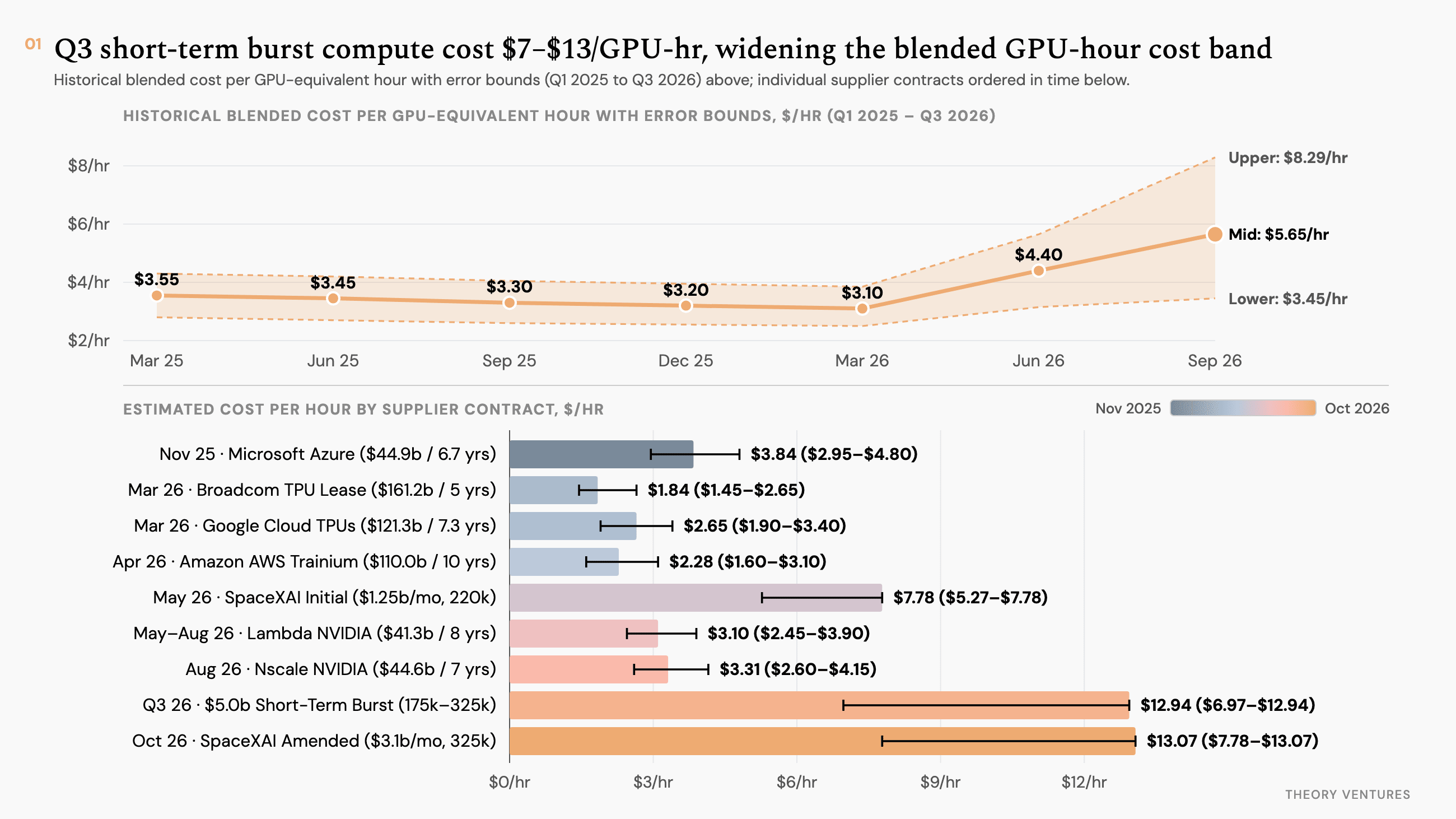
In just two quarters, Anthropic saw their blended cost per GPU-hour jump by 82%. A massive operating profit of nearly a billion dollars in one quarter evaporated, turning into a loss of over half a billion in the next. This was not due to poor management or a drop in users. It was the result of the industry's most expensive addiction: short-term burst compute.
The Burst Compute Trap
When you are building frontier models, you cannot always wait for a new data center to come online. You need compute capacity yesterday. To stay competitive, Anthropic leaned into short-term compute rentals, paying anywhere from $7 to $13 per GPU-hour. For context, that is a massive premium over long-term reserved pricing.
This is the hidden tax on AI innovation. If you want to be first, you pay the spot price. But the spot price for H100s or their successors is not just a line item; it is a margin killer. For builders, the takeaway is clear: your unit economics are not stable. They are at the mercy of a supply chain that is still nowhere near meeting demand.
Financial Engineering as a Core Competency
We used to think of AI startups as research labs. Then we thought of them as product companies. Now, we have to view them as massive exercises in financial engineering. Anthropic is sitting on nearly $900 billion in long-term obligations. Let that number sink in. That is not just a debt load; it is a bet on the future of human productivity that is larger than the GDP of many countries.
For the average founder, you are not going to be managing a trillion-dollar balance sheet. But you are competing in an ecosystem where the cost of entry is being set by these numbers. If the big players are willing to flip from massive profit to massive loss just to secure compute bursts, what does that mean for your API costs? What does it mean for your ability to scale without VC subsidies?
The Efficiency Mandate
The current cycle is defined by brute force. We are throwing more chips and more electricity at the problem. But the volatility in Anthropic's margins suggests that brute force is reaching a financial breaking point. You cannot build a sustainable business if your core cost of goods sold can double in six months because of a supply crunch.
- Reserved vs. Spot: Long-term contracts are the only way to stabilize margins, but they lock you into today's hardware.
- Capital Intensity: AI is no longer a low-overhead software business. It is a heavy industry.
- Model Optimization: The real winners in 2027 won't just be those with the biggest clusters, but those who can get the same results with 50% less compute.
We are entering an era where being a great coder or a visionary founder isn't enough. You have to understand the macroeconomics of silicon. If you are building on top of these models, you are effectively a derivative of these financial pressures. When Anthropic or OpenAI feels the squeeze on compute pricing, that pressure eventually flows downhill to every developer using their API.
What Builders Should Watch
Don't be blinded by the $17 billion revenue figure. Revenue is a vanity metric if your cost to serve that revenue is controlled by a handful of hardware providers and cloud giants. We are seeing a decoupling of growth and profitability that looks very different from the dot-com era or the mobile era.
The volatility we see in these filings is a warning. The cost of intelligence is not a straight line down; it is a jagged path dictated by the physical realities of data centers and energy grids.
If you are a founder, your goal for 2027 should be resilience. You need to build your stack so that you aren't one GPU price spike away from insolvency. This might mean multi-cloud strategies, it might mean smaller, specialized models, or it might mean raising capital specifically to pre-pay for compute capacity years in advance.
The Reality Check
The scale of these long-term obligations—nearly a trillion dollars—tells us that the industry expects the AI boom to last decades, not years. But it also tells us that the stakes are high enough to sink even the biggest ships if the expected gains in efficiency don't materialize. The financial engineering required to keep these companies afloat is becoming as complex as the neural networks they are training.
Keep your eyes on the margins, not just the benchmarks. The most impressive thing a startup can show in 2027 won't be a slightly better chatbot; it will be a stable, predictable profit margin in the face of a volatile compute market. That is the builder's challenge.
Read the original at Tomasz Tunguz →