The Price Is Never Just The Price
In the world of building financial systems, we like to talk about the truth. We talk about the blockchain as a source of truth, but when it comes to price, truth is a localized phenomenon. Recent data regarding XRP on Coinbase reveals a strange, albeit brief, moment where one of the world’s most liquid assets appeared to be on clearance, depending entirely on which pair you were looking at.
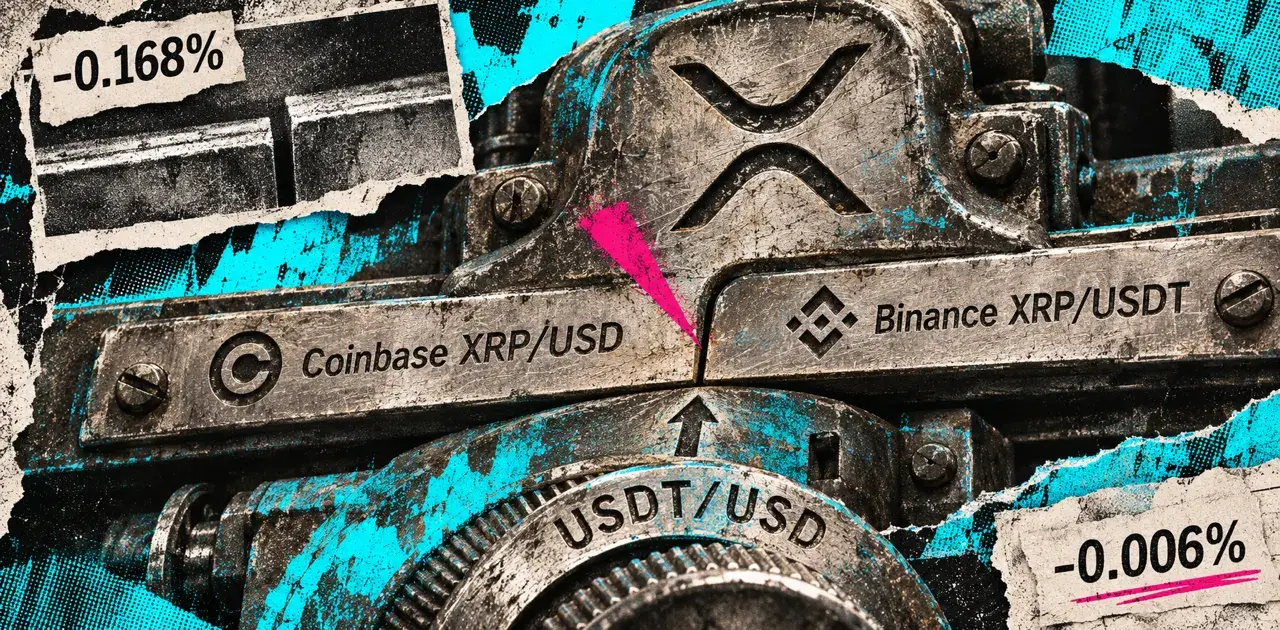
On November 2, a noticeable gap appeared. If you looked at the Coinbase XRP/USD pair, the price looked lower than the rest of the market. At first glance, it looked like a standard arbitrage opportunity—the kind of thing that keeps high-frequency trading firms in business. But for those of us building the tools or managing treasury, it was a reminder that the spread between stablecoins and hard dollars isn't always zero.
The Mirage of the Coinbase Discount
Data showed that the Coinbase XRP price sat at a 0.168% discount compared to global averages. In the fast-moving world of crypto, that is a massive gap. If you are moving a few million dollars, that spread is the difference between a profitable quarter and a loss. However, the reality was more nuanced. Once you account for the conversion of Tether into actual U.S. Dollars, that discount collapsed from nearly 0.17% to a mere 0.006%.
What we saw wasn't necessarily a failure of the XRP market, but a friction point in the transition between fiat and crypto-native stablecoins. For a builder, this is the first lesson: your pricing oracles are only as good as the underlying pair liquidity. If your application relies on a single source of truth for pricing, and that source is a USD pair while the rest of the world is trading against USDT, you are going to see ghosts in your data.
Why Liquidity Pools Diverge
We often treat USD and USDT as interchangeable 1:1 units. On paper, they are. In the plumbing of an exchange like Coinbase, they are very different animals. Coinbase has spent years positioning itself as the bridge to the traditional banking system. This means their USD rails are heavily regulated and subject to different liquidity pressures than the offshore, USDT-dominant pools seen on exchanges like Binance or OKX.
When volatility hits, or when capital starts moving toward specific jurisdictions, these pools de-sync. The November 2 event was a micro-demonstration of how a perceived discount is often just a reflection of the cost of moving money across different types of rails. The "discount" was essentially the market pricing in the effort required to turn a crypto-stablecoin back into a bank-ready dollar.
The Founder Perspective on Oracle Risk
If you are building a DeFi protocol or a payments gateway, these small percentages are where you get liquidated. I have seen founders build systems that assume a global mid-price exists. It doesn't. There is only the price you can actually execute at in a specific venue.
When XRP trades at a discount on a specific exchange, it usually means there is an imbalance in sell-side pressure on that specific platform that the arbitrage bots haven't cleared yet. But when that discount vanishes after a currency conversion, it means the problem isn't the asset—it's the bridge. As builders, we have to stop treating stablecoins as identical to fiat in our backend logic. They carry different risk profiles and different liquidity depths.
Liquidity Fragmenting in Real Time
The XRP incident highlights a growing trend of liquidity fragmentation. We are seeing a split between the regulated, USD-backed exchanges and the global, stablecoin-driven markets. This creates a two-tier pricing system. For a developer, this means you can no longer just pull a price feed from one top-tier exchange and call it a day. You need to be looking at the volume-weighted average across both fiat and stablecoin pairs to get an honest read on what an asset is worth.
The perceived value of a token is often just a reflection of the friction in the exit ramp. If it costs more to get to cash, the token price will reflect that weight.
The Technical Debt of Arbitrage
Most of the time, bots close these gaps in milliseconds. When a gap of 0.168% persists long enough to be measured in a daily close, it signals that the cost of capital or the risk of the trade was too high for the bots to bother. Perhaps the lag in bank transfers or the fees associated with moving USD out of a specific jurisdiction outweighed the potential profit from the trade.
This is where the "builder-first" mindset comes in. If the automated systems aren't fixing the price, the infrastructure is failing. We should be looking at these anomalies not as trading opportunities, but as diagnostic reports on the health of our financial plumbing. If XRP can't stay synced on a major exchange like Coinbase, what happens to lower-cap assets during a real liquidity crunch?
What This Means for the Next Cycle
We are entering a phase where the "basis trade"—the difference between the spot price and the derivative or the difference between two different stablecoin pairs—is becoming the dominant story. The Coinbase XRP data proves that even the most established assets are susceptible to these micro-fractures.
For founders, the takeaway is simple: diversify your liquidity sources. If your project’s treasury is entirely dependent on one exchange's pricing, you are at the mercy of their specific banking relationships. If Coinbase has a hiccup with its USD partners, your "mark-to-market" value could fluctuate wildly even if the rest of the global market is stable.
Final Thoughts for Builders
Don't get distracted by the headlines saying an asset is "cheap" on one platform. It's usually a trap or a technicality. The XRP discount was a ghost in the machine, a result of how we calculate the value of a dollar versus the value of a digital representation of a dollar. Build your systems to recognize the difference, or prepare to be the one providing the exit liquidity for someone who does.
Read the original at CryptoSlate →