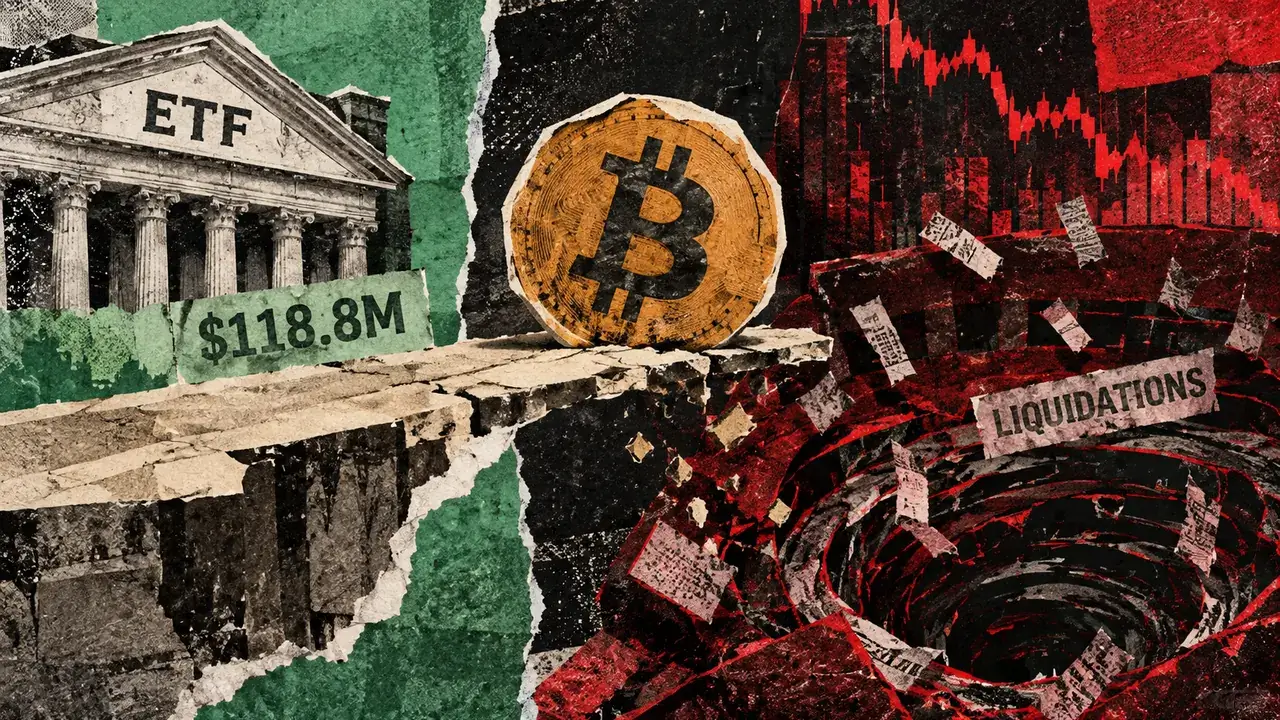
We keep hearing that the institutions are here to save us. The narrative says that as long as BlackRock and Fidelity are seeing green numbers in their daily fund flows, the floor is solid. But the market just gave everyone a reality check. Bitcoin slipped back to the $84,000 range, triggering $143 million in liquidations, even as ETF inflows stayed positive. This is exactly why you can't treat Wall Street buy orders like a guaranteed price floor.
The ETF Disconnect
For months, the crypto industry has been obsessed with the spot ETF flow charts. If the number is positive, we assume the price has to go up. But there is a massive structural difference between a wealth manager buying spot BTC for a long-term portfolio and a retail trader sitting on 20x leverage on a centralized exchange. The ETF buyers are slow, deliberate, and generally not forced to sell when the price drops 5%. The leveraged traders are the opposite. They are fast, emotional, and their positions are literally programmed to vanish if the market moves against them.
When we saw $143 million wiped out in a single liquidation wave, it showed that the internal plumbing of the crypto market is still driven by high-risk bets. The ETF inflows might provide a long-term bid, but they do nothing to stop a cascading liquidation event. If enough long positions hit their margin call price, the resulting sell orders happen regardless of what is happening at BlackRock's trading desk.
Building for Stability vs. Hype
As builders, this disconnect is actually an opportunity to rethink how we design products. If you are building a DeFi protocol or a financial tool, you have to realize that the "institutional era" hasn't actually solved the volatility problem—it has just added a new layer of complexity. We are currently operating in a two-tier market. Tier one is the regulated, slow-moving institutional side. Tier two is the wild, high-leverage retail side. These two worlds are currently colliding in a way that creates massive price gaps.
If your project relies on price stability or assumes that "the dip will always be bought" by institutions, you are taking a massive risk. The institutions aren't here to protect your liquidations. They are here to accumulate an asset class over a ten-year horizon. They don't care if a few thousand traders get wiped out on a Monday afternoon.
The Liquidation Trap
What happened on October 7 was a classic example of the liquidation trap. Traders saw positive inflow data and assumed the path of least resistance was up. They piled into long positions, pushing the funding rates higher and making the market top-heavy. When the price didn't immediately moon, the momentum stalled, the first few stop-losses were hit, and the dominoes started falling.
This is the skepticism we need to maintain. Just because the "smart money" is buying doesn't mean the price can't drop 10% in a few hours. In fact, many institutional players prefer these liquidation events because it allows them to fill their large buy orders at a discount. They aren't the floor; they are the net waiting at the bottom after the crash.
What Builders Should Watch
- Funding Rates: If funding is deeply positive despite sideways price action, a liquidation event is brewing, regardless of ETF flows.
- Exchange Balances: Watch how much BTC is moving onto exchanges versus flowing into cold storage via ETFs. These are two different signals.
- Volatility Products: There is a growing need for hedging tools that protect against these specific types of flash crashes that bypass the institutional bid.
Reframing the Narrative
We need to stop using ETF flows as a proxy for market health. A healthy market is one where price discovery happens through a balance of supply and demand, not one where price is propped up by a single type of buyer. The $143 million in liquidations is a reminder that the crypto market is still a casino for many participants. If you are building in this space, you need to build for the casino reality, not the institutional fantasy.
Founder perspective: don't let the green ETF bars fool you into thinking the risk is gone. The risk has just shifted. We are seeing a transfer of coins from weak, leveraged hands into strong, institutional hands, but the process of that transfer is violent. Your treasury management and your product roadmaps should reflect that volatility.
The Hard Truth
There is no floor. The idea that a specific price point is "safe" because of institutional interest is a myth that gets people liquidated. The only real floor is the one you build yourself through sustainable tokenomics and real-world utility that doesn't depend on the daily candle. The institutions are buyers, but they are not your friends, and they certainly aren't your insurance policy.
Take the lessons from this $143 million wipeout. It tells us that leverage is still the primary driver of short-term price action. If you're building for the long term, ignore the daily flow charts and focus on building systems that can survive a 20% drawdown in a single afternoon. Because as we just saw, even $84k isn't a safe haven when the margin calls start coming in.
Read the original at CryptoSlate →