The Analog Feedback Loop in Deep Space
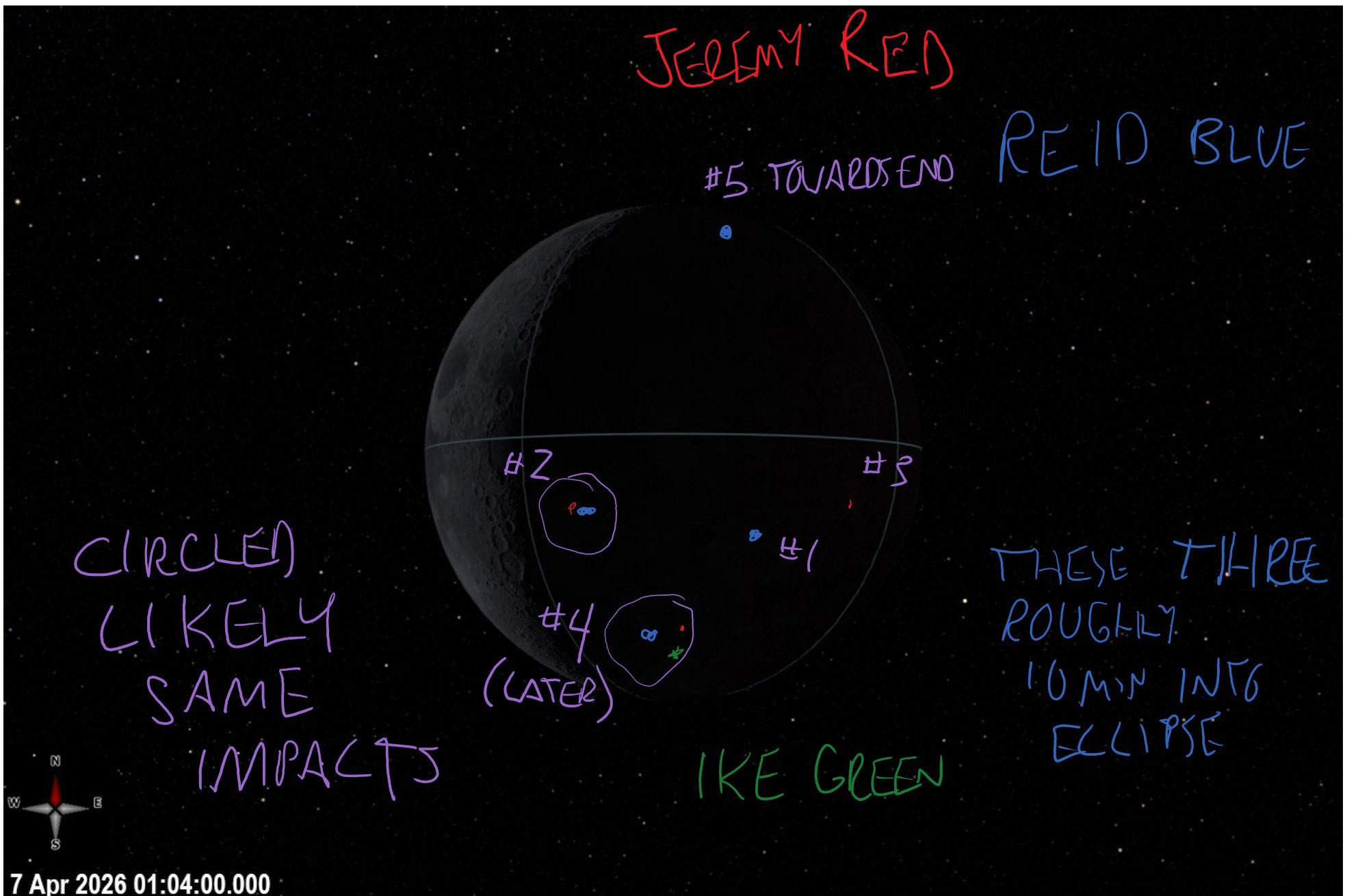
NASA just shared a glimpse into the cockpit of the Artemis II mission. It’s a screenshot from a tablet, dated April 2026, covered in handwritten scribbles. Reid Wiseman, Victor Glover, and Jeremy Hansen were looking out the window, watching impact flashes on the lunar surface, and marking them down in real-time. This isn't high-gloss promotional material. It’s a raw work log from three people doing one of the hardest jobs in the solar system.
For those of us building in crypto and AI, there is a massive lesson here about data integrity and the role of the human operator. We spend so much time trying to automate everything that we forget the value of a high-fidelity observer. NASA has the best sensors ever built, yet they still rely on an astronaut with a stylus to circle a flash on a screen. Why? Because the human brain is still the most efficient edge-computing device we have for pattern recognition in chaotic environments.
Why the Pencil Still Matters
The annotations are color-coded: blue for Wiseman, green for Glover, and red for Hansen. They weren't just taking photos; they were validating phenomena. In the tech world, we call this ground truth. In space, it’s just called survival and science. When a meteoroid hits the dark side of the Moon, it happens in a fraction of a second. An AI might flag it, but a human can contextualize it within the mission's immediate safety parameters.
As builders, we often outsource our intuition to dashboards. We look at a TVL chart or a token distribution map and assume the data is the reality. But the Artemis crew shows us that the best data is the data you participate in collecting. There is a specific kind of accountability that comes from marking a map yourself. You aren't just a consumer of information; you are a witness to it.
The Founder’s Perspective on Lunar Infrastructure
When I look at these annotations, I don't see a science experiment. I see the early stages of site surveying for a new economy. If you are going to build lunar bases or set up relay stations, you need to know where the rocks are falling. You need to know the topography better than a satellite does. This is the ultimate 'boots on the ground' moment, even if those boots are still inside a pressurized capsule.
We talk a lot in the Web3 space about decentralized physical infrastructure (DePIN). Artemis II is essentially the most expensive DePIN project in history. The astronauts are the nodes. Their observations are the consensus mechanism. The handwritten notes are the immutable record of what actually happened during that flyby. It’s a reminder that hardware is nothing without a narrative and a human to verify the output.
Skepticism and the Automation Trap
There is a tendency in the AI sector to claim that we don't need 'humans in the loop' anymore. The argument is that human error is the biggest risk factor. But looking at these annotated photos, I’d argue the opposite. The risk isn't human error; the risk is total reliance on black-box systems that can't explain why they flagged a specific pixel as an impact flash.
The Artemis crew isn't just recording data; they are building a mental model of the lunar environment. This is something we lack in a lot of modern software development. We deploy code and wait for the error logs to tell us something is wrong. We’ve lost the habit of 'watching the window.' We’ve stopped looking at the raw environment our products live in, preferring to look at the telemetry instead.
- Context is King: An automated sensor gives you a coordinate. A human gives you a description of the flash’s intensity relative to the horizon.
- Redundancy: Handwritten notes serve as a failsafe if the digital metadata is corrupted or lost during transmission back to Earth.
- Collaboration: The three different colors on the tablet represent a collaborative verification process that happens in seconds, not hours.
What This Means for the Next Decade of Tech
We are entering an era where the boundary between digital and physical is dissolving. Whether it’s a rover on the Moon or a bot on a blockchain, the challenge remains the same: how do we trust what we see? The Artemis II crew is solving this by combining high-tech imaging with low-tech manual notation. It’s a hybrid approach that founders should be mimicking.
If you are building an AI startup, don't just trust your training sets. Get in there and annotate them yourself. If you are launching a new protocol, don't just trust the audit. Walk through the logic until you can draw it out by hand. The moment you stop being able to manually verify your work is the moment you’ve lost control of the ship.
The human eye remains the most sophisticated sensor we possess, especially when paired with the skepticism of a trained observer.
Final Thoughts for the Builder Community
NASA’s release of these annotated photos is a subtle flex. It shows that despite all the trillions of dollars spent on technology, the most important tool on the Artemis II mission is the judgment of the three people sitting in those seats. They aren't just passengers; they are the final layer of the stack.
For those of us working in the trenches of the new internet, the takeaway is simple. Don't let the tools do the thinking for you. Use the tools to capture the data, but use your own eyes to make sense of it. The flashes on the Moon are real, and someone needs to be there to witness them, mark them down, and tell the rest of us what they mean. That is the job of a founder, and it’s the job of an astronaut.
Read the original at NASA Breaking News →