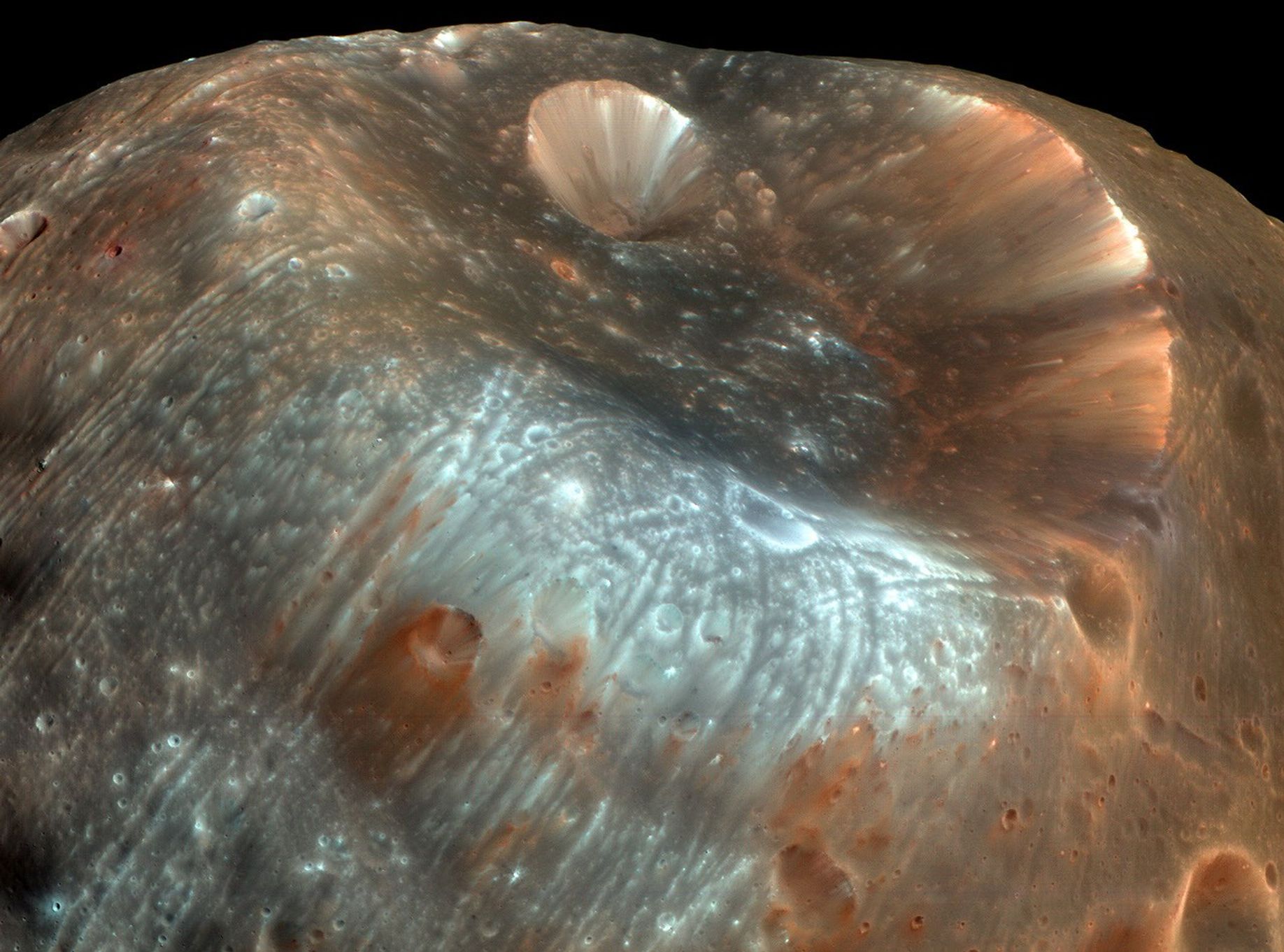
I spent the morning looking at Phobos. Specifically, the massive Stickney Crater that dominates the surface of Mars’ largest moon. NASA just re-released some high-resolution imagery, and while the science community is geeking out over the geology, I’m looking at it from a founder’s perspective. If you look at Phobos, you aren’t just looking at a rock; you’re looking at a case study in technical debt and the reality of working in high-stakes, low-margin environments.
The Scale of the Impact
Stickney Crater is huge. It is nine kilometers across. To put that in perspective, the entire moon of Phobos is only about twenty-two kilometers wide. Imagine building a startup and having a single event or a single bug take up nearly half of your entire operational bandwidth. That is what Phobos is dealing with. The impact that created this crater was so massive that it nearly shattered the entire moon.
For builders in the crypto and AI space, this is a familiar feeling. We often launch projects that get hit by an unexpected market shift or a massive exploit that covers half of our roadmap. The crater isn't just a hole; it’s a permanent feature of the landscape that everything else has to be built around. You don’t just "fix" Stickney Crater. You live with it. You integrate it into the architecture of the moon.
Infrastructure in Harsh Environments
One of the most interesting things about the imagery is the groove patterns radiating away from the crater. For a long time, astronomers thought these were fractures caused by the impact itself. Newer theories suggest they might be related to tidal stresses from Mars or even rolling boulders that moved across the surface after the hit.
This is exactly how legacy systems work in tech. You have an initial event—let's call it the Genesis Block or the first MVP. That event creates ripples that you are still dealing with five years later. Those grooves on Phobos are like the spaghetti code in your backend. They are scars from a previous era that dictate how gravity and physics interact with the surface today. If you want to build a base on Phobos, you can’t ignore the grooves. You have to understand the history of the impact to understand the stability of the ground you’re standing on.
Why Builders Should Care About Phobos
You might be wondering why a crypto and AI guy is talking about Martian moons. It’s because Phobos is the ultimate hardware test. We talk about "building in public," but building in space is building in the ultimate adversarial environment. There is no atmosphere, the gravity is negligible, and you are literally falling toward Mars at a rate that will eventually lead to the moon’s destruction in a few million years.
This is the ultimate "ticking clock" startup. Phobos is a doomed asset. Eventually, it will either crash into Mars or be torn apart by tidal forces to create a ring. When you are building on a platform—whether it's an L2 that lacks decentralization or an AI wrapper that depends on a single API—you are building on Phobos. You have to know the expiration date of your foundation.
The Skeptic's View on Space Mining
We see a lot of hype around space mining and the "trillion-dollar asteroid economy." Stickney Crater is a reality check. Look at the surface density. Look at the dust. The logistics of anchoring a mining rig or a data center to a body with such low gravity are immense. In the crypto world, we call this "slippage." In space, it’s just physics. If you apply force to the surface to drill, you push yourself off the moon.
Founders often overlook the basic physics of their industry. In AI, the physics is compute and energy. In crypto, the physics is liquidity and security. If you try to build a massive protocol on a foundation that can’t handle the "drill," you’re going to float off into the void. Stickney Crater shows us that even the most massive impacts don't necessarily provide a solid place to stand; they just create a new set of problems to solve.
Navigating the Grooves
The lesson for today’s builders is about resilience. Phobos survived the Stickney impact. It didn't break, though it came close. It now carries that scar as its most defining feature. In the tech world, we spend a lot of time trying to look perfect. We hide our pivots, we delete our old repos, and we pretend our failures never happened.
But the most successful founders I know are like Phobos. They have their own Stickney Craters—failed companies, bad partnerships, or technical disasters—that they’ve integrated into their current work. Those scars provide the texture and the "grooves" that make their current projects interesting. They aren't starting from a smooth surface; they are starting from a place of experience.
The Takeaway
Don't be afraid of the big hits. If your project takes a massive blow, look at Stickney. The impact might take up half your surface area, but it also creates a unique topography that wouldn't exist otherwise. The goal isn't to avoid the impact; the goal is to be structural enough to survive it. Understand your foundation, acknowledge your legacy debt, and keep orbiting. Even if the long-term outlook is a crash landing, the data you gather on the way down is worth the mission.
The most important part of any map isn't the clear path, but the landmarks left behind by the things that almost destroyed it.
We need more builders who are willing to look at their failures with the same high-resolution clarity that NASA looks at Stickney Crater. Stop trying to fill the hole and start figuring out how to build around it.
Read the original at NASA Breaking News →