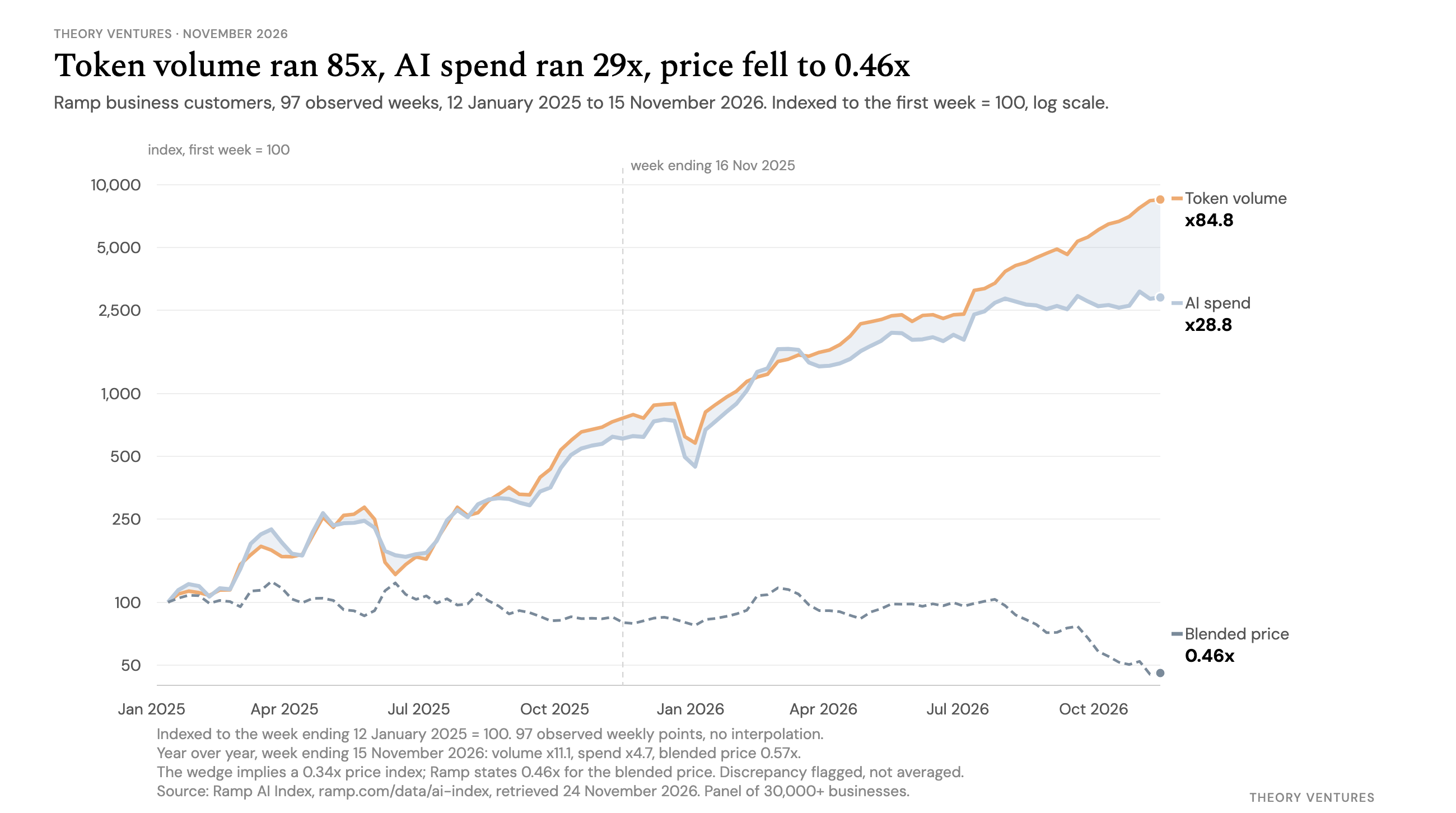
We are currently witnessing one of the most violent price collapses in the history of computing. If you look at the cost of large language model tokens over the last eighteen months, the chart looks less like a market correction and more like a cliff. Prices for inference have dropped by roughly 43% on average, yet the actual consumption of these tokens has increased by more than 11 times. We are in a race to the bottom on price and a race to the moon on volume.
The Ghost of William Stanley Jevons
In the mid-1800s, an economist named William Stanley Jevons noticed something counterintuitive about coal. People thought that if steam engines became more efficient, we would use less coal. The opposite happened. Because engines got cheaper and better, people found a thousand new ways to use them, and coal consumption exploded. This is the Jevons Paradox.
The big question for every founder and investor in the AI space right now is simple: Does Jevons apply to AI tokens in dollar terms, or just in units of compute? If tokens get 90% cheaper, does the market spend 10 times more money to compensate, or do we all just get a massive discount while the chip makers and data center owners starve?
The Two Sides of the Ledger
We are seeing two conflicting sets of data right now. On one hand, you have the efficiency gains. Analysis of spending patterns, specifically from platforms like Ramp, shows that while transaction volume for AI services grew by over 11 times, the actual dollar spend only grew by about 4.7 times. That is a massive gap. It suggests that efficiency is outrunning demand. In that scenario, AI looks like the lightbulb industry. We got better at making light, so light became a cheap commodity. We have more light than ever, but the lightbulb business isn't exactly the engine of a global economic empire anymore.
On the other hand, you have the growth stories from the model labs themselves. Anthropic’s internal data suggests their sales are scaling at a rate of 13.6 times. This indicates that for the top-tier providers, demand is actually outpacing the price drops. This is the copper scenario. When the world started electrifying, we needed so much copper that the price didn't matter; we just needed more of it at any cost. If AI is copper, the data center build-out is justified. If AI is lightbulbs, we are overbuilding into a deflationary trap.
What This Means for Builders
If you are building an AI-native startup, this volatility is your best friend and your worst enemy. A year ago, your margins were dictated by the mercy of OpenAI or Anthropic. Today, your margins are expanding because your input costs are cratering. But there is a catch. If you are just a wrapper—a thin layer over an API—your value is also deflating. When the cost of the underlying intelligence drops to near-zero, you cannot charge a premium for simply passing it through.
Founders need to be looking at the unit economics of their products through the lens of 2027, not today. If the price of tokens continues to drop by 40% annually, your competitive advantage cannot be 'we use GPT-4.' It has to be the proprietary data you feed it or the specific workflow you've locked down. In a Jevons Paradox world, the winner isn't the one who sells the commodity; it's the one who builds the most indispensable machine that runs on it.
The Infrastructure Gamble
There is a lot of nervous energy in Silicon Valley regarding the hundreds of billions of dollars being poured into GPUs and cooling systems. The bull case is that we will find recursive uses for AI—AI agents building AI software—that will consume every spare cycle of compute we can produce. In that world, the 11.1x volume growth is just the beginning.
The bear case is that we are reaching a point of diminishing returns. If a model gets 10% smarter but costs 50% less to run, the enterprise might just pocket the savings rather than double their usage. We have seen this in SaaS before. Once a tool becomes 'good enough,' the buyer stops looking for more features and starts looking for a lower invoice.
The Four Numbers That Matter
To know which way this goes, we have to watch four specific metrics over the next three years. First, the cost of training a frontier model. If this keeps doubling, the labs have to keep prices high to survive. Second, the inference efficiency. If we keep finding ways to run these models on cheaper hardware, the deflationary pressure will be unstoppable.
Third, we have to look at 'Tokens per Dollar' of enterprise revenue. If companies are getting more revenue for every dollar they spend on AI, they will keep spending. Fourth, and most importantly, is the energy cost. You can optimize software all day, but you can't optimize the physics of a power grid quite as easily. Electricity might be the only thing that keeps AI from deflating into obscurity.
A Founder’s Perspective
My take is that we are currently in the 'messy middle.' We are over-subsidizing the cost of tokens to gain market share, which makes the Jevons Paradox look like it's failing. The real test comes when the venture capital subsidies stop and these models have to be priced for profit.
For those of us building in this space, the strategy is clear: don't bet on the price of the token staying high. Bet on the volume of use cases becoming infinite. If you build for a world where compute is free, you’ll be prepared for whatever happens to the price of the 'lightbulb.' The real value isn't in the bulb; it's in what you do with the light.
Takeaway
AI compute is getting cheaper faster than we can find ways to spend the savings. Unless we see a massive explosion in agentic workflows that consume tokens autonomously, we are looking at a deflationary commodity market. Build for volume and utility, not for margin on the compute itself.
Read the original at Tomasz Tunguz →