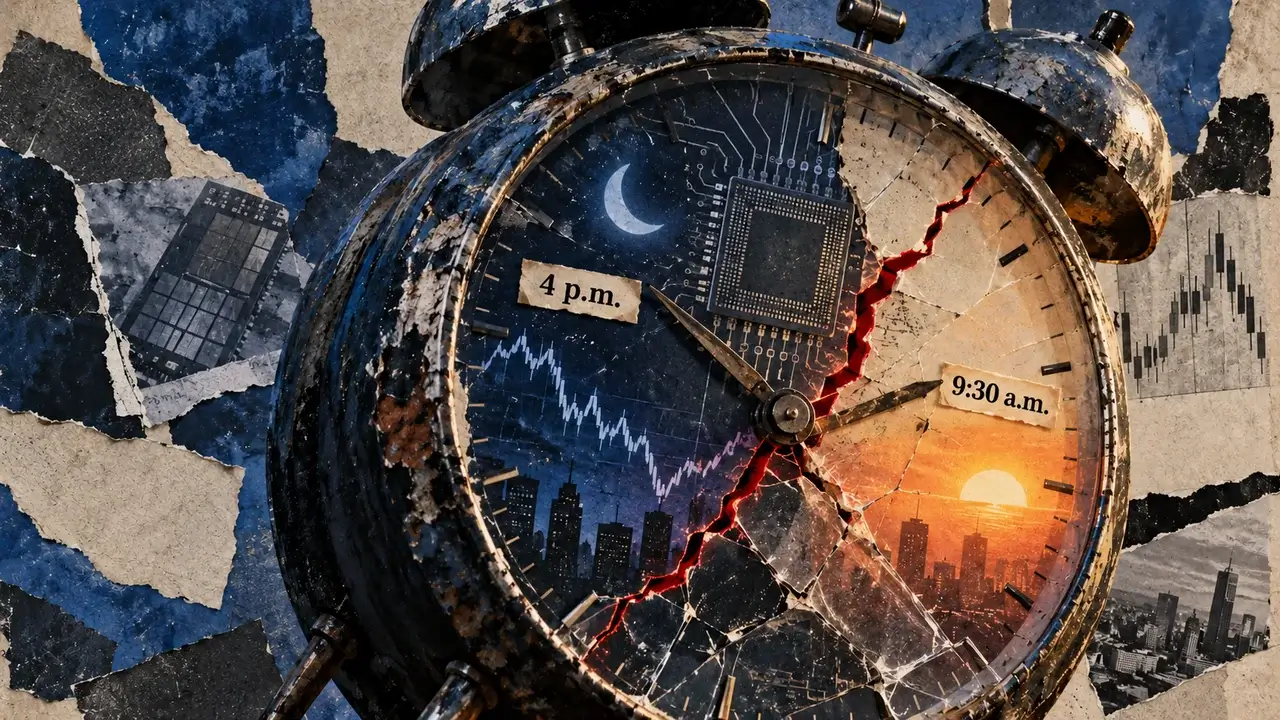
We have reached a weird crossroads in the evolution of markets. For decades, the financial world operated on a schedule that mirrored the human biological clock. You woke up, you traded, and at 4 p.m. Eastern, the bell rang and the madness stopped. That downtime wasn't just for sleep; it was for digestion. It gave investors time to process the day, allowed companies to release news without immediate price spikes, and let the dust settle.
But crypto doesn't sleep, and now it is dragging the stock market into its perpetual motion machine. We are seeing a rise in platforms that allow you to trade synthetic or tokenized versions of American equities while the primary exchanges are dark. It sounds like progress, but for builders and founders, it introduces a layer of volatility that most aren't prepared to navigate.
The Illusion of the Closing Bell
The closing bell is becoming a legacy artifact. When you can leverage a bet on a semiconductor company at 2 a.m. on a Tuesday via a decentralized protocol, the official price listed on the NYSE becomes a lagging indicator. We are moving toward a reality where the "true" price of a stock is no longer determined by the exchange where it lives, but by the global liquidity pool that never shuts down.
This creates a massive discovery problem. Traditionally, price discovery happens when a wide range of buyers and sellers meet in a transparent, regulated environment. When trading happens in the shadows of the night on crypto rails, the volume is thinner. Thin volume leads to erratic price swings. These swings can trigger liquidations or panic selling that greets the traditional market the moment it opens the following morning.
Why Builders Should Care
If you are building in the DeFi space, this is your primary opportunity and your biggest risk. Creating the infrastructure for 24/7 equity trading isn't just about writing a smart contract that tracks a price feed. It is about understanding the systemic risk of disconnected markets. If the crypto market says a stock is down 10% overnight, but the actual shares are locked in a vault until 9:30 a.m., who is right?
For founders, this shift means the tools we build need to be more resilient. We cannot rely on the old assumptions of market stability. If your protocol uses equity prices as collateral, a flash crash on a low-liquidity crypto exchange at 3 a.m. could wipe out users before the Wall Street bankers have even finished their first cup of coffee. We are building the future of finance, but we are doing it without the guardrails that kept the old system from flying off the tracks.
The Friction of Two Worlds
There is a fundamental friction between a settlement layer that moves at the speed of the internet and a regulatory layer that moves at the speed of a courthouse. Wall Street closes because it needs to settle trades, verify balances, and manage the physical reality of money. Crypto settles instantly, or at least pretends to, which creates a mismatch.
We are seeing the emergence of "shadow prices." These are the valuations that exist in the crypto ecosystem while the traditional markets are dormant. The danger here is that these shadow prices can become self-fulfilling prophecies. If enough people believe a stock has crashed based on a crypto-derivative price, they will dump the actual stock the second the market opens. We have effectively exported crypto's inherent volatility into the most stable sectors of the global economy.
- Increased Fragility: Continuous trading removes the "cooling off" periods that prevent market meltdowns.
- Liquidity Gaps: Trading stocks in the middle of the night means dealing with wide spreads and slippage.
- Arbitrage Chaos: The first hour of the traditional market day is becoming a frantic race to close the gap between crypto prices and equity prices.
The Founder’s Perspective
I tend to look at this through the lens of utility. Is 24/7 trading actually helpful, or is it just another way to facilitate gambling? For the average long-term investor, being able to trade at midnight provides zero value. For the builder, however, the value lies in the plumbing. If we can prove that stocks can trade safely on-chain without the overhead of the traditional T+2 settlement cycle, we change the game.
But we aren't there yet. Right now, we are in the "Wild West" phase where the two systems are clashing. Founders who are building these bridges need to be honest about the risks. You aren't just giving people access to stocks; you are giving them access to a market that lacks the circuit breakers and protections that have kept the stock market functional for a century.
The goal shouldn't be to just keep the lights on all night; it should be to build a system where the lights staying on doesn't lead to a house fire.
A Skeptical Takeaway
I am all for decentralization and open access, but we need to stop pretending that 24/7 markets are an unqualified win. The pressure of constant price movement is exhausting for participants and dangerous for systemic stability. If you're building in this space, focus on the settlement tech, not just the trading volume. The real win isn't letting someone buy tech stocks at 4 a.m.; the real win is making the underlying infrastructure so efficient that the time of day no longer matters.
Until then, expect the mornings to get a lot more chaotic. When Wall Street wakes up, it’s increasingly finding that crypto has already decided what the day's prices are going to be. That is a massive shift in power, and it’s one that the traditional finance world isn't ready to handle.
Read the original at CryptoSlate →