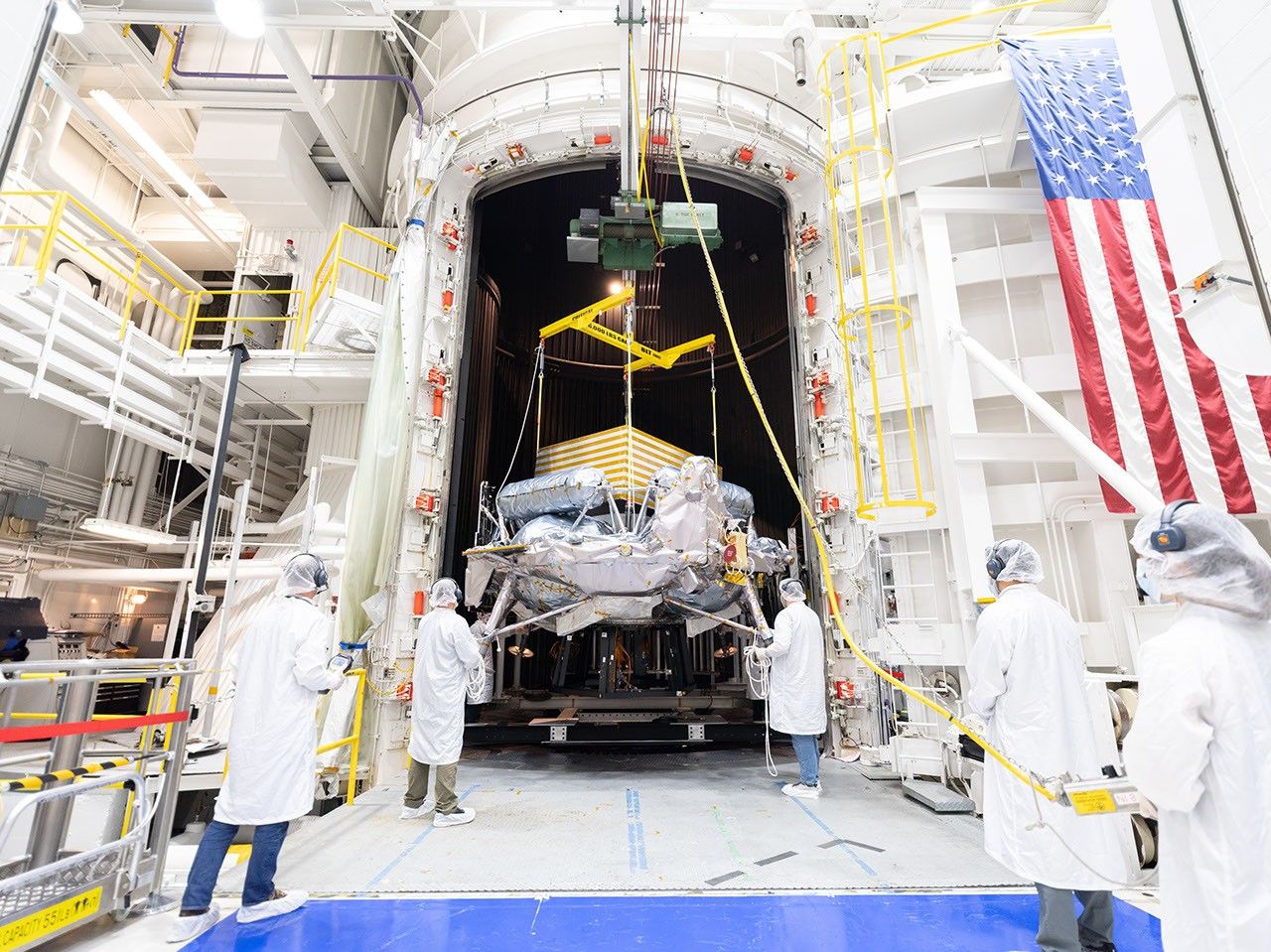
Building for Earth is hard. Building for the vacuum of space, where temperature swings and radiation can melt or freeze your hardware in minutes, is a different kind of nightmare. Last month, Voyager Technologies finished a three-month gauntlet at NASA’s Jet Propulsion Laboratory (JPL) that proves their Griffin-1 lunar lander isn’t just a flashy CAD drawing—it is actually flight-ready.
For those of us in the builder community, this isn't just another space headline. It is a signal that the infrastructure for a lunar economy is moving out of the theoretical and into the mechanical. If you are building AI-driven navigation systems or decentralized compute networks for off-planet use, this is the hardware you will eventually be riding on.
The Gauntlet at JPL
NASA JPL doesn’t go easy on contractors. The environmental testing phase for Griffin-1 was designed to simulate the worst-case scenarios of a lunar mission. This included acoustic testing, where the lander is blasted with sound waves to mimic the violent vibrations of a rocket launch. If a single bolt is loose or a solder joint is weak, these tests will find it.
Beyond the noise, the lander underwent thermal vacuum testing. In space, you don't have air to carry heat away from your processors. You have to rely entirely on radiation and conduction. Seeing a private company pass these tests at a facility like JPL tells us that the engineering maturity in the private sector is finally catching up to the ambitions of the founders leading these projects.
Why Builders Should Care
We often talk about the “middle of the stack” in crypto and AI, but we rarely talk about the physical stack. For years, space was the playground of nation-states with bottomless pockets. Now, we are seeing the emergence of a logistics layer. Griffin-1 is essentially a delivery truck for the Moon.
If you are a founder, you need to look at this through the lens of platform risk. Just as AWS changed how we build software by removing the need to own servers, companies like Voyager Technologies are removing the need for every space startup to build their own descent vehicle. They are providing the utility. The question for us is: what are we going to put on those trucks?
The Skeptical Take
It is easy to get caught up in the hype of “space-grade” hardware, but let’s be real: testing in a lab is not the same as landing on the lunar regolith. We have seen plenty of missions pass every Earth-bound test only to fail because of a sensor glitch or a software bug during the final seconds of descent. Voyager has cleared the physical hurdles, but the operational hurdles are still ahead.
As builders, we should also be wary of the costs. While private landers are cheaper than legacy government programs, they are still incredibly expensive. For a decentralized network to actually function on the moon, the cost per kilogram needs to drop by another order of magnitude. Griffin-1 is a step toward that, but it isn’t the finish line.
The Intersection of AI and Off-Planet Hardware
One of the most interesting aspects of these modern landers is the reliance on autonomous systems. You can’t joystick a landing on the moon from Earth with a three-second delay. The Griffin-1 carries the kind of edge computing and AI-driven vision systems that our community spends all day talking about. Seeing this hardware pass NASA’s environmental standards is a massive validation for edge AI.
We are moving toward a world where the “edge” isn't just your smartphone or an IoT sensor in a factory. The edge is now 238,000 miles away. If you are developing ruggedized AI models that can run on low-power, radiation-hardened chips, your market just got a lot bigger.
The Long Game
Voyager Technologies is playing a long game. By partnering with JPL for these tests, they are buying credibility. In the world of venture capital and government contracts, credibility is the only currency that matters when you are building something this capital-intensive.
For the founders in my circle, the takeaway is simple: the infrastructure is being laid. We are seeing the physical manifestation of the next frontier. It is time to stop thinking about space as a sci-fi concept and start thinking about it as a deployment environment. The hardware is ready. The environment is tested. Now we just need the applications that justify the trip.
The successful completion of environmental testing at JPL isn't just a win for Voyager; it is a green light for the entire ecosystem of builders waiting for a reliable way to get their tech to the lunar surface.
What Happens Next
Now that the environmental trials are over, the focus shifts to integration and the actual launch window. We will be watching the telemetry closely. The transition from a controlled lab at JPL to the chaos of a live launch is where the real stories are written. If Griffin-1 sticks the landing, the conversation around the lunar economy changes from "if" to "how fast."
Don't get distracted by the shiny gold foil and the rocket engines. Focus on the data. Focus on the reliability. Because if we are going to build a decentralized future that extends beyond our atmosphere, we need hardware that doesn't break when the sun hits it.
Read the original at NASA Breaking News →