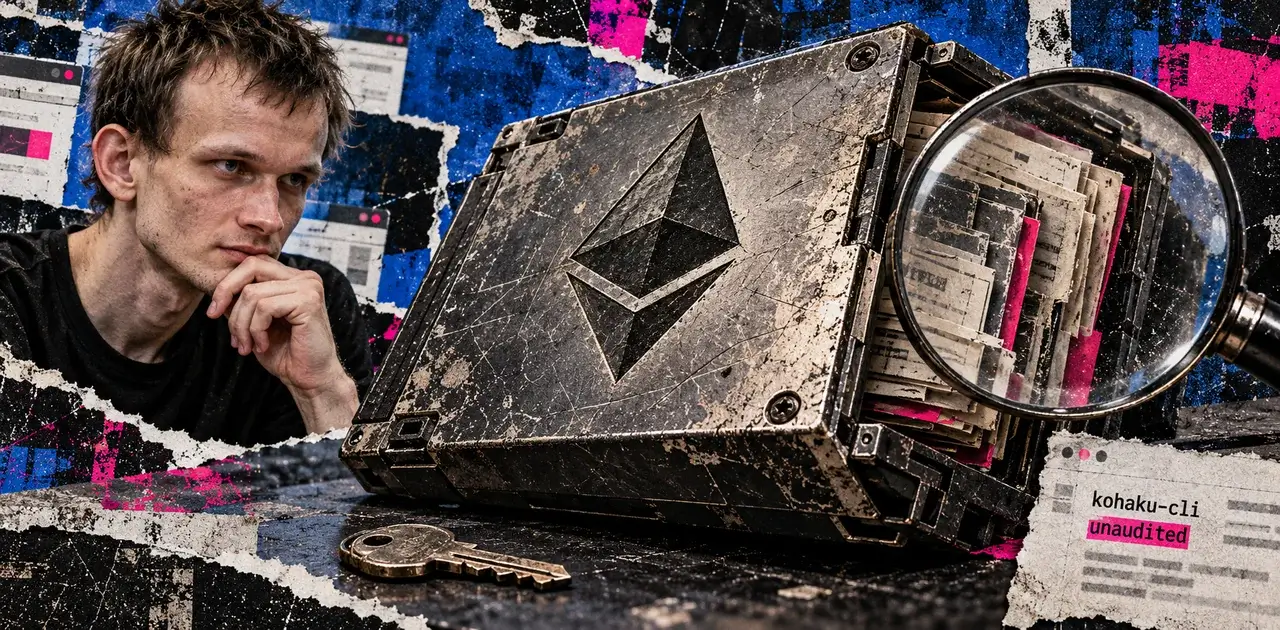
I have spent most of my career watching people try to simplify the web. We have moved from static HTML files to massive, bloated React applications that rely on dozens of third-party servers just to display a balance. But lately, Vitalik Buterin has been doing something that feels like a step back into the future. He is making private payments on Ethereum without touching a traditional crypto website.
For the average user, this sounds like a headache. For builders, it is a masterclass in risk management and decentralization. The source of this shift is simple: the modern web is a massive security hole. When you visit a website to sign a transaction, you are trusting the domain registrar, the hosting provider, the CDN, and the developer’s own security practices. Vitalik is effectively saying that for high-stakes privacy, that chain of trust is too long.
The Local-First Manifesto
The core idea here is retaining local code. Instead of waiting for a server to deliver a website to your browser every time you want to interact with a smart contract, you keep the logic on your own machine. This isn't just about speed; it is about trust boundaries. When you download a package once, you can audit it. When you load a website, the code can change every time you hit refresh.
In the context of private payments, this is critical. Privacy protocols like Railgun or Stealth Addresses rely on complex math and sensitive data. If a frontend is compromised—which we see happen via DNS hijacks almost every month—a malicious actor can swap out the destination address or leak your viewing keys. By moving the interaction to a local environment, you shrink the surface area for these attacks.
Separating the Workflow
Vitalik’s approach breaks down the transaction process into three distinct trust decisions: package updates, signatures, and submission. Most crypto apps try to bundle these into one 'Easy' button. That is a mistake for anyone building for the long term.
- Package Updates: You decide when to pull new code. You aren't forced into a version just because the developer pushed a change to GitHub.
- Signatures: This happens locally. The private keys never see the internet, and more importantly, they don't interact with a potentially poisoned web script.
- Submission: Once the transaction is built, how it gets to the blockchain is a separate logistical hurdle, not a security one.
As a founder, I look at this and see a massive opportunity for 'local-first' developer tools. We have spent the last decade building for the convenience of the browser. We might need to spend the next decade building for the safety of the local machine.
Why Privacy Requires This
Privacy on a public ledger is hard. It requires a lot of heavy lifting on the client side to generate proofs—specifically Zero-Knowledge proofs. When you try to run these in a standard browser tab, you are fighting against the limitations of the environment. More importantly, you are creating a trail. Browsers are designed to be tracked; local environments are designed to be controlled.
Vitalik is using these methods to interact with privacy protocols because it eliminates the middleman. If the website for a privacy tool gets taken down or censored, the protocol still lives on the chain. If you have the code locally, you can still use it. This is what true resilience looks like. It is not about having a pretty UI; it is about having a functional one that cannot be turned off by a centralized authority.
The Builder’s Takeaway
If you are building in the crypto or AI space right now, the temptation is to make everything a sleek SaaS product. That is where the VC money is, and that is what users think they want. But we are seeing a growing class of 'power users'—including the guy who started Ethereum—who are actively moving away from that model.
The future of secure finance isn't a better website; it's a better way to avoid websites entirely.
We should be thinking about how to deliver 'headless' versions of our tools. Provide the CLI, provide the local scripts, and provide the documentation for people to run your tech without your permission. It sounds counterintuitive for a business, but in the world of decentralized infrastructure, it is the ultimate proof of utility.
The Skeptic's Corner
Let’s be honest: 99% of people will not do this. They will continue to use MetaMask or Rabby and click 'Confirm' on whatever website they are told to visit. This local-first movement is currently reserved for the elite, the paranoid, and the developers. But that is how every major shift starts.
The goal isn't to force every grandmother to run a local node and execute Python scripts to send money. The goal is for builders to create local-first wrappers that are as easy to use as a browser, without the inherent risks of the modern web stack. We need to stop thinking of 'Web3' as just 'Web2 with a wallet' and start thinking of it as a fundamentally different way to handle data and execution.
Final Thoughts for Founders
Vitalik’s move to bypass the website is a signal, not a stunt. It’s a reminder that the tools we use to access the blockchain are often its weakest link. If you are building a dApp, ask yourself: could a user still interact with my project if my domain was seized tomorrow? If the answer is no, you haven't built a decentralized application; you've built a centralized one with a very expensive database.
Start looking at how you can decouple your frontend from your logic. Encourage your users to verify signatures. Build for the user who doesn't trust you. It’s a harder path, and it won't look as good in a pitch deck, but it is the only way to build something that actually lasts in this industry.
Read the original at CryptoSlate →