The Icy Rorschach Test on Vega Island
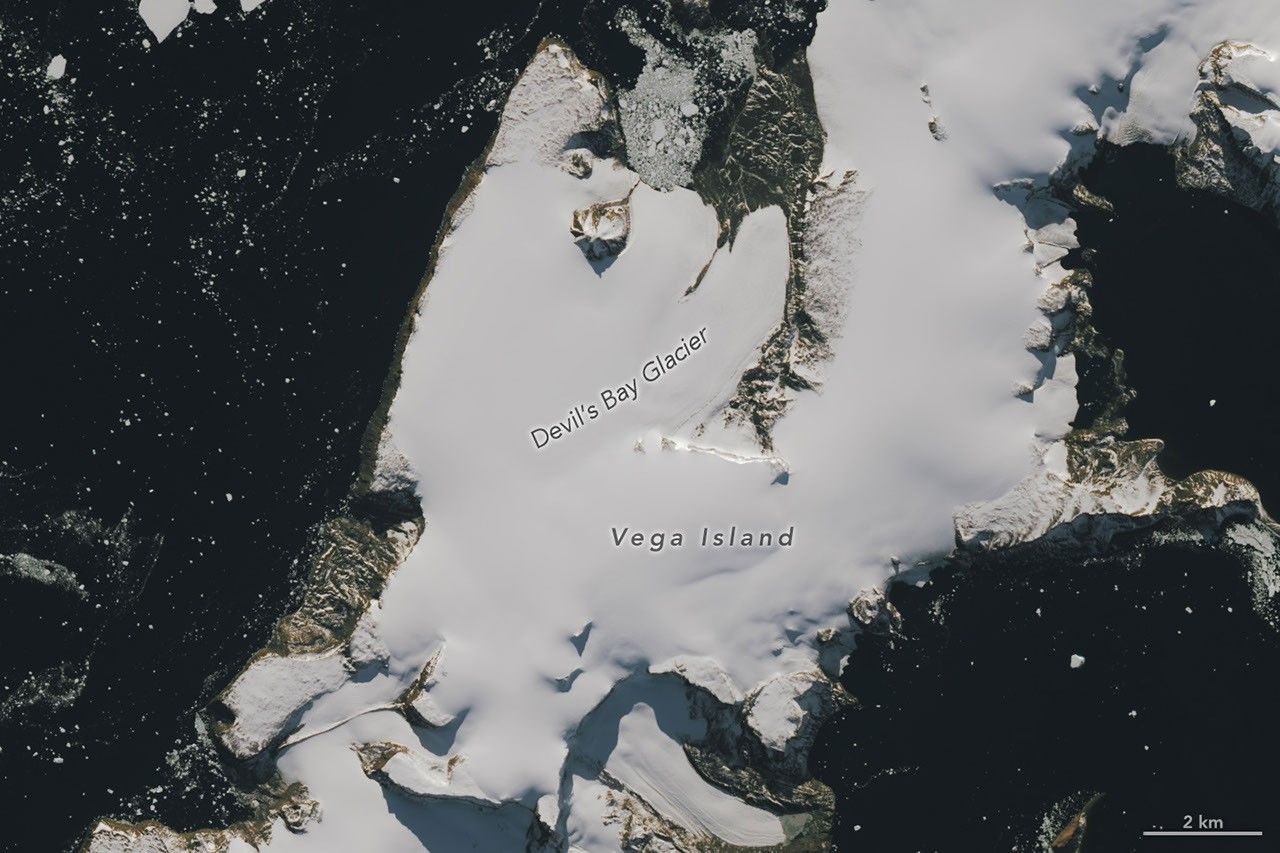
Nature has a weird way of messing with our heads. Recently, satellite imagery of Vega Island off the tip of the Antarctic Peninsula went viral because, if you squint just right, it looks like a giant, frozen skull staring back at us from the abyss. It is a classic case of pareidolia—the human brain’s desperate need to find patterns in chaos. But for those of us building in the tech and climate sectors, the story isn't about a spooky face in the snow. It is about the massive infrastructure required to see it, and what that data actually tells us about the ground we are standing on.
Vega Island is a rugged, desolate chunk of rock located just north of the James Ross Island group. It is historically significant for paleontologists because it holds a treasure trove of Cretaceous and Paleogene fossils. But today, it serves as a high-fidelity benchmark for how we monitor remote environments. The skull visage is formed by the interplay of deep shadows, rocky outcrops, and the shifting patterns of permanent ice and seasonal snow. It is a fleeting aesthetic moment captured by orbital cameras, but the underlying data represents a much more permanent reality.
The Infrastructure of Observation
When we look at high-resolution images of Antarctica, we often forget the stack of technology required to deliver that JPEG to your screen. We are talking about multispectral imaging, orbital mechanics, and massive data pipelines that process raw sensor inputs into something human-readable. For founders and developers, there is a lesson here in signal versus noise. The "skull" is the noise—a distraction for social media engagement. The signal is the rate of glacial recession and the geological composition revealed by the disappearing ice.
I have always been skeptical of hype cycles, whether they are in AI or climate tech. The "scary" imagery on Vega Island is a perfect metaphor for how we often react to data. We focus on the optics because they are easy to process. We see a ghost in the machine and start speculating. But the builders in this space are looking at the spectral signatures of the rocks and the thermal infrared data that tells us exactly how fast the permafrost is degrading. The real horror story isn't a face in the ice; it is the sheer volume of change occurring in regions that used to be static for millennia.
Why Builders Should Care About Remote Sensing
We are entering an era where every square meter of the planet is being indexed and monitored in real-time. If you are building in AI, the frontier isn't just large language models; it is geospatial intelligence. We need systems that can differentiate between a visual anomaly like the Vega skull and a meaningful geological shift. The ability to automate the detection of environmental change at scale is where the real value lies.
Imagine a decentralized network of sensors or a refined AI model that doesn't just see a face, but calculates the exact volume of ice lost since the last satellite pass. That is the kind of utility that survives beyond the news cycle. We are moving away from "neat photos" and toward actionable environmental ledgers. For the crypto-native audience, think of this as the ultimate oracle problem. How do we verify the physical state of the world without human bias or pareidolia getting in the way?
The Skeptic's View on Environmental Optics
I am usually the first person to roll my eyes when a government agency releases a "spooky" photo for Halloween or social media engagement. It feels like a distraction from the harder, more boring work of resource management. However, there is a psychological component to building that we can't ignore. People need a hook to care about data. If a skull-shaped island gets someone to look at the Antarctic Peninsula for the first time, maybe that is a net positive for the awareness of the melting cryosphere.
But we have to be careful not to let the narrative drive the engineering. In the startup world, we see this all the time: a company builds a flashy UI (the skull) while the backend (the actual geology) is crumbling. Vega Island is a reminder that the surface level is often a mask. Beneath that icy face is a complex history of volcanic activity and prehistoric life. Our job as builders is to look past the mask and understand the mechanics of the system.
Takeaway for the Founder Perspective
Stop looking for faces in the data. The goal isn't to find patterns that confirm our fears or biases; it is to build the tools that provide objective clarity. Vega Island is a stunning visual, but it is also a reminder that our vantage point matters. From space, a mountain can look like a monster. Close up, it is just rock and ice under pressure.
If you are developing in the AI or monitoring space, focus on the boring stuff. Focus on the calibration of the sensors, the latency of the data transmission, and the accuracy of the classification models. The world doesn't need more people to tell us the ice looks scary; it needs people to build the systems that help us manage the change. The skull will melt away eventually, but the data we collect now will be the foundation for how we survive the next century.
- Focus on Signal: Don't get distracted by visual anomalies; focus on the underlying metrics.
- Build for Reality: Use remote sensing to solve real distribution and monitoring problems.
- Verify Everything: Treat satellite data with the same skepticism you would a new crypto protocol.
The real value of monitoring the Earth isn't in what we think we see, but in what we can actually prove is happening to the landscape.
Read the original at NASA Breaking News →