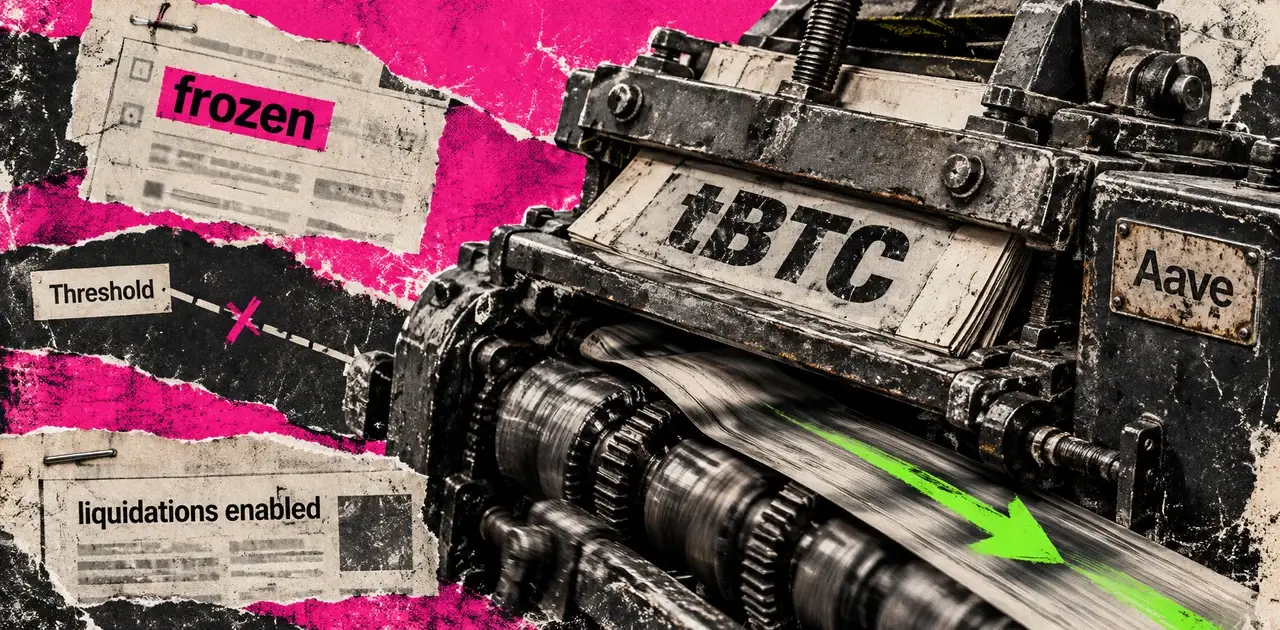
When you build on top of other people’s protocols, you are inheriting their risks, their technical debt, and their emergency brakes. This week, users of the Aave V3 market for tBTC found that out the hard way. A freeze on redemptions for Threshold Network’s wrapped Bitcoin has put roughly $136 million in liquidity into a state of limbo, and it serves as a masterclass in why founder-perspective risk management matters more than marketing fluff.
The Bottleneck in the Bridge
The situation is straightforward but messy. Threshold Network, the group behind tBTC, hit the pause button on redemptions. This wasn't an arbitrary choice; it was a response to potential vulnerabilities. But in the world of decentralized finance, one man's safety measure is another man's liquidity trap. Because tBTC is used as collateral within Aave, the inability to swap that token back for underlying Bitcoin creates a massive friction point for anyone trying to unwind positions or manage their health ratios.
For those not deep in the weeds, tBTC is marketed as a decentralized alternative to WBTC. The selling point is that it doesn't rely on a single custodian like BitGo. Instead, it uses a random selection of signers. It is a great theory, but as we are seeing, "decentralized" doesn't mean "immune to friction." When the mechanism to exit the asset is disabled, the asset's utility in a lending market drops to near zero for anyone looking for an immediate exit.
The Ripple Effect on Aave
Aave is the gold standard for DeFi lending, but it isn't magic. It relies on the assumption that collateral has a reliable price and a reliable way to be liquidated or redeemed. Currently, there is about $136 million sitting in the tBTC market on Aave. While borrowers can still repay their loans or throw more collateral into the pot to avoid liquidation, they can't easily wash their hands of the tBTC itself through the primary redemption route.
This creates a psychological strain on the market. If you are a builder looking at integrating these types of assets, you have to ask yourself: what happens to my users if the bridge breaks? We often talk about smart contract risk, but we don't talk enough about operational risk—the risk that a decentralized autonomous organization (DAO) or a core team will decide to stop the gears from turning for the sake of security.
The Myth of the Risk-Free Bridge
Builders love to talk about trustlessness. But the reality is that almost every bridge or wrapped asset has a "god mode" or an emergency pause functionality. It is a necessary evil to prevent catastrophic hacks, but it is also a massive centralized point of failure. If you are building a product that relies on tBTC, or any wrapped asset for that matter, you are not just betting on the code; you are betting on the governance and the uptime of that specific bridge.
We have seen this movie before. Whether it was the chaos surrounding the WBTC ownership changes or the various bridge exploits of 2022, the lesson is always the same: wrapping Bitcoin is hard, and maintaining a two-way peg during times of stress is even harder. The $136 million currently sitting on Aave is a reminder that in DeFi, liquidity is a privilege, not a right.
What Builders Should Take Away
If you are a founder or a developer, you shouldn't look at this as just a temporary glitch. You should look at it as a case study in dependency management. When you integrate a third-party token as a core pillar of your protocol, you need to have a contingency plan for when that token stops behaving like a liquid asset.
- Diversify Collateral: Never let a single wrapped version of an asset dominate your liquidity pools.
- Transparency in Toggles: Be clear with your users about who holds the "kill switch" for the assets they are using.
- Liquidity Buffers: Understand that on-chain liquidity can vanish in seconds if a redemption route is closed.
The Threshold team is likely doing what they think is best to protect the long-term viability of the protocol. I don't envy the position of having to pause a bridge. But as a skeptical observer, I have to point out that these incidents erode the trust that DeFi is supposed to be building. Every time a major market like this freezes, it gives the critics more ammunition to say that the whole system is held together by duct tape and good intentions.
The Road Ahead
The Aave market will likely recover once the redemptions are re-enabled, but the reputational damage to wrapped assets as a category continues to mount. We are moving toward a world where users are going to be much more selective about which "versions" of Bitcoin they hold. They won't just look at the yield; they'll look at the exit door.
The most expensive liquidity is the liquidity you can't access when you need it most.
For now, the $136 million in Aave is safe in the sense that the numbers are still on the screen. But until that redemption route is open, those numbers are just entries in a ledger that no one can fully settle. If you are building in this space, watch this closely. It is a reminder that in the race to scale, we often sacrifice the very robustness that makes Bitcoin valuable in the first place. Stay skeptical, keep building, but always know where the emergency exit is located.
Read the original at CryptoSlate →