The $36 Trillion Margin Squeeze
Running a stablecoin issuer looks like a license to print money from the outside. You take in dollars, buy Treasury bills, pocket the yield, and issue digital tokens. But the recent financial data from Circle shows a much more sobering reality for anyone trying to build in the payment space. While USDC handled a staggering $36 trillion in transaction volume during the first half of 2026, the company is fighting for every penny of profit.
Circle generated roughly $1.4 billion in revenue over those six months. On the surface, that sounds like a massive win. But when you look at the plumbing, the numbers get thin fast. The company spent about 93% of that revenue just to keep the lights on and the distribution pipes flowing. For every dollar that came in the door, Circle only managed to hold onto about seven cents.
The Cost of Being Everywhere
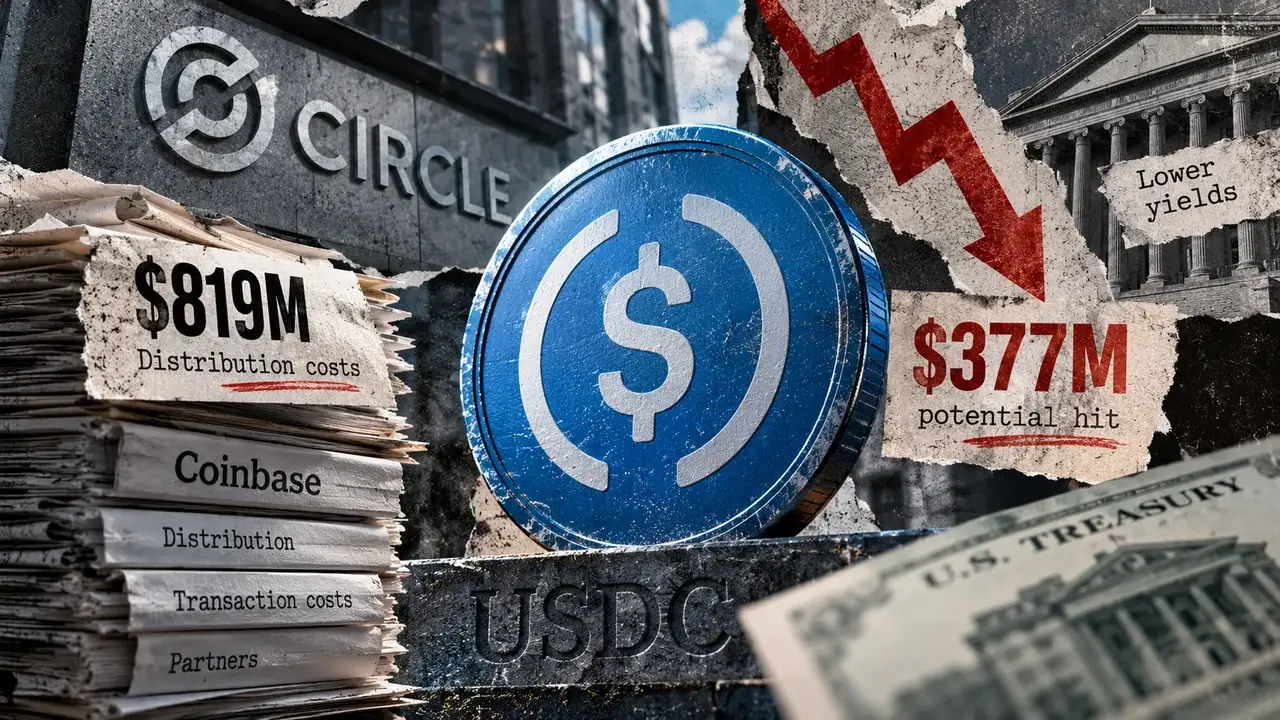
If you are a founder building a protocol or a fintech app, the immediate takeaway is the sheer cost of distribution. Circle didn't just lose money to overhead; they paid out $819 million to distribution partners and transaction costs. This is the hidden tax of being a global standard. To make USDC the preferred dollar-peg on every exchange and in every wallet, Circle has to incentivize the ecosystem.
In the crypto world, we talk a lot about decentralization, but the business of stablecoins is increasingly looking like the business of traditional credit card networks—high volume, low margin, and heavy reliance on a massive web of middlemen. Circle isn't just competing with Tether; they are competing with the entire infrastructure of the legacy financial world, and that infrastructure is expensive to replace or integrate with.
Operational Weight
Beyond the cost of getting the tokens into users' hands, Circle spent another $473 million on operating expenses. For those of us in the startup world, this is a reminder that being "regulated" and "compliant" isn't just a marketing slogan—it’s a massive line item. When you’re moving $36 trillion, your legal, compliance, and security teams aren't just a department; they are the product.
This is the skepticism I always bring to new stablecoin projects claiming they will disrupt the market with zero fees. Circle has scale that most builders can only dream of, and they are still barely cracking a 7% margin on their revenue after expenses. If you don't have $36 trillion in volume, how do you plan to survive the operational burn required to stay on the right side of the law?
Yield Dependence
We also have to talk about where this money comes from. Most stablecoin revenue is essentially a bet on interest rates. When rates are high, the yield on the reserves keeps the engine running. But as we see in these H1 numbers, even with favorable conditions, the spread is tight. If interest rates drop, that $1.4 billion in revenue could shrink significantly while the $473 million in operating costs stays exactly where it is.
This creates a precarious situation for builders. If you are building on top of USDC, you are building on a foundation that is highly sensitive to the Federal Reserve's whims. Circle’s thin margins suggest that the company has to keep growing its volume just to maintain its current position. They are on a treadmill that requires them to move trillions just to net millions.
What This Means for Builders
For the founders in our audience, there are three main lessons here. First, distribution is the most expensive part of the stack. If you aren't accounting for what you have to pay partners to carry your product, your financial models are wrong. Second, compliance is a fixed cost that scales poorly at first. You need massive volume before the overhead starts to make sense.
Third, and perhaps most importantly, the "utility" phase of crypto is finally here, but it’s not as profitable as the "speculation" phase was. Moving $36 trillion is a sign of massive adoption. People are using USDC for real things—remittances, payroll, B2B settlements. But the profit per transaction is microscopic. The days of easy money in crypto infrastructure are over; we are now in the era of efficiency.
The Founder Perspective
I’ve seen plenty of pitch decks for "USDC killers" or new algorithmic experiments. Most of them ignore the boring stuff: the cost of audits, the cost of banking relationships, and the cost of bribing—err, incentivizing—liquidity. Circle’s H1 numbers are a reality check. They are winning the adoption war, but the prize is a low-margin commodity business.
If you’re building in this space, stop looking at the top-line volume. Volume is a vanity metric if your distribution partners are eating 60% of your revenue. Focus on the unit economics. If Circle can only keep seven cents on the dollar with $36 trillion in volume, what does your path to profitability look like?
Strategic Takeaway
Circle is essentially building a new global utility. Like a power company or a water provider, the goal isn't necessarily massive tech-style margins; it's to become indispensable infrastructure. For builders, this means USDC is likely to remain stable and widely available, but the company providing it is under immense pressure to find new, higher-margin revenue streams beyond just holding cash.
Expect to see Circle push harder into software services, identity, and developer tools. They can't survive on the yield spread and volume alone if the margins stay this thin. They need to move up the stack, and if you're a builder, that means they might eventually become your competitor rather than just your infrastructure provider.
Read the original at CryptoSlate →