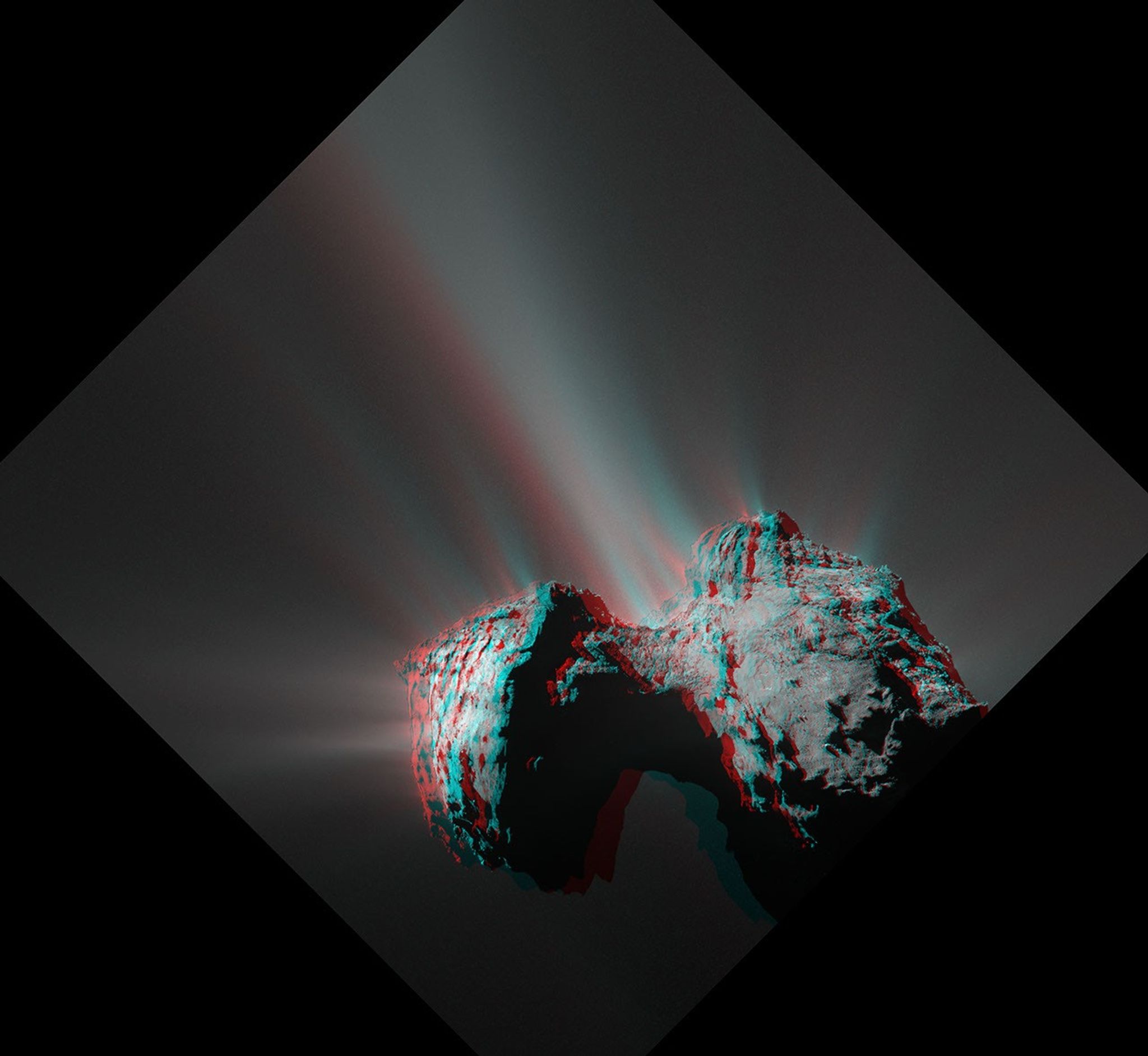
When NASA drops a 3D visualization of a rock hurtling through the vacuum of space, most people see a cool image for their desktop background. I see a data management problem that was solved with brutal efficiency. The recent 3D rendering of Comet 67P/Churyumov-Gerasimenko is a reminder that the most complex datasets in the world are useless unless you can make them legible to a human being.
As builders in the crypto and AI space, we often get caught up in the 'how' of our technology. We talk about TPS, zero-knowledge proofs, or parameter counts. But NASA’s approach to Comet 67P shows that the end goal isn’t the data itself—it is the interface. If you can't see the craters, the ridges, and the physical reality of the asset, you don't really own the understanding of it.
The Value of Dimensionality
Comet 67P isn't just a rock; it's a double-lobed relic from the early solar system. For years, we had flat images. They were informative, but they lacked context. By moving into 3D, NASA is providing a spatial map that allows for actual navigation. In the world of decentralized finance or AI-driven analytics, we are currently in the '2D' phase. We have dashboards full of flat numbers, but we lack the depth perception to see how these systems actually interact under stress.
Founders need to look at this 3D model as a metaphor for product development. If your user interface feels like a flat spreadsheet, you are failing. The depth provided by this comet visualization is what creates engagement. It turns a distant, abstract concept into something that feels like you could reach out and touch it. That is exactly what we need to do with blockchain transactions and AI inference results.
Building for the Skeptic
I’ve always been a bit skeptical of 'visualizations' that are just eye candy. However, this NASA project is different because it is rooted in the Rosetta mission's hard telemetry. There is no fluff here. Every ridge and shadow on 67P represents a real physical coordinate. This is where crypto founders usually trip up. They build beautiful front-ends that mask a lack of substantive back-end utility.
NASA is doing the opposite. They have the most robust back-end in the universe—literally—and they are using 3D modeling as a bridge to communicate that truth. If you are building an AI agent or a new protocol, your '3D model' is your transparency. It is the ability for a user to look at your system from any angle and see that it doesn't break. Skepticism vanishes when the data is high-resolution enough to withstand scrutiny.
The Founder's Perspective on Complexity
Think about the sheer amount of processing power required to turn raw sensor data from a spacecraft millions of miles away into a stereoscopic image. It requires a stack that handles noise reduction, coordinate mapping, and lighting simulation. This is the same stack we are building in the AI sector today. We take noisy, unstructured human data and try to turn it into a structured, '3D' understanding of a topic.
The lesson here is simple: Don't simplify the data, simplify the access to it. NASA didn't remove the complexity of the comet's surface to make the 3D model. They preserved the complexity but changed how we view it. In your own startups, stop trying to hide the 'crypto' or 'AI' parts of your product. Instead, build better lenses for your users to see those parts clearly. High-fidelity transparency is a feature, not a bug.
Why Spatial Data Matters Now
- Perspective: 3D models force you to see the gaps in your own data. If a side of the comet is missing, the model fails. If your product has a logic gap, a high-fidelity UI will expose it.
- Verification: Like a blockchain explorer, a 3D model allows for independent verification of a physical state. It is a source of truth.
- Scalability: Once you have a 3D coordinate map, you can build anything on top of it—VR experiences, scientific simulations, or educational tools.
The Takeaway for Builders
The 3D 67P project isn't just about astronomy; it's about the transition from information to experience. As we move deeper into the age of autonomous agents and decentralized infrastructure, the 'flatscreen' way of looking at data is dying. We need to provide our users with the ability to rotate, zoom, and inspect the systems they are putting their money and trust into.
If a government agency can make a frozen space rock from the dawn of time look like a tangible asset, you have no excuse for having an opaque product. Build with depth. Build for clarity. Stop selling the sizzle and start showing the topography of the steak.
Read the original at NASA Breaking News →