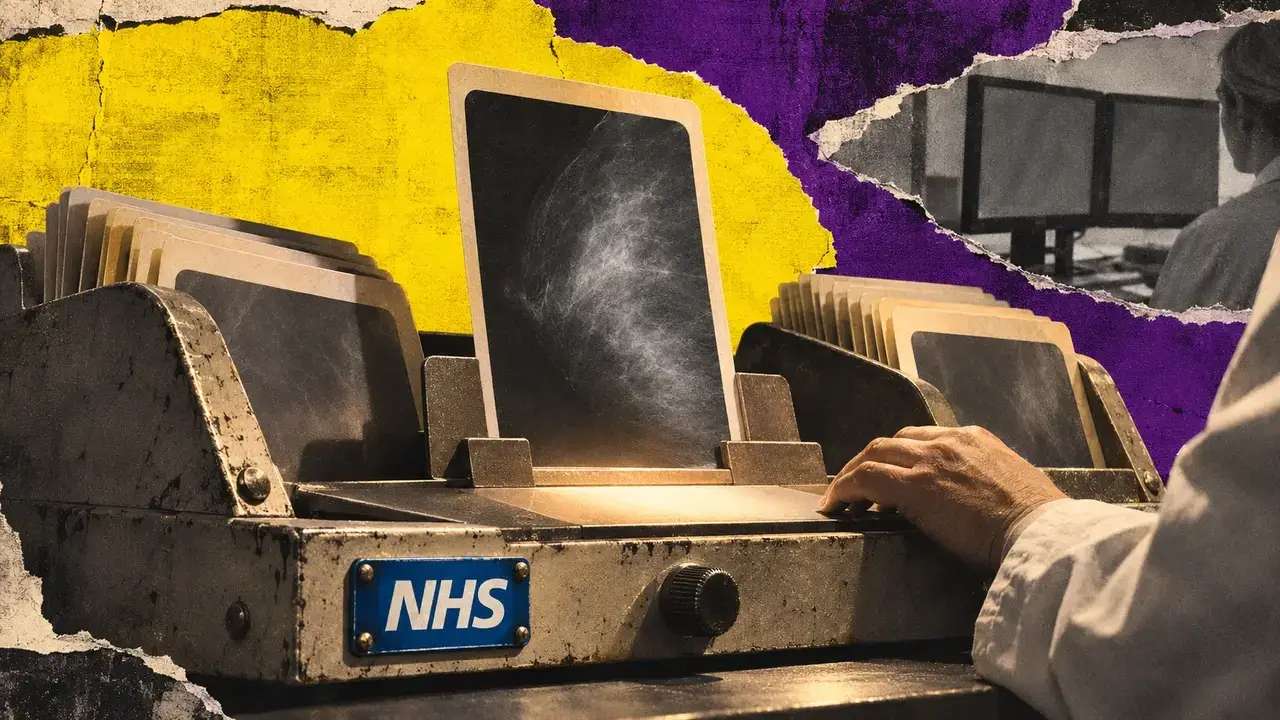
The United Kingdom just launched one of the largest real-world stress tests for artificial intelligence in healthcare history. The trial involves 660,000 women and aims to determine if an AI algorithm can replace the second human reader in a standard mammogram screening. Currently, two radiologists look at every scan to minimize errors. The NHS wants to know if they can cut that human requirement in half without losing patients in the process.
The Efficiency Trap
From a builder's perspective, this is the ultimate use case. We talk about AI automation in trivial tasks all the time—writing emails, generating code, or summarizing meetings. But this is different. This is about biological life and death. The UK is facing a massive shortage of radiologists, and the backlog is growing. The temptation to let a machine handle the heavy lifting is massive.
The study, known as the Gemini trial, isn't just about whether the AI is smart. It is about whether the workflow can sustain the transition. In the trial, every mammogram will still be seen by at least one human, but the second set of eyes will be silicon. If the AI flags something the human missed, or vice versa, a third party mediates. It is a hybrid model that sounds great on paper, but it presents unique challenges for those building the underlying infrastructure.
The Data Integrity Problem
When you are dealing with a sample size of 660,000 people, the margin for error in data processing is non-existent. For founders in the AI space, the takeaway here is about the reliability of the training sets. Most medical AI models struggle with generalization. An algorithm trained on data from a specific demographic in London might fail when applied to a different population in Manchester due to slight variations in imaging equipment or biological factors.
If you are building in this space, you have to realize that 'good enough' is a failing grade. In crypto, we talk about the cost of a bug being the loss of funds. In med-tech AI, a bug is a missed stage-one tumor. This trial will be a landmark because it forces the AI to prove it can handle the messiness of a national health system, not just a clean, curated dataset in a lab.
The Human-in-the-Loop Reality
One thing I appreciate about this UK trial is that it doesn't try to eliminate humans entirely. It focuses on the 'second reader' role. This is a smart entry point for builders. Trying to replace a professional entirely is a regulatory and ethical nightmare. Replacing a redundant check, however, is a productivity win.
The skepticism comes in when we look at the 'black box' nature of these algorithms. Radiologists can explain why they see a shadow or a density. AI often can't. If the AI flags a scan and the human doesn't see it, who wins the argument? This trial is as much about human-computer interaction (HCI) as it is about neural networks. We need to build systems that don't just give an answer, but provide a pathway for the human to verify that answer.
Why Builders Should Watch This
This isn't just a medical story; it is a blueprint for how AI will be integrated into all critical infrastructure. Whether you are building automated legal review tools, smart contract auditors, or diagnostic engines, the hurdles are the same: liability, trust, and scale.
- Scale: Handling 660,000 records in a live environment tests the limits of cloud latency and processing power.
- Liability: Who is responsible if the AI misses a signal that a human would have caught? The NHS? The software provider?
- Trust: Will the public accept a machine making decisions about their health?
We are moving out of the 'demo' phase of AI. The era of cool chatbots is ending, and the era of industrial application is beginning. The Gemini trial is the front line of this shift. If this succeeds, it paves the way for AI to take over administrative and diagnostic functions across the board. If it fails, or if there is a high-profile mistake, the regulatory backlash will set the industry back a decade.
The Ethical Bottleneck
I’ve always been a bit of a skeptic when it comes to the 'move fast and break things' mentality in high-stakes sectors. You can't A/B test a human life. Builders in this space need to be more than just engineers; they need to be ethicists. The UK trial is using a double-blind approach to compare two different AI workflows against the traditional human-only method. This is the kind of rigorous validation we should demand from all AI startups claiming to disrupt legacy industries.
The goal is not to prove that AI is better than a human. The goal is to prove that AI plus a human is better than two humans.
That is a subtle but vital distinction. It’s about augmentation, not total replacement. For those of us looking at the next five years of development, the winners won't be the ones building the 'smartest' AI, but the ones building the most 'integrated' AI—tools that slide into existing workflows without breaking the trust of the professionals using them.
The Takeaway
The UK's massive trial is a reality check for the AI industry. It proves that for AI to be useful at scale, it must solve a labor crisis without compromising safety. For builders, the lesson is clear: don't just build a model; build a verifiable, transparent workflow. The future isn't a machine replacing a doctor; it's a machine making the doctor's second opinion obsolete, provided the data holds up under the pressure of 660,000 lives.
Read the original at CryptoSlate →