We have reached the end of the honeymoon phase for generative AI. Theory Ventures just dropped their second annual AI in Practice survey, and the data paints a picture of a sector that is maturing, getting more paranoid, and finally starting to look like traditional software engineering.
For founders and builders, this is where the real work begins. The initial magic of a chatbot responding to a prompt has faded. Now, we are dealing with the messy reality of production logs, security vulnerabilities, and the logistical nightmare of routing queries across multiple models. If you are building in this space, you need to look past the valuation headlines and look at what teams are actually struggling with on the ground.
The Security Disconnect
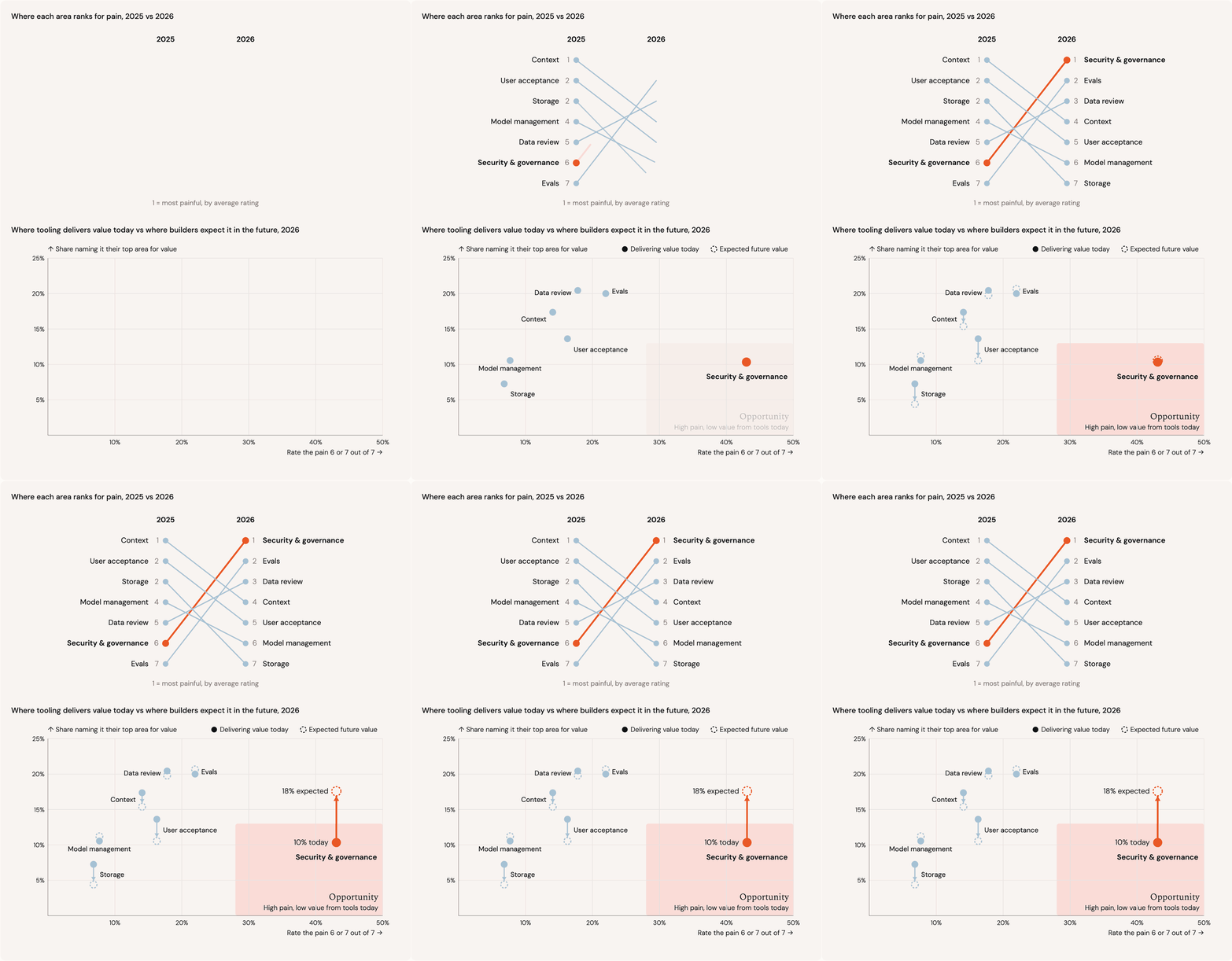
The most glaring statistic in the survey is the gap between security concerns and security value. According to the data, 43% of teams cite security as their primary pain point. Meanwhile, only 10% of those same teams feel that their current security tooling is actually delivering tangible value. That is a massive disconnect.
As a founder, I see this as the biggest opportunity for the next two years. We have spent eighteen months rushing to integrate LLMs into every corner of the enterprise without building the proper guardrails. Now, the bill is coming due. Data leakage, prompt injection, and the simple fear of proprietary data being used to train the next iteration of a public model are keeping CTOs up at night. The current tools are clearly not meeting the moment. If you can solve for security without sacrificing the speed of deployment, you have a business.
The Multi-Model Reality
For a while, the narrative was that one model would rule them all. Whether it was GPT-4 or a massive open-source play, the assumption was that developers would pick a horse and ride it. The survey suggests otherwise. Roughly 45% of teams are now routing queries across multiple models.
This is a tactical shift. Builders are realizing that using a massive, expensive model for simple classification tasks is a waste of resources. They are using smaller, cheaper models for the grunt work and reserving the heavy hitters for complex reasoning. This creates a new layer of complexity in the stack: orchestration. If you are building an AI-first product, you can no longer assume your backend will be tied to a single API. You need to build for modularity and cost-optimization from day one.
The Sandbox and the Agent
We are also seeing a consolidation in where these AI agents actually live. Cloudflare has emerged as a dominant force here, hosting 62% of agent sandboxes. This makes sense from a latency and edge-computing perspective, but it also shows that builders are looking for stability and familiar infrastructure rather than experimental AI-native clouds.
Agents are no longer just toys; they are being given real tasks. The survey highlights that 48% of teams are now using coding agents to read and analyze production logs. This is a significant milestone. We have moved from agents writing "Hello World" snippets to agents performing forensic analysis on live systems. It marks a transition from AI as a creative assistant to AI as a utility player in the DevOps stack.
Infrastructure is the New Bottleneck
The shift toward analyzing production logs suggests that the biggest hurdle for AI adoption isn't just the quality of the model anymore; it's the quality of the data pipeline. If an agent is reading logs, it needs clean, structured, and accessible data. Most legacy systems aren't built for this. We are seeing a resurgence in the importance of data engineering.
For the builder community, the takeaway is clear: the "wrapper" era is dying, and the "infrastructure" era is taking its place. The companies that will survive are the ones building the plumbing that makes these models usable in a high-stakes corporate environment. It isn't just about what the AI can do; it is about how the AI fits into the existing workflow without breaking everything else.
Why the Skepticism is Healthy
I have always been a bit skeptical of the "AI will replace everything tomorrow" narrative. The Theory survey validates this skepticism. When 43% of your users are scared of the security implications and only 10% are happy with the solutions, you don't have a solved market; you have a crisis. But for a founder, a crisis is just a list of features that customers are willing to pay for.
We are seeing the transition from the "wow" factor to the "how" factor. How do we secure this? How do we route this? How do we monitor this? The teams that focus on the boring parts of the stack—the logs, the sandboxes, and the security protocols—are the ones that will still be standing in 2026. The novelty has worn off. Now, we just have to make it work.
The Founder Takeaway
If you are building right now, stop chasing the highest benchmark scores. The market is telling you exactly what it needs: better security, better orchestration, and better integration with existing DevOps practices. The fact that nearly half of all teams are already using agents for production log analysis tells you that the demand for utility is there. The fact that they hate their security tools tells you where the money is going to flow next.
Build for the multi-model world. Don't get locked into one provider. Invest in the edge. And for heaven's sake, solve the security problem. The companies that bridge that 33% gap between fear and value are going to own the next decade of the enterprise stack.
Read the original at Tomasz Tunguz →