The Ghost in the Machine
In the world of hardware and high-stakes engineering, we often talk about redundancy and safety margins. We assume that if a system is linear and the individual parts are stable, the whole thing will behave. But every now and then, a piece of research comes out of a place like NASA's Langley Research Center that reminds us why things actually fall apart. This isn't just about satellites; it is a fundamental lesson in how complexity creates failure points that are invisible to the naked eye.
NASA’s recent technical brief on complex modes in lightly damped structural systems sounds like dry academic reading. It isn't. It is a post-mortem on why systems we think are stable suddenly exhibit erratic, non-linear behavior. For anyone building in the crypto or AI space, the parallels are uncomfortable. We are all building interconnected systems with "light damping"—systems where we try to minimize friction and maximize efficiency—without realizing that the coupling between those parts is creating a new kind of instability.
The Proportionality Myth
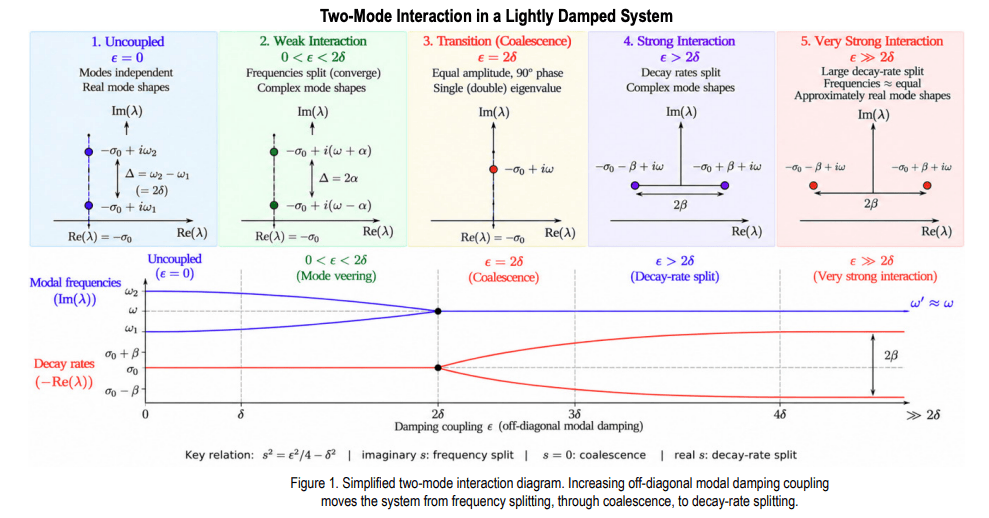
Most engineers start with the assumption of proportional damping. In plain English, that means we assume if you push on a system, the energy dissipates in a predictable, uniform way across all its parts. If the parts are mostly independent and the friction is low, we expect it to stay that way. But NASA is pointing out a specific, dangerous edge case: what happens when two different "modes" or frequencies of a system are too close together?
When these frequencies align and the damping is nonproportional—meaning the energy isn't bleeding out evenly—the modes start to interact. They couple. What was once a simple, predictable oscillation becomes a "complex mode." In structural terms, this means the system starts moving in phases you didn't design for. It isn't just vibrating; it’s warping in ways that can lead to catastrophic fatigue.
The takeaway for builders is that proximity equals risk. In software, we see this when two microservices have nearly identical latency profiles. Under normal load, they work fine. But if a specific type of traffic hits them, they start to sync up and oscillate. Because the "damping" (error handling or rate limiting) isn't perfectly proportional across the stack, the entire system enters a complex failure state that a simple reboot won't fix.
The Problem with Efficiency
We are obsessed with removing lag. In DeFi, we want the fastest settlement. In AI, we want the lowest latency for inference. We are effectively building "lightly damped" systems. We have removed the friction that traditionally prevents catastrophic feedback loops. NASA's research suggests that by stripping away that friction, we have made our architectures hyper-sensitive to these mode interactions.
When two structural modes are closely spaced, they don't even need high energy to start interacting. They just need a specific kind of coupling. For a founder, this is the equivalent of having two different revenue streams or two different protocol dependencies that are too similar. If they are coupled through a shared liquidity pool or a shared set of validators, you have created a structural weakness. You think you have two different things, but under stress, they act as one complex, failing mode.
Understanding Nonproportional Damping
The core of the NASA brief rests on how these modes are coupled. In a perfect world, damping is distributed. In the real world, you might have a very stiff structure with a tiny bit of soft material at one joint. That is nonproportional. The energy doesn't know where to go, so it concentrates.
I see this in AI startups all the time. You have a massive, rigid LLM stack, but your "damping" is a thin layer of human-in-the-loop moderation or a small vector database. The damping is concentrated in one spot. When the system faces a high-frequency input—like a viral bot attack or a massive data drift—the rigid parts of the system and the soft parts start to fight. The resulting "complex mode" is an output that is neither fully AI-generated nor fully human-controlled, but a hallucinated mess that breaks the product's utility.
Lessons for the Founder-Engineer
If you are building a system today, you need to look for where your frequencies are too close together. If you have two dependencies that respond to market volatility in the same 10-millisecond window, you are in the danger zone. You have created a structural resonance that will eventually be triggered.
- Diversify your "Damping": Don't rely on a single mechanism to handle system stress. Spread your error handling and circuit breakers across different layers of the stack.
- Watch for Coupling: If two parts of your system are starting to act in sync, that is a warning sign, not a feature. Forced synchronization in a lightly damped system is a precursor to a break.
- Respect the Phase Shift: NASA found that these complex modes often involve a phase shift—parts of the system moving at different times than expected. In business, this looks like a lag between a market event and your system's response. If that lag isn't accounted for, the correction itself becomes the problem.
The Skeptical View
The academic response to this is usually to add more modeling and more math. But as a builder, you don't always have the luxury of a NASA-sized simulation budget. The pragmatic approach is to accept that complex modes are inevitable in any sufficiently advanced system. The goal isn't to prevent them entirely, but to ensure that when they do happen, they don't have the structural authority to take down the whole ship.
We have spent the last decade building systems that are "efficient" but fragile. We’ve removed the weight, the cost, and the friction. NASA is reminding us that friction—damping—is what keeps a system from vibrating itself to pieces. If you're going to build light, you better understand exactly how your components are talking to each other when the pressure is on.
The Takeaway
Complexity isn't just about having many parts; it's about how those parts interact when things get shaky. NASA’s look at two-mode interaction is a clear warning: when your system's natural frequencies get too close, the resulting behavior is no longer linear or predictable. Build in enough "proportional damping"—real-world friction and buffers—to keep your modes separate, or prepare for the ghost in the machine to start tearing your architecture apart.
Read the original at NASA Breaking News →