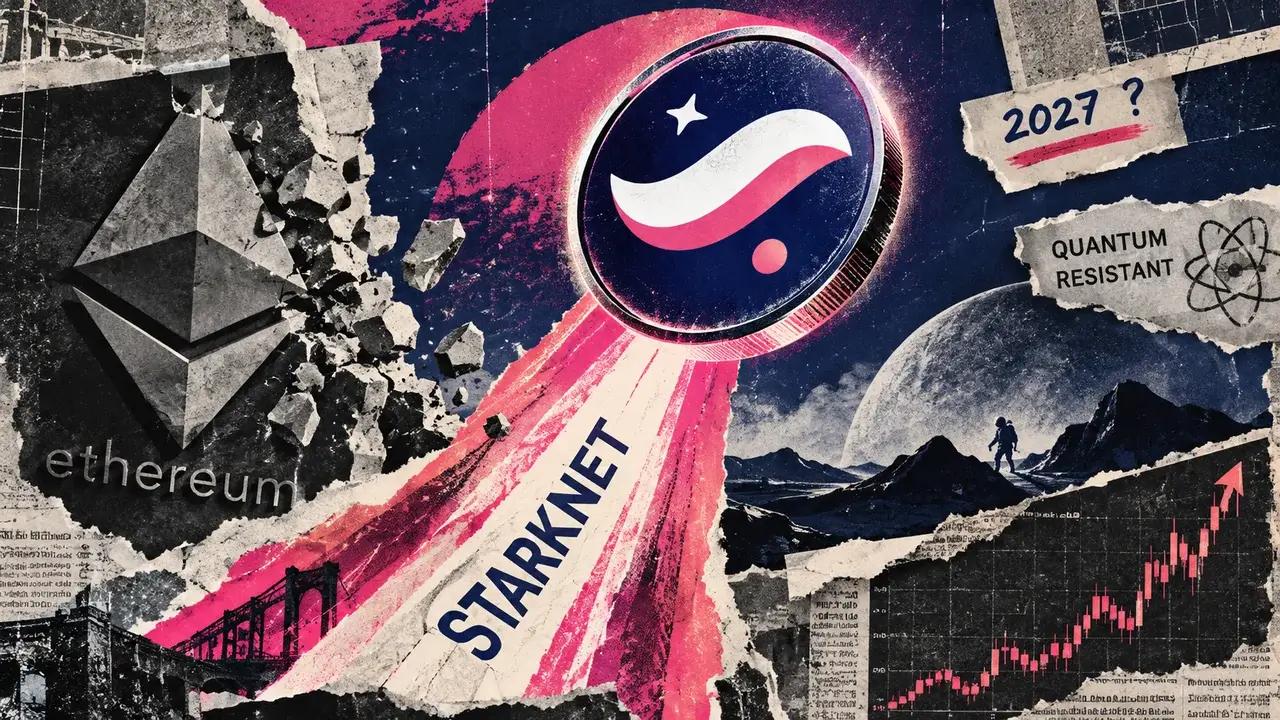
Starknet is at a crossroads, and the market is reacting with the kind of volatility we haven't seen in months. The core team recently floated the idea of migrating away from their current position as an Ethereum Layer 2 to become an independent, quantum-resistant Layer 1. This isn't just a minor technical shift; it is a fundamental pivot in how they view their place in the ecosystem.
The Market Reaction
The numbers tell a story of intense speculation. Over a seven-day period, the STRK token more than doubled in value. By late October 11, the price hovered around $0.1190, marking a daily gain of nearly 18% and a weekly climb of over 116%. Trading volume surged into the billions as investors tried to price in what an independent Starknet would actually look like. But as a founder, I look at these green candles and see a lot of noise. Price action is a distraction from the underlying engineering challenge: can a rollup survive if it cuts the cord with its parent network?
The Sovereign Argument
Starknet’s logic for leaving Ethereum centers on sovereignty and future-proofing. By becoming a standalone Layer 1, they gain total control over their consensus mechanism and economic model. They are specifically leaning into the "quantum-resistant" angle, preparing for a future where traditional cryptographic signatures might be vulnerable to advanced computing. It’s a bold long-term play, but it introduces immediate friction.
For years, the pitch for rollups has been simple: inherit the security of Ethereum while providing faster, cheaper transactions. If Starknet leaves, they have to bootstrap their own security from scratch. They aren't just building a scaling solution anymore; they are competing for validators, nodes, and trust in a crowded market where liquidity is already fragmented.
What This Means for Builders
If you are building on Starknet right now, this news should make you pause. A migration to a standalone Layer 1 changes the risk profile of your dApp. You are no longer effectively anchored to the $300 billion security budget of Ethereum. Instead, you are betting on Starknet’s ability to attract enough capital to secure its own chain. The technical overhead of such a migration is also non-trivial. Smart contracts that rely on specific Ethereum-linked primitives might need significant adjustments.
However, there is an upside for builders who want more flexibility. An independent Starknet could theoretically offer features that Ethereum’s roadmap doesn't prioritize, such as faster finality or specialized transaction types that aren't possible under the current rollup constraints. The question is whether the trade-off in security and ecosystem interoperability is worth that extra bit of performance.
The Ghost of Fragmentation
The biggest threat to the crypto space right now is fragmentation. We have too many chains, too many bridges, and not enough users. When a major player like Starknet talks about leaving the Ethereum ecosystem, it signals a potential breakdown in the "Ethereum-centric" roadmap. If every successful Layer 2 eventually graduates to a Layer 1, then the Layer 2 experiment was just a temporary incubation phase, not a long-term scaling solution.
This creates a coordination headache. Users hate hopping between different wallets and bridges. If Starknet becomes an island, it needs to ensure that the bridge back to Ethereum is seamless, or it risks isolating its current user base. For founders, this means you need to be very careful about where you lock your liquidity. Are you building on a platform that wants to be part of a larger network, or one that wants to be the center of its own universe?
Quantum Resistance or Marketing?
The pivot to "quantum resistance" feels a bit like a narrative hedge. While it is a legitimate technical concern for the next decade or two, it is also a convenient way to differentiate a new Layer 1 in a market that is tired of the same old scaling stories. It’s a great hook for a whitepaper, but for a builder today, it doesn't solve the problem of high gas fees or user onboarding. It is a future-proofing measure that only matters if the network survives long enough for quantum computers to become a real threat.
The market is rewarding the ambition, but the execution risk here is massive. Moving a live ecosystem is like trying to change a jet engine while the plane is at 30,000 feet.
Final Takeaway for Founders
Do not let the 116% price jump cloud your judgment. If you are building in this space, you need to look at the long-term viability of the tech stack. If Starknet goes through with this, they are essentially resetting their clock. They will need to prove they can attract a robust set of validators and maintain a high level of decentralization without the Ethereum safety net.
My advice? Watch the developer docs, not the price charts. If the migration path looks messy or if the core team starts prioritizing tokenomics over developer experience, it’s a red flag. But if they can pull off a quantum-resistant sovereign chain while maintaining their current dev tooling, they might just carve out a niche that justifies the hype. For now, stay skeptical and keep your eyes on the migration plan details.
Read the original at CryptoSlate →