The Liquidity Illusion
Everyone talks about bringing real-world assets to the blockchain like it is a foregone conclusion. The narrative is simple: take a high-value private company, chop it up into tokens, and let people use it as collateral. But as Aave Labs is currently finding out with its SpaceX integration, the gap between a digital token and actual cash is a massive, high-risk gray area.
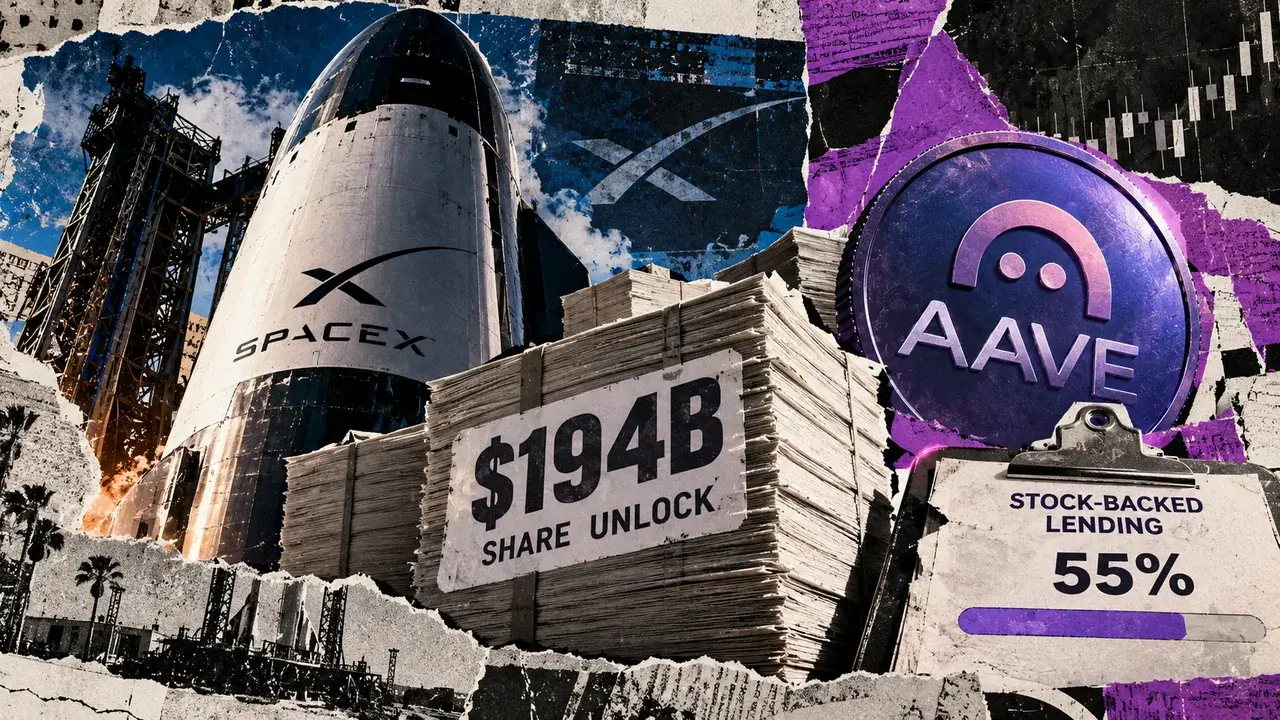
SpaceX just hit a major milestone that has nothing to do with rockets. A massive share unlock, involving roughly 1.3 billion shares valued at nearly $200 billion, recently went live. For a company that stays private, this is a seismic event. For Aave, which just proposed using tokenized SpaceX shares (SPCXc) as collateral on its new V4 Equities Hub, it is a reality check on the fragility of tokenized equity.
The Founder's Dilemma with Tokenization
As someone who has built and consulted in this space, I see the appeal. If you own equity in a unicorn, that wealth is usually locked in a vault. You are rich on paper but cash-poor in practice. Tokenization promises to solve this by letting you borrow against those shares. Aave wants to be the bank for the new elite, letting them keep their moon-mission upside while drawing down liquidity for daily operations.
But here is the problem: private equity is private for a reason. It does not trade on an open, liquid exchange. When 1.3 billion shares suddenly become eligible for sale, the price discovery process is not like checking the price of ETH on Uniswap. It is a slow, opaque negotiation. If a large holder decides to dump their position to fund another venture, the value of those shares can crater, leaving Aave holding a bag of tokens that nobody wants to buy.
The LlamaRisk Warning
Aave’s own risk advisors, LlamaRisk, did not hold back in their assessment. They highlighted a critical flaw in the plan: the reliance on a single custodian and the inherent lack of a secondary market. If you are a builder looking at this, you need to understand that tokenization does not magically create liquidity; it just digitizes the existing constraints.
When an unlock of this magnitude happens, the pressure on the price is immense. In a traditional market, market makers absorb some of that shock. In the world of DeFi collateral, if the price drops and the liquidation engine kicks in, who is on the other side of that trade? Most crypto whales are not looking to buy lock-up restricted private equity in the middle of a market panic.
Why Builders Should Care
If you are building in DeFi or RWA (Real World Assets), this SpaceX situation is your roadmap for what not to ignore. We often get blinded by the "trillion-dollar market" projections and forget the plumbing. The plumbing for private equity is old, rusty, and full of legal trapdoors.
- Custodial Risk: You are trusting a third party to actually hold the paper shares. If that entity fails or faces regulatory heat, your on-chain token becomes a worthless entry in a database.
- Price Oracles: How do you accurately price a private company that only raises money every few years? Using secondary market estimates is a guessing game that can lead to massive over-collateralization or, worse, systemic insolvency.
- Exit Liquidity: DeFi works because you can usually swap one asset for another instantly. With tokenized stocks, you are subject to the whims of private buyers and company-imposed transfer restrictions.
The Reality of On-Chain Equities
I am not saying tokenized equity is a bad idea. I am saying we are trying to run before we can crawl. Aave’s Equities Hub is an ambitious bet, but the SpaceX unlock shows that the underlying asset is far more volatile and complex than a standard ERC-20 token. For a founder, the takeaway is clear: do not mistake a token for the asset itself. The token is just a wrapper, and if the wrapper is tied to a $200 billion liquidity event, the wrapper is going to get stretched to its breaking point.
Real-world assets come with real-world problems. You cannot code away the legal complexities of a private share unlock with a smart contract.
The Skeptic's Path Forward
We need to stop pretending that every asset is suitable for DeFi. High-growth private companies like SpaceX are built on scarcity and controlled access. DeFi is built on permissionless transparency. These two philosophies are currently at odds. Until we have robust, legally-compliant secondary markets that operate at the speed of the blockchain, these tokenized experiments will remain high-stakes gambles for the protocols involved.
For Aave to succeed here, they need more than just a vault. They need a way to ensure that if a liquidation happens, they aren't trying to sell a rocket ship to a crowd that only knows how to trade meme coins. The SpaceX unlock is a warning shot across the bow of the RWA movement. It’s time to pay attention to the math, not just the marketing.
Read the original at CryptoSlate →