We have all been told the same golden rule since the early days of Bitcoin: always send a test transaction. It is the industry standard for due diligence. You send five or ten dollars, wait for the confirmation, and once you see the balance reflect on the other side, you send the rest. It is supposed to be the fail-safe that protects us from the permanent nature of the blockchain. But as recent data from Bitquery shows, even the test transaction is being turned into a weapon.
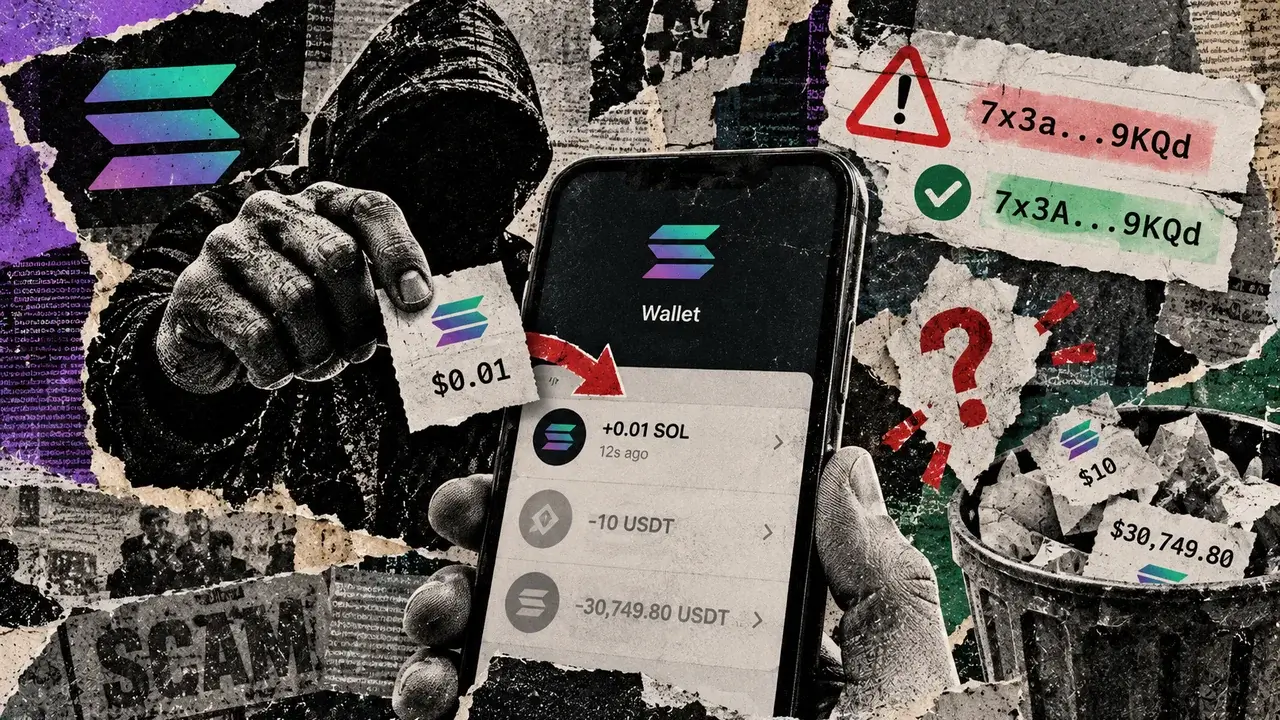
A recent deep dive into Solana network activity has uncovered a massive address poisoning campaign. Over 4.5 million wallets have been targeted. In one specific case, a user did exactly what they were supposed to do. They sent a $10 test payment to an address they believed was theirs. It landed. Feeling confident, they followed up with a transfer of $30,750. That money is now gone. The address they sent it to was a near-perfect clone generated by a scammer, and the user fell for a psychological trap that builders need to start taking seriously.
The Architecture of a Poisoning Attack
Address poisoning is not a new concept, but the scale and speed at which it is happening on high-throughput chains like Solana is alarming. The mechanics are simple yet devastatingly effective. Scammers use vanity address generators to create a wallet that looks almost identical to yours. They usually match the first four or five characters and the last four or five characters of your legitimate frequent contacts or your own secondary wallets.
Once they have a matching address, they send a tiny amount of SOL or a worthless token to your wallet. This puts the malicious address right at the top of your transaction history. The attacker is betting on the fact that most humans do not read all 44 characters of a Solana address. We scan the beginning, we scan the end, and we hit send. By infiltrating the transaction history, the scammer effectively replaces your trusted contact with a lookalike.
Why the Test Transaction Failed
The tragedy of the $30,750 loss lies in the fact that the victim was trying to be careful. In this specific scenario, the attacker did not just wait for the user to copy a past address. They actively monitored the mempool or the chain for the test transaction itself. When the user sent that first $10 to their actual legitimate destination, the scammer immediately sent a zero-value or tiny-value transaction from a "poisoned" address to the user's wallet.
When the user went back to their wallet software to send the remaining thirty grand, the most recent transaction in their UI was no longer the legitimate test they just performed. It was the scammer's inbound transaction. The user copied the address from the top of the list, assuming it was the destination that had just successfully received the $10. It is a sophisticated exploit of user interface trust and human habit.
The Builder's Responsibility
If you are building in the Solana ecosystem, or any ecosystem for that matter, this is a wake-up call. We cannot keep blaming the user for "not being careful enough" when the tools we provide them are actively being manipulated. If a user follows the best-practice advice of the entire industry and still loses their life savings, the fault lies in the design of our interfaces.
Wallets currently treat every transaction history item with equal visual weight. A transaction from a known, labeled contact looks exactly like a random inbound transfer from a vanity address designed to mimic that contact. This is a massive UX debt that we are forcing users to pay for with their own capital. We need to start rethinking how transaction histories are displayed. Should zero-value transfers from unknown addresses even be visible in the primary send/receive flow? Probably not.
What This Means for the Solana Ecosystem
Solana's low fees are its greatest selling point for builders, but they are also a double-edged sword. It costs a fraction of a penny to spam millions of wallets with poisoned transactions. On Ethereum, the cost of gas acts as a natural deterrent for large-scale spam. On Solana, a scammer can target 4.5 million people for a relatively small overhead. If even one person sends $30,000 to the wrong place, the ROI for the attacker is astronomical.
This creates a "noise" problem. When the ledger is filled with millions of deceptive entries, the integrity of the user experience degrades. We are seeing a shift where the blockchain is no longer just a ledger of value, but a billboard for social engineering. As founders, we have to recognize that the chain is permissionless, but our front-ends do not have to be mindless.
Tactical Takeaways for Founders and Users
If you are managing a project, you should be looking at ways to implement address books that require manual verification. Relying on the "recent transactions" list is becoming a legacy risk. We need better filtering at the RPC level or within the wallet client to flag addresses that share high similarity with the user's own address but have no prior history of significant interaction.
For users, the takeaway is harsher: the test transaction is no longer enough. You have to verify every single character, or better yet, use QR codes and strictly managed address books. Never copy an address from your transaction history. It is now a compromised environment.
Ultimately, this isn't a Solana problem; it's a human perception problem. But as we push for mass adoption, we have to build for the humans we have, not the perfect, hyper-vigilant machines we wish they were. If a user does everything right and still loses, the system is broken. It is time we start fixing the UI so the scammer's vanity address doesn't have a place to hide.
Read the original at CryptoSlate →