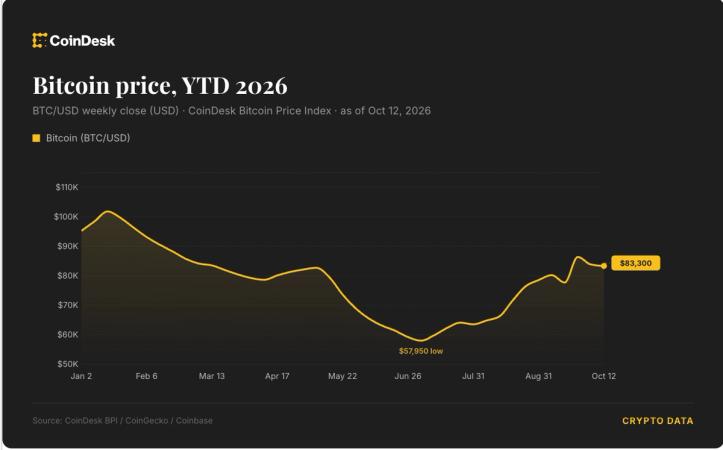
We are watching Bitcoin trade in a tight range around the $83,000 mark. After a significant run-up, the market seems to be catching its breath. But this isn't just a natural pause in price action; it is a calculated wait-and-see approach from the big money. Everyone is staring at the upcoming U.S. inflation data, trying to figure out if the Federal Reserve is going to stay the course or pivot yet again.
The Macro Weight on Crypto
For those of us building in this space, price is often noise, but macro liquidity is the signal. Right now, the signal is messy. Treasury yields are sitting at levels we haven't seen in two decades. When you can get a guaranteed return on government debt that rivals historical equity averages, the appetite for riskier assets like Bitcoin starts to face real friction. This is why we see a 'lid' on the current price despite the recent momentum.
Inflation data is the primary driver here. If the Consumer Price Index (CPI) comes in hotter than expected, it gives the Fed a reason to keep rates high for longer. For a founder, that means the cost of capital stays high. It means the runway you thought you had might be shorter if your burn is high and your next raise depends on a 'risk-on' environment. We have to stop looking at Bitcoin as a decoupled asset. In the eyes of the institutional traders currently moving the needle, it is a high-beta play on global liquidity.
The Yield Problem for Builders
Why should a developer or a founder care about Treasury yields? Because liquidity is a zero-sum game in the short term. When yields are high, capital stays parked in 'safe' havens. This drains the pool of venture capital and retail liquidity that fuels ecosystem growth. When Bitcoin hits a range like $83,000 and stalls, it usually indicates that the 'smart money' is waiting for a reason to either go all-in or retreat to the sidelines.
We are seeing the odds of aggressive rate hikes slump, which is generally a good sign. However, the market is still pricing in a lot of uncertainty. As builders, we should be preparing for a scenario where the cost of borrowing stays elevated throughout the next two quarters. If you are relying on a massive bull run to fix a broken business model, you are gambling, not building.
Separating Hype from Reality
The headlines will tell you that Bitcoin is 'stalling' or 'consolidating.' I prefer to look at it as a period of price discovery under pressure. The current range is a battlefield between those who believe the inflation cycle is broken and those who fear a resurgence. If the data shows inflation is sticky, expect the $80,000 support level to be tested. If it shows cooling, we might see the break toward $90,000 that everyone is tweeting about.
But don't get distracted by the charts. The real story is how the underlying infrastructure handles these price levels. Are we seeing increased on-chain activity, or is this just exchange-traded volume? For the most part, we are seeing a shift toward institutional dominance. The Bitcoin ETFs have changed the game, and those investors don't care about your favorite meme coin. they care about the macro-economic calendar.
What This Means for the Founder Perspective
If you are running a crypto-native project, your strategy should be independent of whether Bitcoin is at $83,000 or $75,000. Real builders use these range-bound periods to optimize. When the market isn't screaming 'buy everything,' you get a clearer picture of who your actual users are. The tourists leave when the price stops going vertical.
High interest rates and high yields act as a filter. They filter out the low-effort projects and the founders who are just here for the exit. If you can survive and grow while Treasury yields are at twenty-year highs, you are building something with actual staying power. The friction in the market is actually a gift; it kills the competition that only exists because of cheap money.
- Watch the CPI data, but don't trade on it. Use it to understand the sentiment of your potential investors.
- Keep an eye on Treasury yields. As long as they remain at decade-highs, don't expect a vertical 'moon' scenario without significant resistance.
- Focus on sustainable growth. The era of easy capital is on pause until the Fed sees a clear path back to their 2% target.
A Skeptical Take on the 'Bullish' Narrative
It is easy to be bullish when the price is near all-time highs. But a founder's job is to be the resident skeptic. Why is the market not pushing higher? Because the risk-reward ratio is currently being skewed by the bond market. If you can get 5% for doing nothing, you need a very compelling reason to buy Bitcoin at $83,000. That reason usually comes in the form of a weakening dollar or a failing banking system. Neither is currently showing the kind of immediate collapse the 'hyperbitcoinization' crowd hopes for.
Instead, we have a slow grind. This is actually healthier for the long-term prospects of the industry. Rapid, parabolic moves lead to spectacular crashes. A range-bound Bitcoin gives the rest of the market time to catch up. It allows for infrastructure to be tested and for real-world use cases to prove their value beyond mere speculation.
The market can stay irrational longer than you can stay solvent, but the macro cycle eventually forces everyone to face the truth of the data.
We need to be looking at the next six months as a period of stabilization. The volatility isn't gone, it's just redirected into the macro data releases. For those of us in the trenches, the mission remains the same: build products that solve problems regardless of what the Fed decides to do with interest rates. If your project requires a $100,000 Bitcoin to be viable, you aren't building a business; you're building a derivative.
The takeaway here is simple: The range near $83,000 is a reflection of a market that is no longer flying blind. It is waiting for the next signal from the real economy. As builders, our job is to ignore the noise, manage our runways, and keep shipping. The liquidity will return when the data allows it, but until then, efficiency is the only way forward.
Read the original at Decrypt →