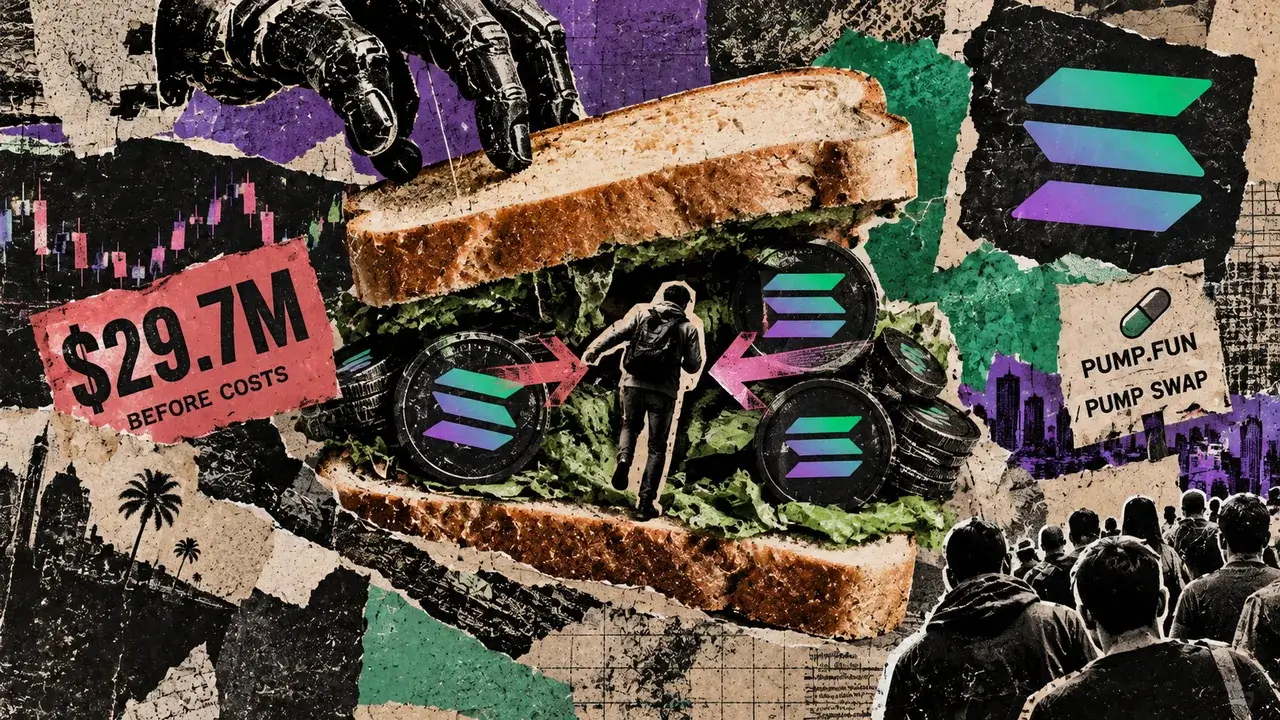
If you have spent any time trading on Solana lately, you have probably felt the sting of a transaction that did not go quite right. You buy a token, the price jumps a fraction of a second before your trade hits, and you end up with fewer tokens than you expected. You just got sandwiched. New data from Bitquery suggests this is not just a minor annoyance; it is a massive, industrialized operation that has extracted nearly 30 million dollars from the ecosystem over the last year.
The Anatomy of the Squeeze
For those who are not deep in the technical weeds, a sandwich attack is a form of Maximum Extractable Value or MEV. A bot monitors the mempool for a pending buy order. When it sees one, it front-runs the trade by buying the same asset first, pushing the price up. Your trade then executes at that higher price, pushing it even higher. Finally, the bot sells its position immediately back into the liquidity pool. The bot captures the difference, and the retail user captures the loss. On Solana, this process has become remarkably efficient.
The Bitquery report highlights that while the gross revenue for these bots is roughly 29.7 million dollars, that is not pure profit. Running these bots is expensive. You have to pay for high-end server infrastructure, specialized RPC nodes, and substantial tip amounts to validators to ensure your transactions are bundled correctly. Even so, the sheer volume of extraction shows that the business model is working.
Why Pump.fun is the Epicenter
The most striking part of the data is where these attacks are happening. According to the study, about 96 percent of the detected attacks targeted Pump.fun and its related infrastructure. This is not a coincidence. Pump.fun has become the primary laboratory for the current memecoin craze, and its specific mechanics make it a goldmine for MEV bots.
Pump.fun uses a bonding curve. This is a mathematical formula that dictates the price of a token based on its supply. Because the price movements on a bonding curve are deterministic and predictable, it is much easier for a bot to calculate exactly how much it can squeeze a user without failing the transaction. When you combine high volatility, massive retail participation, and predictable pricing math, you get a perfect environment for extraction.
For builders, this is a cautionary tale about user experience. Most users on these platforms are not sophisticated traders. They are clicking a button and hoping for the best. When nearly every trade is being front-run, it creates a hidden tax that degrades trust in the platform and the underlying network. If the goal is to bring the next billion users to crypto, we cannot have a system where every newcomer is immediately harvested by a bot.
The Cost of Doing Business
It is easy to look at a 30 million dollar figure and get angry at the bot operators. But from a founder’s perspective, these bots are just rational actors responding to the incentives of the system. If the protocol allows for front-running, someone will do it. The problem is not the existence of the bots; the problem is the architecture that makes the bots profitable.
Solana has often been touted as a high-speed, low-cost alternative to Ethereum. While that is true in terms of gas fees, the hidden costs of MEV can sometimes make a Solana trade more expensive in real terms than an Ethereum trade. When you factor in the slippage caused by these sandwich attacks, the efficiency of the network starts to look a bit different. The 29.7 million dollars taken out of the system is liquidity that could have stayed in the pockets of builders and creators.
How Builders Should Respond
If you are building an application on Solana or any high-throughput chain, you have to assume that MEV is the default state of nature. You cannot rely on users to set their slippage tolerances correctly. Most people do not even know what slippage is. They just know they got less than they expected. This puts the burden of protection on the developer.
- Private Transaction Routes: We are seeing a rise in services that allow users to bypass the public mempool. By sending transactions directly to validators, you remove the opportunity for bots to see the trade before it happens.
- Better Slippage Defaults: Many front-ends default to a one or two percent slippage, which is a wide-open door for a sandwich bot. Dynamic slippage that adjusts based on pool depth could help mitigate this.
- Protocol-Level Mitigations: Some new DEX designs are experimenting with batching trades or using encrypted mempools to make front-running physically impossible.
The reality is that as long as there is money to be made from ordering transactions, MEV will exist. The Bitquery data shows that the bots are getting smarter and more focused. They are moving away from general-purpose DEXs and zeroing in on high-velocity launchpads where the retail heat is highest.
The Bottom Line
The extraction of 30 million dollars from the Solana ecosystem is a tax on innovation. While Pump.fun has been incredibly successful at generating volume and attention, it has also provided a massive playground for predatory bots. For the Solana ecosystem to mature, the community needs to move past the idea that high volume is the only metric that matters.
We need to start looking at the quality of that volume. If a significant chunk of a network's activity is just bots eating retail traders, that is not sustainable growth. It is a cycle of extraction that eventually runs out of new participants. Builders who prioritize user protection over raw volume will be the ones who survive the next phase of this market. Honesty about these numbers is the first step toward fixing the problem.
Read the original at CryptoSlate →