The Mirage on the Chain
In the world of decentralized finance, numbers are usually treated as the ultimate truth. We look at charts, we track volume, and we measure the health of a network by its liquidity. But lately, the numbers on Solana have been lying to us. Not because the blockchain is broken, but because the actors on it have become incredibly efficient at gaming the metrics.
A recent incident involving a single trading bot on the Raydium DEX serves as a perfect case study for why founders and builders need to look past the dashboard. Using a relatively small seed of $12,000, this single bot managed to churn through $1.4 billion in trading volume. Think about that math for a second. That is not organic growth; it is a high-speed shell game that makes a ghost town look like a metropolis.
How the Wash Works
The mechanics aren't particularly complex, which is the scariest part. By utilizing a technique known as wash trading, the bot executes buy and sell orders against itself in rapid succession. Because Solana’s transaction fees are negligible, the cost of doing this is virtually zero. The bot isn't trying to make money on the trades; it is trying to manufacture prestige.
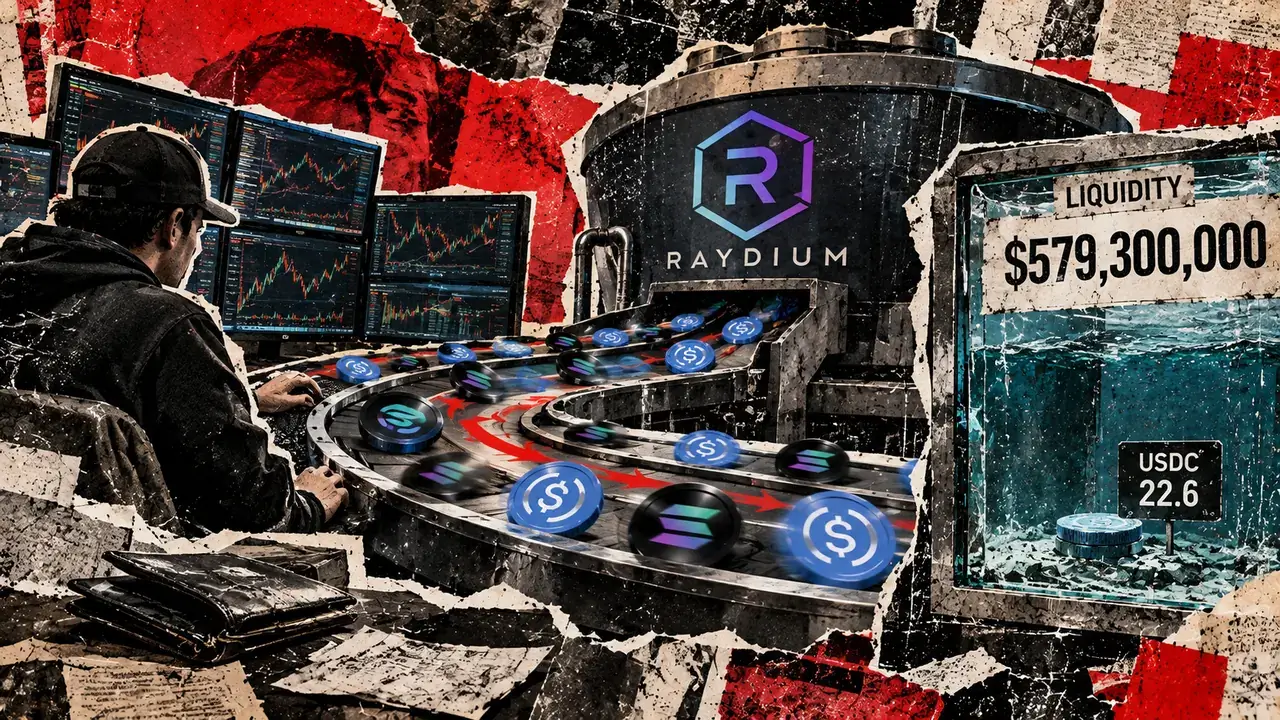
When a token appears to have hundreds of millions of dollars in volume, it climbs the rankings on aggregators like DEXScreener. It attracts the eyes of retail traders who think they are seeing a breakout. In reality, they are looking at a hall of mirrors. On October 22, snapshots of Raydium showed liquidity pools that claimed to have over $500 million in depth while actually holding about 22 USDC in real value. It is the digital equivalent of a Hollywood set where the buildings are just painted plywood held up by 2x4s.
The Founder’s Dilemma
For those of us building real products, this environment is toxic. It creates a skewed sense of what success looks like. If you are launching a legitimate project with actual utility, your organic volume will look like a rounding error compared to these ghost bots. It creates a pressure to 'play the game' just to stay visible.
But playing that game is a race to the bottom. When liquidity is fake, the exit is always a trap. If you are building on Solana, you have to realize that the 'Total Value Locked' and 'Volume' metrics are currently being heavily manipulated by MEV bots and wash traders. If your business model relies on these numbers being accurate, you are building on sand.
The Problem with Raydium and Permissionless Pools
Raydium is the primary venue for this activity because of its low barrier to entry. Anyone can spin up a pool. This is the beauty of DeFi, but it is also its greatest weakness. When there is no friction to create a market, there is no friction to fake one. The bot in question was able to inflate the stats of a specific token to the point where it dominated the global charts, despite having no actual holders of substance.
This isn't just a Solana problem, but Solana’s speed makes it the most effective laboratory for this kind of manipulation. On Ethereum, gas fees would have eaten that $12,000 in minutes. On Solana, that $12,000 can fuel a billion-dollar illusion for days.
What Builders Should Watch For
If you are evaluating a partnership or looking at a new ecosystem to build in, you need to change your due diligence process. Stop looking at the volume column. It is the easiest metric to fake. Instead, look at the distribution of holders. Look at the frequency of unique active wallets that aren't just bouncing the same tokens back and forth. Real growth is slow and messy; it doesn't look like a vertical line on a volume chart.
We also need to talk about the aggregators. Platforms like DEXScreener and Birdeye are essentially the front page of crypto right now. When their algorithms allow a pool with $22 in liquidity to rank as a top-tier asset because of fake volume, they are failing the users. As builders, we should be pushing for better filtering tools that can distinguish between a bot-driven wash and a human-driven trade.
The Long-Term Impact
This kind of activity eventually leads to a liquidity crunch and a crisis of confidence. When retail investors get burned by 'ghost pools' enough times, they leave. When they leave, the real projects suffer because the overall capital in the ecosystem shrinks. We are seeing a short-term boost in Solana's metrics at the cost of long-term trust.
The takeaway for founders is simple: don't chase the ghost volume. Focus on building things that people actually need to hold, not just things they want to flip. The bots will eventually run out of gas or the developers will patch the loopholes, but the projects with real users will be the only ones left standing.
The Bottom Line
Metrics are a tool, not a destination. If a bot can turn $12,000 into $1.4 billion in volume, then volume no longer means what we thought it meant. In this market, honesty is a competitive advantage, even if it doesn't show up on the leaderboard today.
Read the original at CryptoSlate →