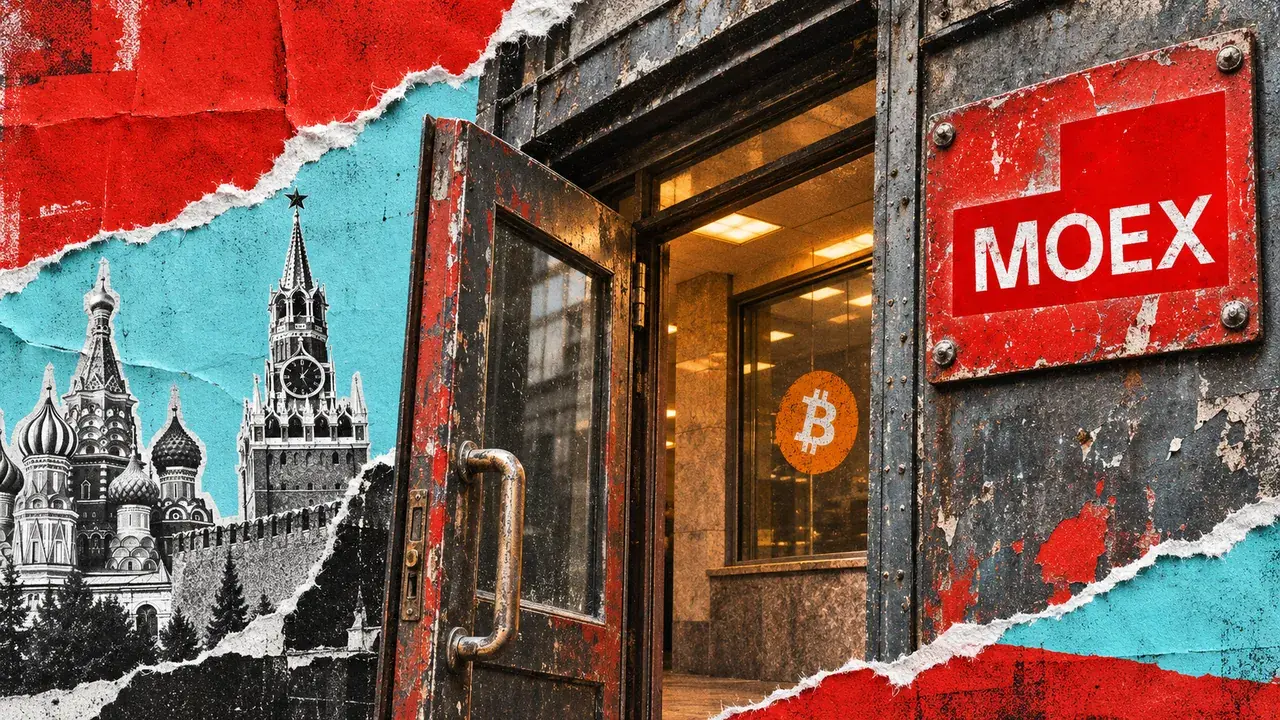
The Kremlin’s Pragmatic Pivot
Russia has spent years flirting with a total ban on crypto. The Central Bank of Russia (CBR) long viewed Bitcoin as a threat to monetary sovereignty, a volatile asset that could undermine the ruble. But geopolitical reality has a way of forcing a change in perspective. With the Moscow Exchange (MOEX) preparing to launch Bitcoin trading as early as December, we are seeing a shift from ideological opposition to desperate pragmatism.
This isn't a story about mass adoption or the 'freedom' of decentralized finance. It is a story about a state-sanctioned exit ramp. As of late November, local exchanges are authorized to list crypto assets provided the central bank clears their specific rulebooks. The timing isn't accidental; the Moscow Exchange, already under heavy US sanctions, is looking for any liquidity layer that doesn't rely on the legacy SWIFT system or Western clearinghouses.
The Rules of the Game
If you are a retail investor in Russia, the government isn't exactly rolling out the red carpet. They are offering a narrow, highly regulated hallway. The current framework limits ordinary participants to a paltry 300,000 rubles in annual purchases per intermediary. At current exchange rates, that is less than $3,000 USD. For a serious builder or a high-net-worth individual, that isn't an investment strategy; it’s a rounding error.
Furthermore, the ban on using Bitcoin as a direct payment method remains firmly in place. You can trade it, you can hold it, and you can potentially use it for international settlement if you are a state-approved entity, but you cannot buy a coffee with it in Moscow. The CBR is maintaining its grip on the domestic economy while using Bitcoin as a pressure valve for cross-border trade.
The Role of the National Clearing Centre
The pilot program, slated for an early December kickoff, centers on the National Clearing Centre (NCC). This is a critical detail for builders to watch. The NCC is the backbone of the Russian financial market, and it is currently the primary target of Western sanctions. By moving Bitcoin onto this infrastructure, Russia is essentially creating a parallel financial universe.
They are betting that Bitcoin’s neutral, borderless nature can serve as a medium of exchange that the Office of Foreign Assets Control (OFAC) can’t easily switch off. However, the paradox for the Russian government is that for Bitcoin to be useful for trade, it needs liquidity. By capping retail participation so aggressively, they are stifling the domestic liquidity they might eventually need to facilitate larger state-level transactions.
What This Means for Builders
If you are building in the crypto space, Russia’s move provides a case study in 'Capture vs. Co-option.' We often talk about decentralization as a way to escape state control, but here we see a state attempting to wrap an entire blockchain ecosystem in its own regulatory layers. For developers, this highlights the growing divide between 'Clean' institutional crypto and 'Wild' permissionless crypto.
- Infrastructure Compliance: Exchanges operating in these jurisdictions won't be using standard DeFi protocols. They will be using permissioned, state-monitored gateways. Builders in the KYC/AML space will find a growing market, though one fraught with ethical and legal landmines.
- Arbitrage and Liquidity: The 300,000 ruble cap creates a disconnected market. Whenever a government puts a hard lid on how much of an asset a citizen can buy, a shadow market usually forms to fill the gap. Builders should watch for how 'official' trading on MOEX interacts with the already robust P2P market in Russia.
- Sanctioned Stack: Seeing a major national exchange that is already sanctioned move into Bitcoin proves that crypto is now the 'Plan B' for the global financial fringe. This puts pressure on Western developers to decide how 'neutral' their protocols really are.
The Skeptical Take
We shouldn't mistake this for a bullish retail event. This is a government trying to figure out how to pay for imports without using the US Dollar. The restrictions placed on retail investors show that the CBR is still terrified of capital flight. They don't want Russians moving their wealth into Bitcoin to protect themselves from ruble inflation; they want the state to have a tool to bypass sanctions.
The December 1st pilot is likely to be a clunky, high-friction experience. Expect high fees, rigorous surveillance, and limited exit options. For the Russian founder, this might provide a legal way to move some capital, but the caps make it nearly impossible to run a large-scale international business through these sanctioned exchanges without special state dispensations.
A Fragmented Global Market
What we are witnessing is the balkanization of the crypto market. We used to have one global Bitcoin price. Increasingly, we have the 'Western' price, the 'Sanctioned' price, and the 'Local' price. Russia’s entry into formal Bitcoin trading on MOEX accelerates this trend. It turns Bitcoin into a commodity traded on a state-controlled shelf, rather than a decentralized currency used by people.
The paradox of Bitcoin in 2024 is that as it becomes more useful to nations, it often becomes more restricted for the individuals living within them.
Russia isn't 'adopting' Bitcoin because they've seen the light of Satoshi’s whitepaper. They are using it because the door to the rest of the world has been slammed shut. For the rest of the crypto world, the challenge is maintaining the integrity of the network while these massive, state-level games are being played on top of it.
The Bottom Line
Russia’s move to allow Bitcoin trading on the Moscow Exchange is a tactical shift, not a cultural one. The 300,000 ruble cap ensures that retail investors stay on a short leash, while the state tests the waters for institutional sanctions evasion. For builders, it’s a reminder that Bitcoin is neutral, but the on-ramps are anything but. Watch the December 1st pilot closely, but don't expect a retail boom—expect a highly controlled experiment in sovereign survival.
Read the original at CryptoSlate →