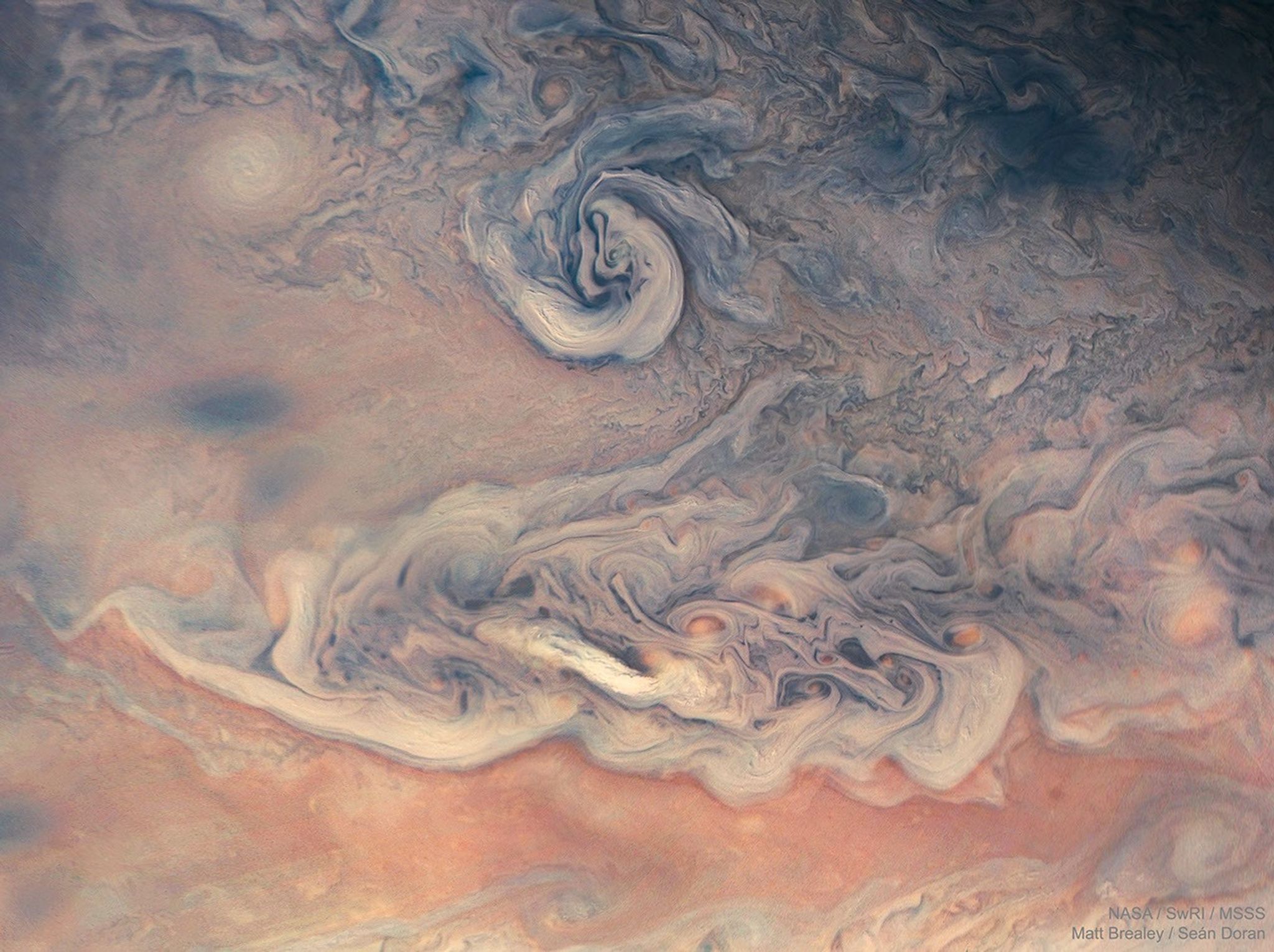
NASA just released a new set of images from the Juno spacecraft, detailing the chaotic, marble-like swirls of Jupiter’s northern atmosphere. To the casual observer, it is art. To the builder, it is a reminder of the massive engineering hurdles inherent in gathering data from a place that actively tries to destroy the sensors sent to observe it.
The Logistics of Deep Space Data
We often talk about data as if it is a commodity that exists in a vacuum—clean, accessible, and ready for an LLM to digest. The Juno mission proves the opposite. Since 2016, this titanium-shielded probe has been orbiting a planet with a magnetosphere so powerful it creates a radiation environment that would fry standard consumer electronics in seconds. For founders in the AI and hardware space, the lesson here is about resilience and the cost of collection.
The images we see today are not what the spacecraft "sees" in a literal sense. The raw data transmitted across millions of miles of void is often a noisy, fragmented stream of telemetry. It requires a sophisticated pipeline to transform those bit-level transmissions into the high-resolution topographic maps of hydrogen and helium clouds. When we look at these storms, we are looking at the result of a massive, multi-year edge computing success story.
Edge Computing Under Extreme Constraint
Juno carries a camera called JunoCam. Interestingly, it was not originally part of the primary science payload; it was included largely for public engagement. Yet, it has become one of the most significant tools for atmospheric study. This speaks to a pivot many crypto and AI founders face: the secondary feature often becomes the killer app.
Building for a environment like Jupiter’s orbit is the ultimate test of hardware-software integration. You have limited power, limited bandwidth, and a high probability of bit-flips due to radiation. This mirrors the challenges of building decentralized infrastructure in areas with intermittent connectivity or high interference. If you can make a node survive the radiation belts of a gas giant, you can probably make a mesh network work in a subterranean mine.
Predictive Models and Fluid Dynamics
The swirls captured in the November 22nd release are a visual representation of fluid dynamics at a scale that breaks most terrestrial models. Jupiter’s weather patterns are deep-rooted, driven by internal heat rather than sunlight. For researchers, the goal is to build predictive models that can explain why these vortices persist for centuries while Earth’s storms dissipate in weeks.
This is where the AI crossover happens. Modern astrophysics is increasingly reliant on machine learning to categorize these cloud formations and detect anomalies that human eyes might miss after looking at thousands of frames. However, we have to be skeptical of the "black box" approach here. In high-stakes science, a model that says "there is a storm here" without explaining the physics behind it is useless. Builders should take note: interpretability is not a luxury; it is a requirement when the cost of data is this high.
The Decentralization of Discovery
One of the most interesting aspects of the Juno project is how NASA handles the image processing. They don't keep it all in-house. A large portion of the stunning color-enhanced images we see are processed by "citizen scientists"—essentially a decentralized network of volunteers using their own hardware and software stacks to refine the raw data.
This is a working model of what many web3 projects strive for: a centralized entity provides the raw protocol or data source, and a decentralized community adds value through specialized labor. It’s a proof of concept for the data-DAO model. By opening the pipeline, NASA gets a diverse range of perspectives and mathematical approaches to image processing that a closed-shop internal team could never reproduce at scale.
What This Means for the Next Cycle
We are entering an era where the distinction between "space tech" and "standard tech" is blurring. The same computer vision algorithms used to map the turbulence of Jupiter are being adapted for autonomous drones and environmental monitoring on Earth. The hurdle is no longer just the code; it is the physical infrastructure required to keep that code running in hostile territory.
For founders, the takeaway is simple: stop building for the perfect environment. The real world—and certainly the solar system—is noisy, radiated, and uncooperative. Whether you are building an AI-driven trading bot or a decentralized physical infrastructure network (DePIN), your success depends on your ability to handle degraded signals and harsh conditions.
The Reality Check
Jupiter is a beautiful, terrifying reminder of the scale of the universe. But it is also a data management problem. Every swirl we see in the Juno images represents a victory over entropy. It is easy to get caught up in the hype of "space exploration," but the actual work is in the plumbing—the telemetry, the error correction, and the data pipelines.
If you are building the future of AI or decentralized systems, look at these images not just as wallpaper, but as the hardest-won data in the history of our species. The winners of the next decade won't just be the ones with the best models; they will be the ones who figured out how to get reliable data from the most difficult places.
The beauty of the Jovian atmosphere is a byproduct of violent physics; the clarity of the image is a byproduct of exceptional engineering.
We need more of the latter in the crypto and AI space. Less focus on the aesthetic of the final product, and more focus on the resilience of the pipeline that produced it.
Read the original at NASA Breaking News →