Prediction markets have always been the promised land for crypto utility. They take the abstract concept of decentralized finance and turn it into something humans actually understand: betting on the future. Polymarket has spent the last year proving that this model works, capturing the zeitgeist during a chaotic global election cycle. But as any founder knows, scaling a product from a niche experiment to a global infrastructure layer requires tearing down the old pipes.
Polymarket is currently undergoing a significant technical upgrade to its trading system. While the marketing might lean into words like "seamless" or "enhanced," the reality for builders and heavy users is a bit more manual. The platform is shifting to a new version of its contracts, and here is the catch: your existing positions are staying right where they are. They won't be automatically migrated to the new system.
The Logistics of On-Chain Friction
For the average person clicking buttons on the web interface, this might look like just another series of wallet prompts. You log in, you see a request to approve a new contract, and you move on. But if you are building on top of Polymarket or using their Conditional Token Framework (CTF) for third-party integrations, the workload just landed on your desk.
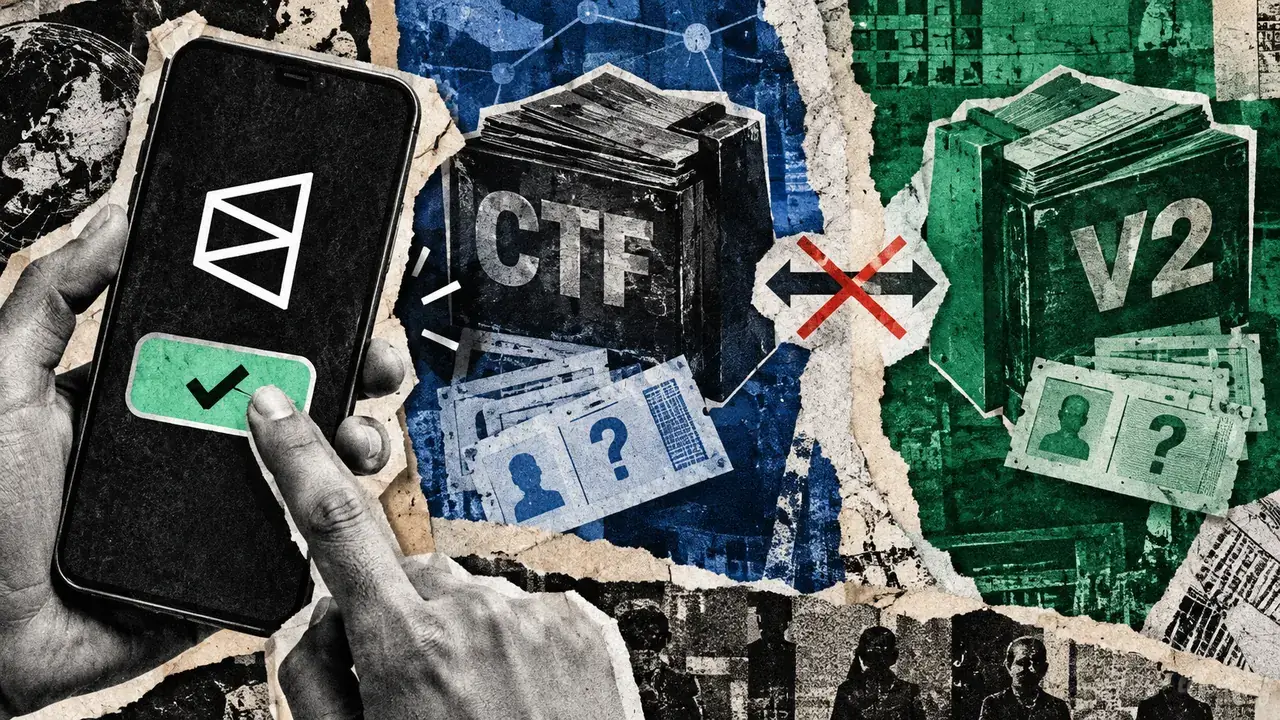
The shift requires a dual-track approach. For a period, the ecosystem will be split between the legacy contracts and the new V2 identifiers. This isn't just a cosmetic change. It involves managing specific permissions and identifiers that ensure the liquidity in the new system doesn't get tangled with the old one. It is a necessary friction, but it is friction nonetheless.
From a founder's perspective, this is a classic migration dilemma. You have to decide between forcing a hard cutover—which breaks things and upsets users—or running parallel systems, which doubles the maintenance overhead. Polymarket has chosen the latter. They are keeping the CTF support intact while asking developers to bake in support for the new V2 contracts.
Why Builders Should Care
If you are building an interface, a liquidity bot, or a data aggregator for prediction markets, this move is a signal. It tells us that the initial architecture, while functional, wasn't built for the volume we are seeing now. The upgrade is likely aimed at better capital efficiency and faster settlement, but the manual nature of the migration suggests that backward compatibility is getting harder to maintain.
We often talk about "composable" finance as if it is a set-it-and-forget-it Lego kit. It isn't. Every time a major protocol updates its core logic, every piece of the stack built on top of it has to adjust. If you have automated strategies running on the old contracts, they aren't going to magically start interacting with the new liquidity pools. You have to go back to the code, update the contract addresses, and re-verify your permissions.
The Risk of Fragmented Liquidity
The biggest concern with any non-automatic migration is liquidity fragmentation. When you have two versions of a market running simultaneously, you run the risk of widening spreads. If half the traders are on the old contract and half are on the new one, the price discovery process gets muddied. For a platform that prides itself on being a source of truth for global events, price accuracy is everything.
Polymarket seems to be betting that the user experience will be smooth enough that the migration happens quickly through natural attrition. As old markets resolve, users will naturally gravitate toward the new ones. But for long-dated markets—things that don't settle for months or years—we are going to see a long tail of legacy activity that builders have to account for.
A Founder’s Reality Check
As much as we love the idea of "code is law" and immutable systems, the reality of building in crypto is a constant cycle of patches and upgrades. This Polymarket shift is a reminder that even the most successful protocols are still works in progress. If you are building in this space, you can't just build for the protocol as it exists today. You have to build for the inevitability of the version change.
The takeaway here isn't that the upgrade is bad. In fact, it is probably vital for the platform's survival as it enters a post-election lull where it needs to find new ways to stay relevant. The takeaway is that decentralization doesn't mean zero maintenance. It just means the maintenance is decentralized.
What to Do Next
- For Traders: Don't panic, but pay attention to the prompts. If you have significant capital in long-term bets, realize they are sitting on the old rails. They will still resolve, but they won't benefit from any features added to the new system.
- For Developers: Audit your integrations. If you are relying on hard-coded contract addresses or old CTF logic, your tools might start showing incomplete data or failing to execute trades on the new markets.
- For Ecosystem Observers: Watch how quickly the volume shifts. The speed of this migration will be a great case study in how much "gravity" a leading protocol actually has over its user base.
We are moving out of the experimental phase of crypto where "good enough" was the standard. Now, we are seeing the growing pains of real infrastructure. Polymarket is growing up, and growing up usually involves leaving some old things behind.
Building in crypto means accepting that your foundation is always moving. The winners are those who can swap the engines while the plane is still flying.
Read the original at CryptoSlate →