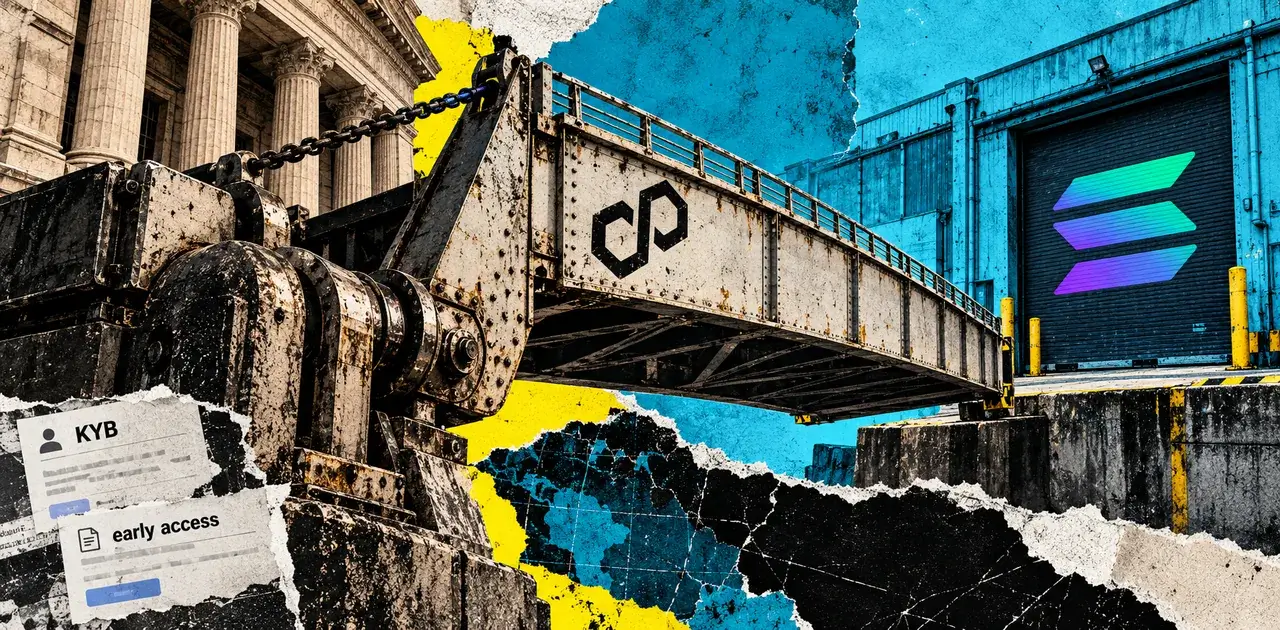
The Invisible Bridge Between Chains and Banks
I have always been a bit of a skeptic when it comes to the term interoperability. Usually, when someone in this space says they are building a bridge, they really just mean they are building another complicated way for you to lose your money in a smart contract exploit. But the recent move by Polygon to bring US banking access to Solana’s stablecoin ecosystem actually looks like a tool built for people who are trying to run a real business.
For the longest time, Solana and Polygon felt like two separate islands. Solana has the speed and the massive $15 billion stablecoin market, while Polygon has spent the last few years quietly embedding itself into the infrastructure that legacy finance actually trusts. By expanding their OMS (Open Money System) to include Solana, Polygon isn't just adding another ticker to a dashboard; they are providing a way for foreign businesses to actually touch the US dollar without jumping through the hoops of traditional predatory banking.
Why This Matters for Founders
If you are a builder outside the United States, your biggest headache isn't usually the code. It is the off-ramp. You can raise a seed round in USDC, you can pay your global contractors in SOL, but the moment you need to pay for a physical office or deal with a vendor who only takes fiat, you hit a brick wall. The friction of moving value from a high-speed chain like Solana into a regulated US bank account has historically been enough to kill a startup's momentum.
This expansion allows eligible foreign entities to verify their identity and connect their stablecoin holdings directly to banking rails. This is a pragmatic shift. We are moving away from the era of crypto-anarchy and into the era of crypto-utility. For a founder, this means less time worrying about how to liquidate payroll and more time actually building the product. It reduces the reliance on middle-man exchanges that often charge exorbitant fees for the simple act of moving your own money.
The Compliance Catch
We need to be honest about the limitations here. This isn't a free-for-all. This is an early-access rollout restricted by jurisdiction and heavy verification requirements. If you were hoping for a way to move anonymous millions, this isn't for you. Polygon is leaning heavily into the regulatory-compliant side of the fence, which is exactly why this has a chance of surviving the current legal climate.
The real value here isn't the technology of the bridge itself, but the regulatory clearance that comes with it. Connecting a decentralized ledger to a centralized bank account is a legal nightmare, and Polygon is essentially offering to do the heavy lifting of that compliance for you.
For builders, this is a double-edged sword. It means you have to play by the rules, but it also means the money you move is clean, tracked, and less likely to be frozen by a panicked compliance officer at a mid-tier regional bank. It is the cost of doing business in the real world.
The Solana Liquidity Factor
Solana’s stablecoin market is sitting at roughly $15 billion. That is a staggering amount of liquidity that has, until now, been largely trapped within the digital ecosystem. You could trade it, you could lend it, and you could stake it, but you couldn't easily spend it on a new server rack in the physical world. By opening this door, Polygon is effectively making Solana assets more liquid in the most literal sense of the word.
I have talked to plenty of founders who chose Solana for its performance but lamented the difficulty of connecting back to the broader financial world. This move levels the playing field. It suggests that the future of the industry isn't one chain winning everything, but rather specific chains serving as the engine while others serve as the interface to the old world.
A Dose of Skepticism
As much as I like this move, we should watch the implementation closely. "Early access" is often code for "we are still figuring out the bugs." We have seen plenty of projects promise seamless banking integration only to have their bank partners pull the rug out from under them six months later because of a change in Fed policy or a sudden bout of risk-aversion. The durability of these banking rails is the biggest question mark.
Furthermore, the verification process for foreign businesses is notoriously slow. If Polygon can't streamline the KYC/KYB process, the technical capability of the bridge won't matter. A bridge that takes three months to cross is just a long pier.
The Takeaway for Builders
If you are building on Solana, this is a signal to stop thinking about your treasury as a "crypto treasury" and start thinking about it as capital. The walls are coming down. The ability to move between $15 billion in on-chain liquidity and the US banking system is a massive upgrade for operational efficiency. Focus on building your product, but keep an eye on these off-ramps. The winners in the next cycle won't just be the best coders; they will be the founders who know how to navigate the friction between the new and old financial systems without getting burned.
- Solana's $15B stablecoin market is now more accessible to legacy banking.
- Compliance is the primary feature, not a bug.
- Foreign businesses get a legitimate path to US dollar rails.
- Watch the rollout speed; early access often means limited scale.
The tech is getting quieter, and the utility is getting louder. That is usually a sign that we are finally getting somewhere.
Read the original at CryptoSlate →