We have spent the last few years hearing that crypto is finally growing up. We have institutional ETFs, regulatory clarity in some regions, and massive infrastructure. Yet, every time a major exchange experiences a surge in withdrawals, the market flinches. This week, we saw Bitcoin ease down to $77,900. It is a small percentage drop, but the underlying movements tell a much louder story about where the money is going and why the people building this space need to pay attention.
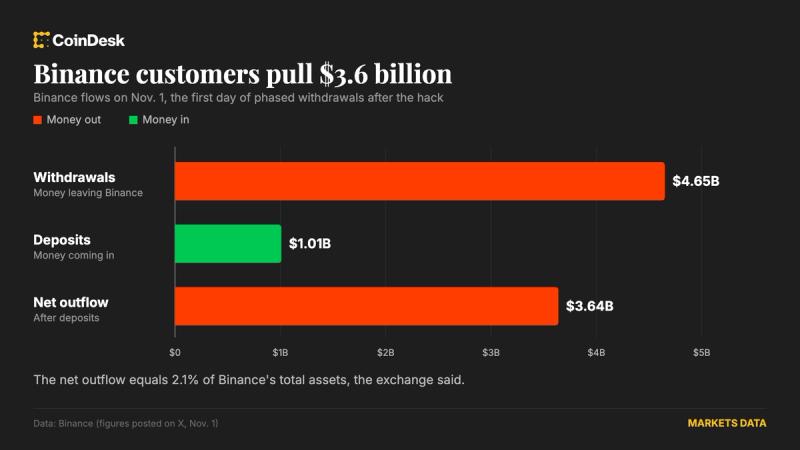
The catalyst for the current cooling period is Binance. After a period of paused activity, the exchange reopened withdrawals, and the floodgates opened. Customers pulled a net $3.64 billion from the platform. When you combine that with a $643 million exit from Bitcoin ETFs, you get a market that is suddenly very conscious of its own exit doors. For a founder, this isn't just about a red candle on a chart; it is about liquidity management and the psychological state of the average user.
The Exchange Bottleneck
Binance remains the giant in the room. When $3.6 billion leaves an exchange in a short window, it creates a ripple effect. This isn't necessarily a sign that people are quitting crypto entirely, but it is a sign that trust is still fragile. People move their assets when they feel a sense of urgency. As builders, we have to ask ourselves: are we building systems that rely on these centralized chokepoints, or are we creating actual alternatives that can handle this kind of volume without causing a price slide?
The price dip to $77,900 is relatively minor in the grand scheme of Bitcoin's volatility, but the volume of the outflow is significant. It shows that even with the arrival of Wall Street through ETFs, the core of the market activity still happens on these massive centralized hubs. If the hub gets congested or users get nervous, the price suffers. This is a design flaw in the current market structure that decentralization was supposed to fix, but hasn't quite managed to yet.
The ETF Illusion
For months, the narrative has been that ETFs would provide a floor for the price. The idea was that institutional money is "sticky" and won't flee at the first sign of trouble. The $643 million loss in ETF holdings suggests otherwise. Institutional investors are just as capable of taking profits or hedging their bets as retail traders. When the ETFs and the exchanges bleed at the same time, it creates a vacuum.
If you are building a product in the DeFi space or an AI-driven trading tool, this is your data point. The correlation between exchange health and ETF stability is tighter than most people want to admit. We are still in a phase where a few large entities control the pulse of the entire industry. This creates a massive opportunity for anyone building tools that offer genuine self-custody or peer-to-peer liquidity that doesn't rely on the permission of a single CEO or a board of directors.
Why $77,900 Matters
Numbers like $77,900 are psychological benchmarks. When we break a high, everyone is a genius. When we retreat slightly, the skepticism returns. The 0.4% drop since midnight UTC is a rounding error in any other industry, but in crypto, it is a signal. It tells us that the market is currently saturated and looking for a reason to either push higher or retreat further to find support.
The $3.6 billion outflow from Binance is the real story here. It represents a massive shift in where capital is sitting. Some of it is likely moving to cold storage, which is good for long-term holders. Some of it is likely moving to other exchanges or being converted to stables to wait out the volatility. Regardless, the liquidity is being rearranged. For builders, this means your user base is currently preoccupied with moving their money rather than using your apps.
The Founder's Perspective
If you are running a startup in this space, do not get distracted by the $77k price tag. Focus on the $3.6 billion. That is capital looking for a home. The fact that users are pulling funds from a major exchange suggests they are either looking for safety or looking for something better to do with their assets than just leaving them on a dashboard.
The biggest risk to a builder isn't a price dip; it's a lack of usable liquidity when your users need it most.
We need to stop pretending that the infrastructure is finished. If the reopening of withdrawals on one platform can trigger a multi-billion dollar exit and a market-wide cooling, we are still in the early, fragile days. The tools we build next need to focus on resilience. We need bridges that don't break, wallets that aren't confusing, and liquidity pools that don't dry up when the market gets sweaty.
What This Means for the Next Cycle
This cooling period is a healthy, if annoying, part of the cycle. It flushes out the leverage and tests the pipes of the exchanges. The $3.6 billion exit is a stress test. If Binance handles it without further issues, it actually builds long-term confidence. But in the short term, it creates a drag on the price that makes everyone nervous.
We should expect more of this. As Bitcoin moves into higher price brackets, the dollar amounts being moved will only get larger. A $3 billion outflow today will be a $30 billion outflow in a few years. Our current infrastructure is barely holding on to the current scale. If you are building for the future, you should be building for a world where billions move in minutes, not days.
- Exchange Reliability: The market is still heavily dependent on centralized exchange health.
- ETF Sensitivity: Institutional money moves faster than the "diamond hands" narrative suggested.
- User Behavior: Large-scale withdrawals indicate a shift toward self-custody or a search for safer yield.
The takeaway for the builder community is simple: don't mistake a bull market for a finished product. The price can be $77,900 or $100,000, but if the underlying movement of funds is still this clunky and centralized, we haven't won yet. Keep building the tools that make these massive outflows irrelevant to the health of the broader ecosystem. The goal isn't just a higher price; it's a more robust network that doesn't care what happens on a single exchange's withdrawal page.
Read the original at CoinDesk →