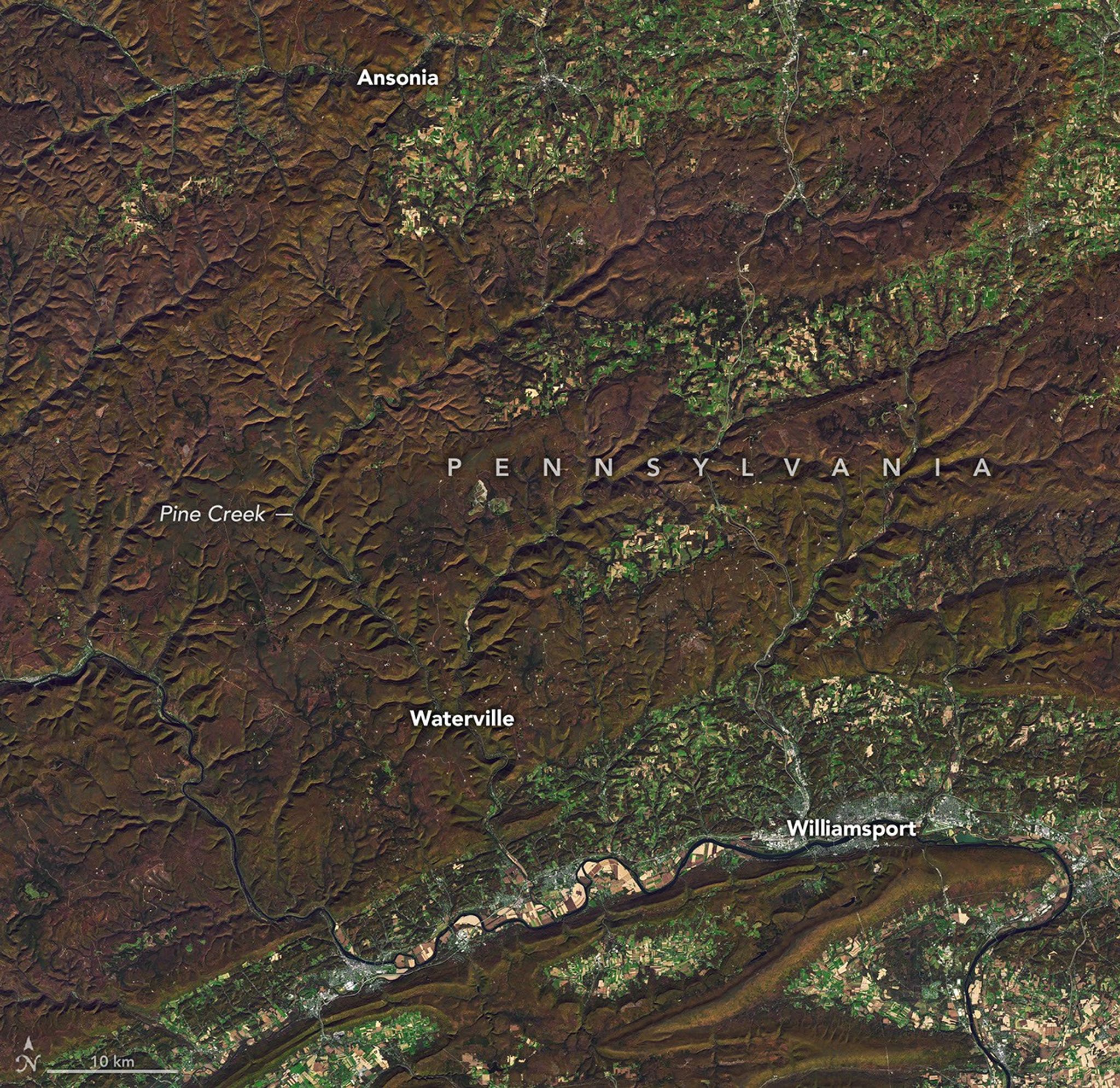
When you spend all day looking at token charts and LLM latency graphs, you start to lose your sense of scale. You forget that the most successful systems on Earth weren't built in a three-month sprint. I was looking at the recent satellite data of Pine Creek Gorge, often called the Grand Canyon of Pennsylvania, and it hit me how much nature resembles a well-executed, long-term technical roadmap.
The Architecture of Erosion
From a high-altitude perspective, the gorge looks like a deep scar cutting through the Allegheny Plateau. It is a massive breach in the landscape, stretching nearly 50 miles. But if you look at the mechanics, it wasn't a sudden catastrophic event that created this. It was the result of the Tiadaghton River, now known as Pine Creek, essentially performing a slow-motion stress test on the crust of the Earth.
For builders, there is a lesson here about legacy systems. The Allegheny Plateau is a tough, high-elevation block of sedimentary rock. It was built to last. But water, much like a persistent bug or a shift in market sentiment, eventually finds the hairline fractures. Over thousands of years, the water carved out a canyon that reaches depths of over 1,450 feet. It is a reminder that persistence is the ultimate disruptor.
Fall Foliage and Surface Level Hype
Right now, the area is covered in the deep oranges, reds, and yellows of the fall season. It looks great on a satellite feed. It is the kind of visual that attracts tourists and creates a lot of surface-level noise. In our world, this is the equivalent of a new UI wrapper on a mediocre API. It looks beautiful, but the real story isn't the colors on the trees; it is the structural integrity of the canyon underneath.
Too many founders focus on the foliage. They want the aesthetic of success before they have the depth of a product. If you strip away the seasonal leaves of Pine Creek Gorge, you are left with a massive, permanent geological feature. If you strip away the marketing of your startup, what is left? If the answer is just a flat plateau with no depth, you haven't built anything that will survive the next cycle.
Glacial Diversion and Pivot Points
The history of this gorge is actually a story about a massive pivot. Millions of years ago, the water in this region flowed in a completely different direction. It wasn't until the arrival of massive glaciers during the last Ice Age that the flow was blocked. The water was forced to find a new path, eventually cutting through the plateau to the south.
- Constraints create new paths: The glacier was a hard constraint. It didn't destroy the water; it forced the water to become more powerful in a concentrated area.
- Deepening the moat: Once the new path was established, the sheer volume of water accelerated the carving process. In business, once you find your product-market fit after a pivot, you have to lean in until you've carved a moat that competitors can't easily cross.
- Structural permanence: Even after the glaciers melted, the path remained. Good infrastructure outlasts the pressure that created it.
The Founder Perspective on Scale
If you were standing at the bottom of the gorge, looking up at 1,400 feet of rock, you would feel small. That is the correct feeling to have when you are building something significant. The scale of the Allegheny Plateau is a reminder that we are operating within systems much larger than ourselves. Whether it is the global financial system or the current AI compute bottleneck, these are the plateaus we are trying to carve through.
I see a lot of people in the crypto space trying to build 'canyons' overnight. They launch a protocol, pump the volume, and wonder why they haven't made a dent in the industry six months later. They are trying to simulate the effects of thousands of years of erosion with a pressure washer. It doesn't work. You end up with a muddy mess, not a landmark.
Managing the Environment
Today, the gorge is protected. It is a National Natural Landmark. This is the 'regulation' phase of a project's lifecycle. Once you have built something so large and significant that it becomes a permanent part of the landscape, the rules change. You are no longer just a river cutting through rock; you are a resource that needs to be managed and preserved.
Building for the long term means accepting that your most important work will likely be slow, invisible to most, and incredibly difficult. But if you keep flowing, you eventually change the map.
What Builders Should Take Away
Stop looking at the seasonal changes and start looking at the erosion. If you are building a new L2, an AI agents platform, or a decentralized physical infrastructure network, your goal shouldn't be the 'fall foliage' of a high valuation. Your goal should be the 'gorge'—the deep, undeniable impact on the foundation of your industry.
Pennsylvania's Grand Canyon isn't a miracle. It is the logical conclusion of water meeting resistance over a long enough time horizon. If you have the right direction and enough volume, the rock will eventually give way. Don't worry about the noise. Just keep carving.
Read the original at NASA Breaking News →