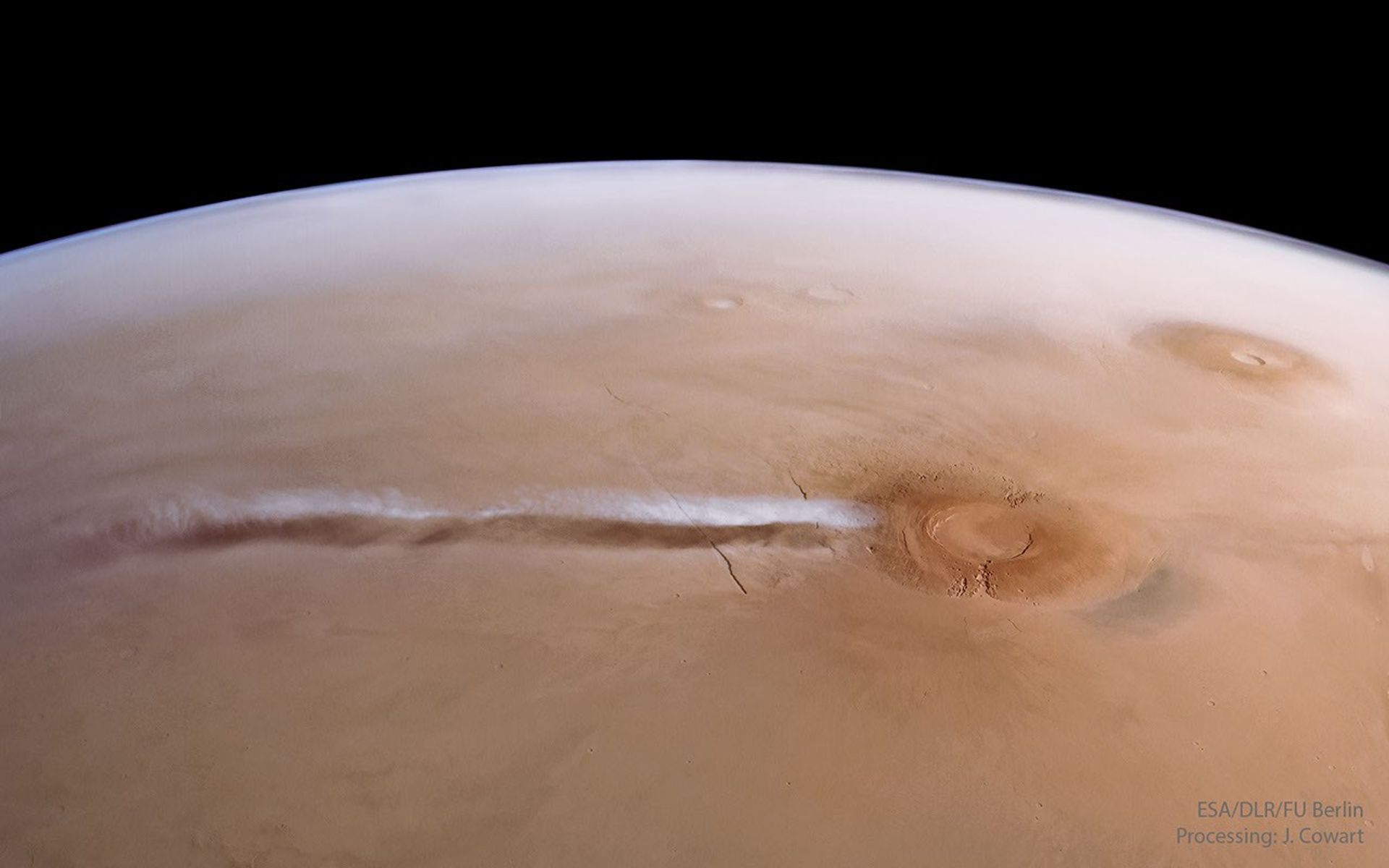
We talk a lot about building on-chain, but rarely do we talk about building on other planets. I was looking at the recent imagery coming back from the Arsia Mons region on Mars, and it reminded me why I started tracking DeSci (decentralized science) in the first place. There is a specific weather phenomenon there—a massive, 1,100-mile-long cloud—that appears and disappears with a mechanical regularity that should make any systems architect envious.
The Recurring Bug in the Martian Matrix
This cloud isn't your standard terrestrial vapor. It forms over the Arsia Mons volcano, a massive shield volcano near the Martian equator. It peaks during the southern summer, stretching out like a white tail across the red landscape. The interesting thing for those of us in the tech space isn't just the visual; it is the data consistency. It happens every morning for about 80 days, growing for a few hours and then dissipating as the sun warms the atmosphere.
For a founder, this is a lesson in predictable environmental triggers. We often build systems that are reactive—responding to market volatility or user spikes. The Martian atmosphere, despite being thin and harsh, follows a rigid set of physical laws that create this massive structure without fail. It is a closed loop. When we look at the imagery provided by NASA's Mars Express, we aren't just looking at space photography; we are looking at the output of an incredibly complex, autonomous climate engine.
Why Builders Should Care About Remote Sensing
You might ask why a crypto or AI builder should care about a cloud on a dead planet. The answer is data provenance and sensor networks. Right now, our understanding of Martian weather is limited to a handful of high-cost government assets. If you wanted to build a predictive model for Martian dust storms or atmospheric moisture today, you are at the mercy of centralized data silos that release information on a delay.
This is where DeSci and decentralized hardware networks (DePIN) intersect. If we ever intend to be a multi-planetary species, the infrastructure for monitoring these environments cannot be owned by a single entity. We need permissionless access to orbital data. Seeing a 1,100-mile cloud reminds us that the scale of data we are dealing with in the solar system is orders of magnitude larger than anything we are currently processing on Ethereum or Solana.
The Challenge of Atmospheric Modeling
Modeling a cloud like the one over Arsia Mons is technically difficult because the Martian atmosphere is less than 1% as dense as Earth's. Conventional fluid dynamics models used for Earth weather often break down when applied to the thin CO2 atmosphere of Mars. This is a classic "edge case" problem. In software, we spend 80% of our time fixing the 20% of edge cases. In planetary science, Mars is the edge case.
Builders in the AI space should see this as a training ground. Generative models and neural networks thrive on identifying patterns in noisy data. Martian weather is the ultimate noise. If you can build a model that accurately predicts the elongation of the Arsia Mons elongated cloud (AMEC) based on orbital telemetry, you've built something that can handle almost any complex system on Earth.
The Infrastructure of the Future
We are entering an era where space-based data is becoming a commodity. Companies like SpaceX have lowered the cost to orbit, but the data layer is still lagging. I expect to see a rise in protocols specifically designed to handle long-range telemetry and verifiable proof of observation.
- Verifiable Data: How do we know the sensor data hasn't been tampered with?
- Incentivized Observation: Can we reward amateur astronomers or private satellite operators for contributing to a global (or interplanetary) climate model?
- Distributed Storage: Storing high-resolution orbital imagery on-chain is impossible, but we need decentralized indexing to ensure this history isn't lost.
The Arsia Mons cloud is a reminder that there is a reality outside of our digital bubbles. It is a physical phenomenon that occurs whether or not the markets are up, whether or not the latest LLM is hallucinating, and whether or not we are paying attention. That kind of objective reality is what we should be striving to capture in our code.
The most successful systems are those that work in harmony with their environment, rather than trying to override it. Mars doesn't ask for permission to form a cloud; the conditions simply make it inevitable.
A Reality Check for Founders
I see too many founders building solutions for problems that don't exist. They are building "Uber for X" or "Tinder for Y" on the blockchain. Meanwhile, we have an entire solar system of data that is waiting to be organized, verified, and utilized. If you are looking for a project with real longevity, look at the physical world. Look at the gaps in our scientific knowledge.
The scientists studying this cloud are using 20-year-old cameras because that is what is currently in orbit. There is a massive opportunity for a new generation of builders to provide the hardware, the software, and the economic incentives to modernize how we look at our neighborhood in space.
Final Thoughts
Don't get blinded by the hype of the current cycle. The real builders are looking at the long game. They are looking at how to create systems that are as reliable and recurring as the morning clouds on Mars. If your protocol can't survive a bear market, it certainly won't survive the vacuum of space. Build for the long haul, build with objective data, and stop ignoring the sky.
Read the original at NASA Breaking News →