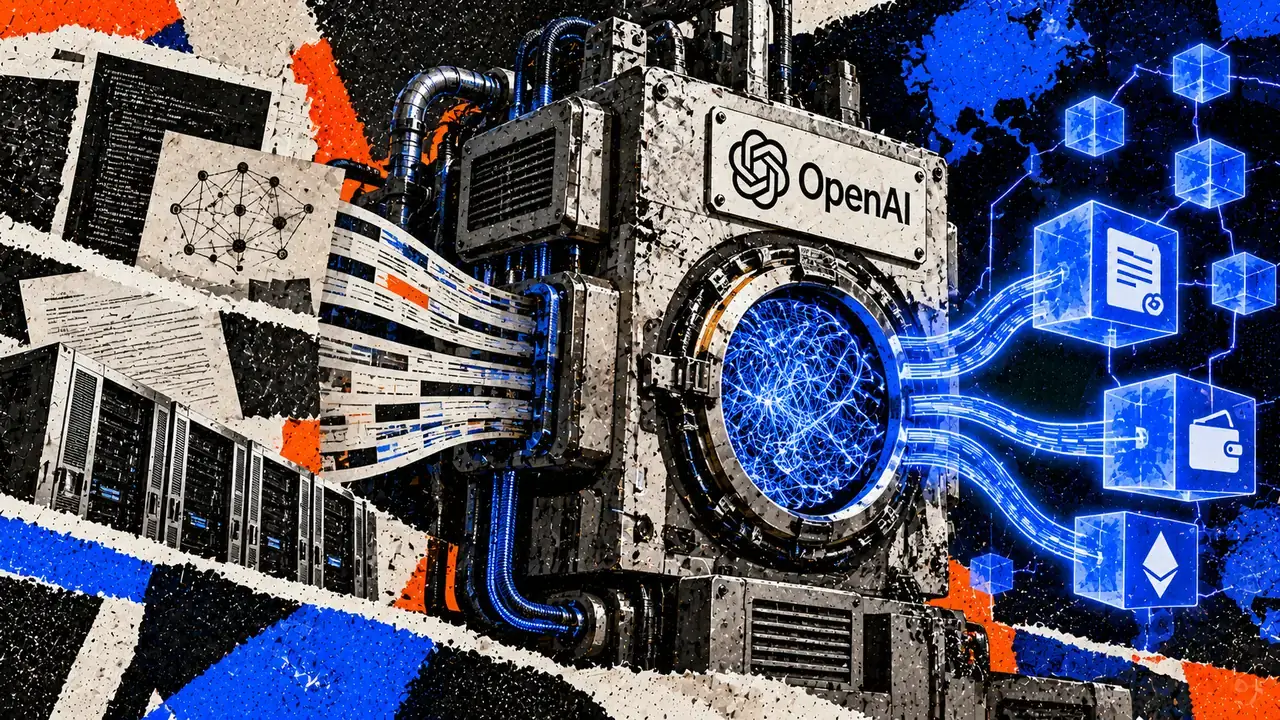
The dirty secret of the crypto world is that we are all operating on a timeline dictated by math that hasn't changed much in decades. We rely on the assumption that certain problems are just too hard for a computer to solve. But OpenAI is starting to make people wonder if that assumption is about to expire. Ethereum researcher Justin Drake recently sounded a loud alarm, suggesting the industry might need to enter what he calls bunker mode to survive the next leap in AI capabilities.
The End of the Math Shield
For a long time, the defense against hacking a Bitcoin or Ethereum wallet was simply the heat death of the universe. The math behind elliptic curve cryptography (ECC) is so complex that even the fastest supercomputers would take trillions of years to guess a private key. We’ve built a multi-trillion dollar industry on the back of this physical impossibility. But AI isn't a traditional computer program. It doesn't just crunch numbers; it finds patterns where humans see noise.
OpenAI’s recent breakthroughs in mathematical reasoning—specifically their new models designed to solve high-level logical problems—have changed the conversation. Drake’s concern isn't that a chatbot will suddenly guess your seed phrase. The fear is that AI will find a shortcut through the math itself. If an AI can solve the underlying equations that power our encryption, the trillions of years of safety we thought we had could evaporate in months.
What Bunker Mode Actually Looks Like
When someone like Justin Drake talks about bunker mode, they aren't talking about panic selling. They are talking about a massive, coordinated migration of assets. If our current cryptographic standards are found to be weak against AI-driven attacks, every single user on every major blockchain would need to move their funds to new addresses using entirely different encryption methods.
This isn't as simple as clicking a button. It would require a fundamental rewrite of the protocol layers. We are talking about post-quantum or AI-resistant cryptography. The transition would be messy, expensive, and likely leave a lot of people behind. If you lose your keys in a normal year, you lose your money. If you fail to migrate during a bunker mode event, your money becomes a target for the first person with a high-end GPU and the right model.
The Founder Perspective: Don't Panic, But Prepare
As a founder, I’ve seen plenty of doomsday scenarios come and go. Most of them are hype designed to sell new tokens or security software. However, this feels different because it’s based on the rapid acceleration of a technology that is already disrupting every other industry. If AI can write code, diagnose diseases, and simulate physics, why would we assume our 20-year-old math puzzles are safe forever?
The real risk for builders isn't just the security of the funds; it's the loss of trust. If the bedrock of the industry is proven to be shakable, the institutional money we’ve worked so hard to attract will flee back to traditional systems. Builders need to start looking at their tech stacks now. Are you building on a chain that has a clear path to cryptographic upgrades? If you are building a wallet or a bridge, how modular is your security?
The Hidden Vulnerability: Public Keys
One specific detail Drake highlighted involves how public keys are handled. In a standard Bitcoin transaction, your public key isn't fully exposed until you spend from an address. This provides a thin layer of protection. But many modern accounts and smart contracts have their public keys exposed from day one. In an AI-dominant world, an exposed public key is a roadmap. If the AI can work backward from that key to find the private one, the game is over.
This means we might see a return to older, more conservative privacy practices. The convenience of modern UX might have to take a backseat to the raw necessity of staying hidden from the machines. It’s a trade-off that many users won't like, but it’s better than the alternative of having an empty wallet.
Is OpenAI Really That Close?
It’s important to stay grounded. OpenAI hasn't cracked ECC yet. They are working on general reasoning models. But the delta between where AI was two years ago and where it is today is massive. We are seeing a compression of timelines. What we thought was a 20-year problem (quantum computing) might be solved by a 2-year problem (AI-enhanced mathematical discovery).
We shouldn't assume the developers at OpenAI are trying to break Bitcoin. They are trying to build the most capable intelligence in history. Breaking encryption is just a side effect of being able to solve any hard problem. If you build a tool that can solve the hardest math problems in the world, you’ve unintentionally built a master key for the current internet.
Strategic Takeaway for the Industry
The takeaway here isn't to run for the hills. It’s to realize that the technical debt we’ve been ignoring is starting to accrue interest. We have relied on static math in a world of exponential technology. That is a bad bet. The industry needs to prioritize crypto-agility—the ability to switch out our underlying security algorithms without breaking the entire network.
For the average builder, this means two things. First, stop assuming your current security stack is a permanent solution. Second, pay attention to the research coming out of the Ethereum Foundation and other core groups regarding post-quantum transitions. The people who are watching the AI space most closely are the ones telling us to get ready. It would be wise to listen before the bunker doors need to close for real.
Read the original at CryptoSlate →