Security in the crypto world is often a trade-off between being a paranoid recluse and being a sitting duck. For years, if you wanted to manage a bitcoin treasury while traveling or dealing with an emergency, you were stuck in a cycle of complex workarounds. You probably remember the old way: boot up a laptop with Tails OS, mess around with PGP keys, and pray that you didn't leave a digital paper trail for someone to exploit later. It was clunky, prone to human error, and frankly, too slow for anything urgent.
The Shift to Hardware-Level Portability
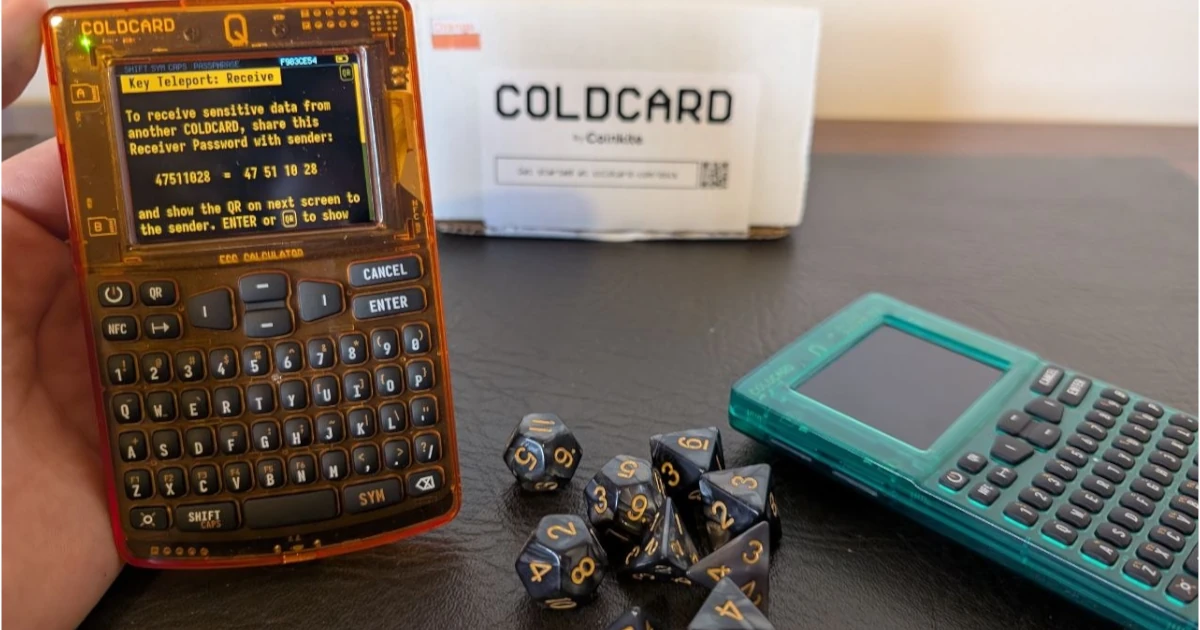
We are now a full year into the lifecycle of the Coldcard Q, and its Key Teleport feature has shifted the conversation from software-based security to hardware-native recovery. For founders building on top of bitcoin or companies holding their own reserves, this is more than just a convenience feature. It is a fundamental shift in how we think about the physical risks of holding private keys.
Key Teleport isn't about moving your seed phrase through the air. Instead, it allows a user to securely transport their master secret to a new device without exposing it to an internet-connected computer. In the past, if you lost your hardware wallet while traveling, your options were limited and risky. You either had to carry a backup which doubled your physical theft risk or trust a software environment that could be compromised.
Why Tails and PGP Failed the Test
For a long time, the gold standard for remote key management was a combination of Tails OS and PGP encryption. As a builder, I have always looked at this setup with a bit of skepticism. While it is theoretically secure, it relies on the user not making a single mistake across a dozen different steps. If you're stressed, in a rush, or dealing with an emergency, that complexity becomes a liability.
The Coldcard Q approach simplifies this by keeping the sensitive operations inside the secure element of the device. By using a specialized encrypted format, the device can effectively "teleport" the necessary data to another Coldcard. This removes the need for a general-purpose operating system to ever touch the raw data. When we talk about reducing the attack surface, this is exactly what we mean. You are removing the weakest link: the general-purpose computer.
The AI Threat and Modern Encryption
One of the more interesting developments over the past year is how this specific implementation has stood up to modern decryption techniques. We are entering an era where AI-driven attacks can identify patterns in encrypted data that humans would never notice. Traditional PGP setups, while robust, are often configured poorly by users, leaving small breadcrumbs that a sophisticated AI model could potentially exploit over time.
The Key Teleport implementation was designed with this threat in mind. It doesn't just encrypt the data; it does so in a way that resists modern pattern analysis. In testing environments, even advanced AI tools have failed to crack the payloads generated by this system. For a founder, this is the kind of peace of mind that matters. You don't want to find out three years from now that the "secure" method you used today has been trivialized by a new LLM.
Practical Implications for Bitcoin Treasuries
If you are managing a treasury, your biggest concern isn't just a hacker in Russia; it's physical logistics. How do you move value across borders? How do you authorize a transaction if your primary site is compromised?
The goal of any treasury system should be to make the physical device interchangeable while keeping the secret static and inaccessible.
With this hardware-level teleportation, a company can keep its master secrets in a deep-cold storage vault but maintain the ability to "activate" a fresh device in a different geographic location. It effectively separates the utility of the wallet from the physicality of the chip. This is a massive win for decentralized teams who need to maintain high-security standards without being tethered to a single desk or safe.
What This Means for Builders
If you're building in the Bitcoin space, you need to watch how hardware is evolving to solve social problems. Key management is essentially a social problem disguised as a technical one. We need to move away from asking users to be amateur cryptographers. The reason Coldcard's Q is gaining traction isn't just because it's "more secure," but because it streamlines a high-stress process into something repeatable.
- Reduced Overhead: You no longer need to maintain complex "go-bags" with specialized laptops.
- Error Minimization: By keeping the logic in the hardware, you prevent the user from accidentally pasting a seed into the wrong window.
- Future-Proofing: Resistance to AI-based decryption is becoming a non-negotiable requirement for long-term storage.
The Reality Check
Is it perfect? No. You are still reliant on a specific vendor's ecosystem, which is always a point of friction for the truly paranoid. However, in the realm of practical security, the trade-off is clearly in favor of the hardware-native approach. The days of booting up Linux from a USB stick in a hotel room should be behind us. As founders, we should be advocating for tools that let us focus on building, rather than worrying if our PGP headers are leaking metadata.
The last year has shown that this wasn't just a gimmick. It is a mature piece of the Bitcoin security stack. For anyone responsible for significant capital, the focus should be shifting away from software workarounds and toward dedicated hardware that understands the realities of a mobile, high-risk world.
The Takeaway
Stop relying on complex software stacks for emergency key management. The future of Bitcoin treasury security is in hardware that can safely move secrets without ever touching a keyboard. If your security plan involves more than three steps during an emergency, it's not a plan—it's a prayer. Move toward hardware-native solutions that reduce human interaction with the raw data.
Read the original at Bitcoin Magazine →