The Great Liquidity Migration
In the crypto world, we talk a lot about decentralization, but the reality for most builders and traders still centers on the big ramps. Recently, the numbers painted a picture of a major shift in where the industry keeps its cash. While the headlines usually focus on the giants, the real story is in the movement of the capital itself. We are seeing a massive rotation of funds that suggests the market is tired of the old guard's drama.
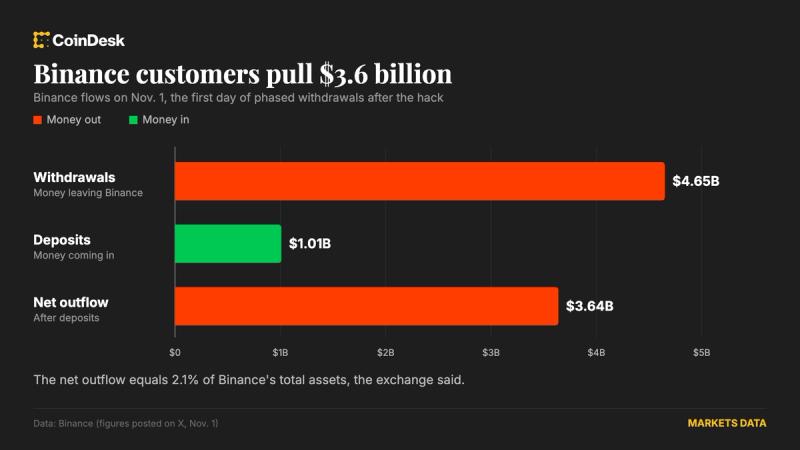
Reports indicate that Binance just processed a staggering $7 billion in net outflows. In the same breath, OKX emerged as the primary beneficiary, capturing about $445 million in daily net inflows. For those of us building in this space, this isn't just a scoreboard update. It is a signal that the user base is becoming more mobile and less loyal to a single brand name when the stakes get high.
The Cost of Dominance
Binance has been the undisputed king of the hill for years. But being the biggest also means having the biggest target on your back. Between regulatory scrutiny and leadership changes, the platform is facing a crisis of confidence that isn't easily solved with a new marketing campaign. When $7 billion leaves an ecosystem, it is rarely a single event. It is a slow leak caused by thousands of individual decisions to seek out a quieter, less volatile home for their assets.
As a founder, I look at these outflows and see a lesson in platform risk. Many builders have built their entire liquidity strategies around one exchange. When that exchange starts bleeding capital at this scale, the ripple effects hit every token pair and every market maker. The migration to OKX suggests that users are looking for a balance between liquidity and a lower profile. OKX has managed to stay relevant without being quite as loud as its competitors, and right now, quiet is what the market wants.
Why OKX is Winning the Inflow Race
A $445 million daily inflow doesn't happen by accident. It happens because the infrastructure is ready to receive it. Over the last two years, OKX has invested heavily in its wallet integration and its on-chain tools. They stopped trying to be just a trading post and started trying to be a bridge to the broader decentralized world. For the average user, the switch isn't just about escaping Binance; it is about finding a toolset that feels modern.
I have spent a lot of time looking at how these exchanges treat developers. The platforms that provide the smoothest APIs and the best documentation usually win in the long run. If the capital is moving to OKX, the developers will follow. We are seeing a shift where the "builders first" mentality is actually starting to pay off for the exchanges that bothered to prioritize it. It is no longer enough to just have the most coins listed; you have to have the most reliable rails.
The Institutional Quiet Period
We shouldn't mistake these outflows for a total exit from the crypto market. The money isn't necessarily turning back into fiat; it is just changing hands. This suggests that the underlying appetite for digital assets remains high, even if the appetite for specific centralized entities is wavering. Institutional players, in particular, are extremely sensitive to regulatory friction. If they see a platform under fire, they don't wait to see if things get better. They move.
The movement of $7 billion isn't just a number on a chart; it is a vote of no confidence in the status quo of exchange dominance.
For builders, this is a reminder to stay exchange-agnostic. If your project relies on the health of a single centralized entity, you are essentially betting your company's life on their legal department. The diversification we see in these inflow numbers should be reflected in how we build our own treasuries and distribution networks.
What This Means for the Next Cycle
We are entering a phase where the "too big to fail" myth in crypto is being tested daily. The fact that OKX can lead the pack while a giant like Binance retreats shows that there is still room for competition in a supposedly saturated market. The builders who succeed in the coming years will be those who recognize that the gatekeepers are changing.
The shift toward platforms that emphasize security and technical robustness over pure volume is a healthy one for the industry. It forces every player to sharpen their tools. If you are building a dApp or a new protocol, look at where the smart money is flowing. It isn't just moving to a different UI; it is moving to a different philosophy of how an exchange should function in a post-regulation world.
Takeaway for Builders
The lesson here is simple: liquidity is fickle, and reputation is everything. The $7 billion exit from Binance is a massive warning sign that no lead is safe. Meanwhile, the $445 million win for OKX proves that there is a huge opportunity for platforms that can offer stability during a storm.
- Don't put all your eggs in one exchange basket.
- Focus on platforms that prioritize developer experience and transparent reserves.
- Watch the capital flows to identify where the next generation of users is migrating.
The landscape is shifting beneath us. The exchanges that survive will be the ones that realize they are service providers, not untouchable empires. For the rest of us, it is time to diversify and stay skeptical of any platform that thinks it is bigger than the market itself.
Read the original at Cointelegraph →