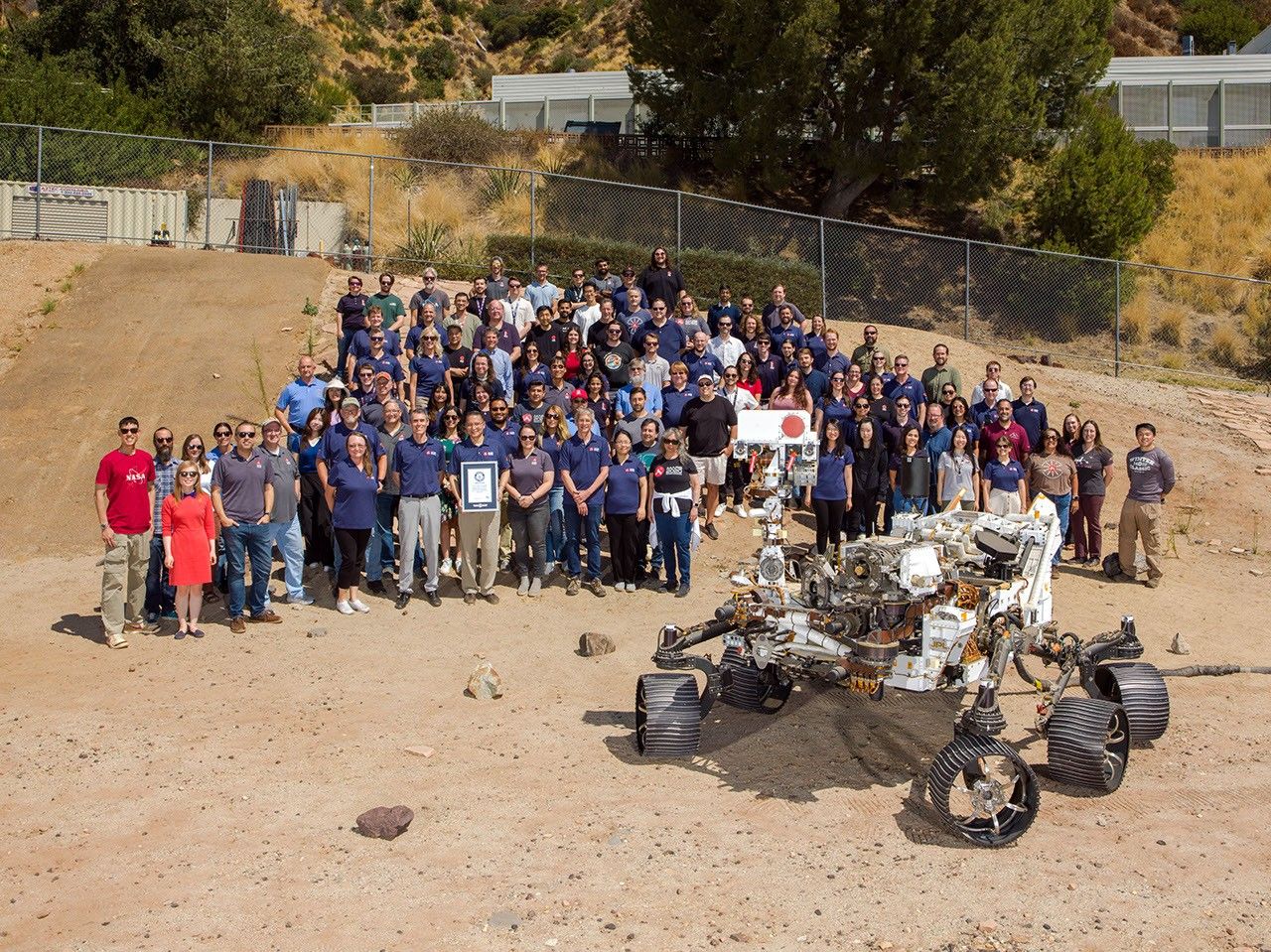
NASA’s Perseverance rover team recently stood in a dirt lot in Southern California to hold up a certificate from Guinness World Records. They officially clocked the longest distance traveled on Mars in a single day, roughly 1,140 feet. It is a nice milestone for the trophy case, but for those of us building in crypto and AI, the photo contains something far more valuable than a piece of paper.
Standing in the frame next to the team is a machine called OPTIMISM. It stands for Operational Perseverance Twin for Integration of Mechanisms and Instruments Sent to Mars. It is a full-scale, functional replica of the rover currently sitting 140 million miles away. While the world focuses on the distance record, builders should be looking at the twin. NASA doesn't just build; they simulate. They don't just ship; they stress-test in a sandbox first.
The High Cost of Being Wrong
In the world of hardware and deep space exploration, a software bug isn't just a nuisance; it is a billion-dollar brick. You cannot send a technician to Mars to tighten a bolt or reboot a server. This is a level of stakes that most founders in the Web3 space claim to understand, yet rarely respect in practice.
We have become addicted to the "move fast and break things" culture. In AI, that looks like shipping models with massive hallucination issues because we want to be first to market. In crypto, it looks like deploying smart contracts to mainnet with audits that were rushed or skipped entirely. We treat the live environment as our testing ground, and when things break, we call it a learning experience. NASA calls it a mission failure.
The existence of OPTIMISM tells us that the team at the Jet Propulsion Laboratory (JPL) views simulation as a non-negotiable part of the stack. They have a physical "Mars Yard"—a literal sandbox—where they can replicate the exact terrain the rover is facing. If the rover on Mars hits a snag, the engineers don't guess. They go to the twin, recreate the problem, and find the solution before sending a single line of code across the solar system.
Building Your Own Mars Yard
For builders, the takeaway here is the necessity of a robust staging environment. In AI development, this means rigorous evaluation frameworks. You need a way to measure your model's performance against edge cases before it ever touches a customer. If you are building an LLM-powered agent, your "Mars Yard" is a suite of deterministic tests that challenge the agent's logic in a controlled setting.
In crypto, the Mars Yard is the testnet, but we often treat it as a ghost town. Founders rush through testnet phases because there is no liquidity there and no hype. But the Perseverance team didn't get a world record by chasing hype. They got it by ensuring that when they told the rover to move, it was going to move exactly as intended. They minimized the delta between the lab and reality.
If you are building a protocol, your testnet should be an adversarial environment. You should be trying to break your own code with the same intensity that a hacker would. If you aren't doing that, you aren't building a mission-critical product; you are just gambling with other people's capital.
Autonomy vs. Control
The record-breaking distance was made possible by AutoNav, the rover's self-driving system. This is where the AI parallels become obvious. NASA realized that if a human had to joystick every single movement from Earth, the rover would barely move. The latency is too high. The rover had to be smart enough to navigate hazards on its own.
However, that autonomy was built on top of a foundation of extreme predictability. They didn't just give the rover an AI and hope for the best. They mapped the boundaries. As we integrate AI into our business workflows, we need to apply the same philosophy. Give the system autonomy to solve problems, but build the guardrails in a simulated environment first. You don't want your AI agent to set a record for the wrong reasons because it decided to take a shortcut through a digital crater.
Why the Twin Matters More Than the Record
Records are fleeting. Someone will eventually beat the 1,140-foot mark. What won't change is the engineering discipline required to operate at that level. The twin, OPTIMISM, is a symbol of that discipline. It represents a commitment to truth over assumptions.
In the startup world, we often fall in love with our own assumptions. We assume users will behave a certain way. We assume the market will stay liquid. We assume the tech will hold up under load. NASA assumes nothing. They verify everything on the twin before they execute on the primary.
If you want to build something that lasts—something that can survive the harsh environment of a bear market or a shifting regulatory landscape—you need a twin. You need a version of your project where you can fail safely. You need a process that values the boring work of simulation as much as the exciting work of shipping.
The Founder’s Takeaway
The Guinness World Record is the headline, but the engineering rigor is the story. As a founder, your job isn't just to set records; it is to build systems that are capable of setting them. That requires a shift in mindset from "shipping fast" to "shipping right."
- Build a functional twin of your environment, whether that is a robust testnet or a comprehensive AI evaluation suite.
- Don't treat simulation as an afterthought. It is the core of your risk management strategy.
- Respect the stakes. If your product handles data or money, treat it like a billion-dollar rover on a distant planet.
NASA’s team is celebrating a distance record today because they spent years in a California dirt lot with a machine named OPTIMISM. They earned their confidence. You should aim to do the same.
Real innovation isn't just about how far you go; it is about how much you know before you take the first step.
We see a lot of "rovers" in the tech space that break down the moment they hit the first rock. Don't be that founder. Build the twin, run the simulations, and then go for the record.
Read the original at NASA Breaking News →