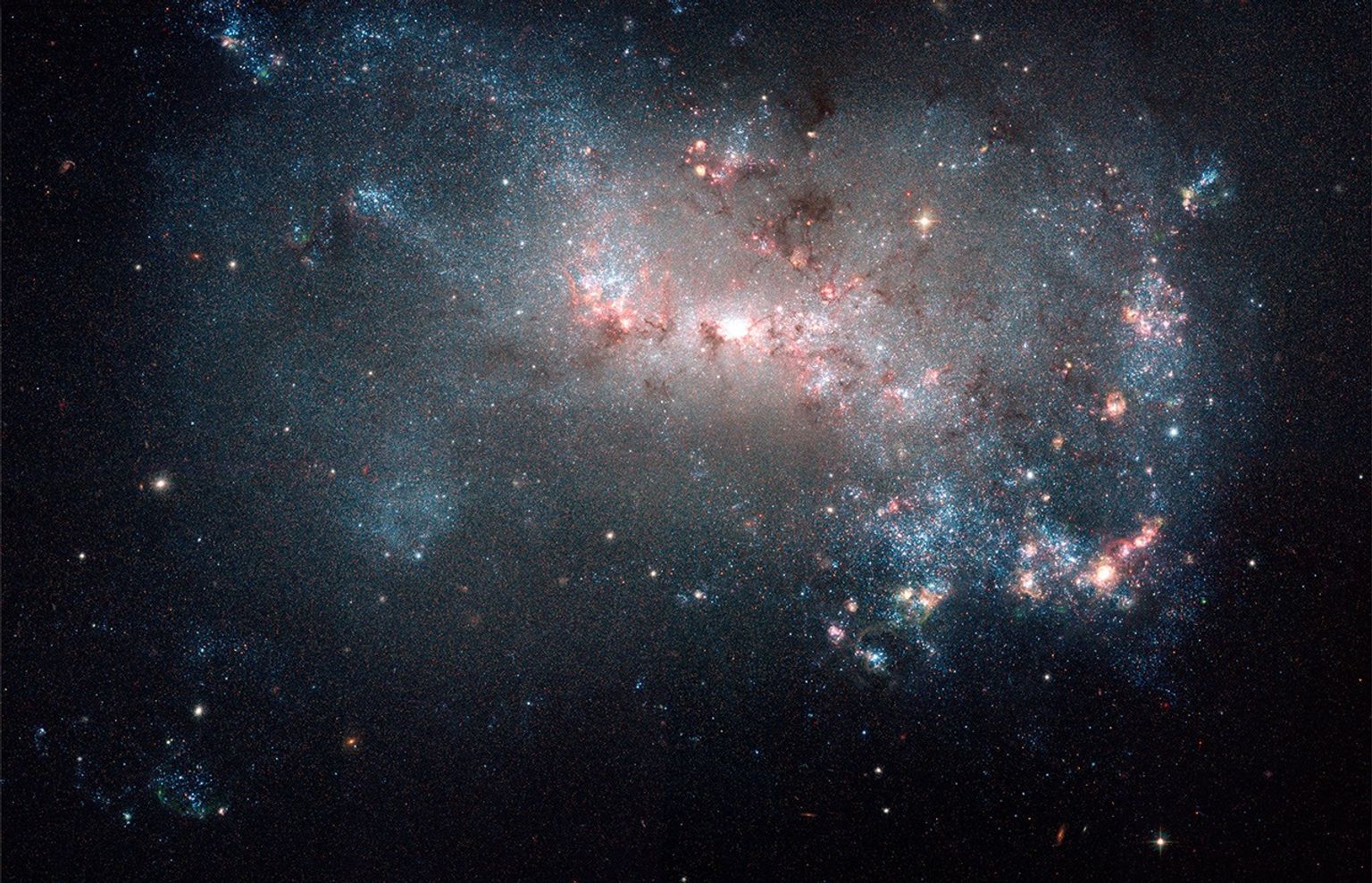
We talk a lot about optimization in the crypto and AI space. We spend months tweaking parameters and refining tokenomics to make sure everything adds up. But every so often, nature sends a reminder that even the most fundamental models can have massive, unexplained leaks. This week, that reminder came from NASA’s Hubble Space Telescope.
Astrophysicists have been looking at 37 nearby dwarf galaxies. Based on everything we know about how stars live and die, these galaxies should be packed with oxygen. Oxygen is the byproduct of massive stars reaching the end of their lifecycle; they explode and scatter these heavy elements across the neighborhood. But when the Hubble team looked at the data, the numbers didn't match the reality. A huge chunk of the expected oxygen was simply gone.
The Invisible Leak
In our world, this is the equivalent of running a decentralized exchange and realizing 30% of the liquidity disappeared without a transaction record. It is a systemic discrepancy that points to a flaw in the underlying model or an invisible mechanism at work. For these dwarf galaxies, the "missing" oxygen suggests that these systems aren't closed loops.
The current leading theory is that supernova explosions are more violent than we assumed. Instead of just scattering elements within the galaxy, they might be blowing the oxygen entirely out of the galaxy’s gravitational pull and into intergalactic space. Because dwarf galaxies have less mass and weaker gravity, they can't hold onto their lunch when things get explosive.
Why Builders Should Care
If you are building a protocol or a complex AI agent system, this story hits close to home. It is about the difference between theoretical yield and actual output. We often build models assuming a closed system—that every input remains accounted for within the ecosystem. We forget about the "galactic wind" of our own markets.
- Gravity is your infrastructure: In a dwarf galaxy, the lack of mass means the system is fragile. In tech, if your infrastructure or liquidity is shallow, a single high-impact event (a supernova) can strip your system of its most valuable assets.
- Output leakage: You might be producing value, but if your retention mechanisms aren't strong enough, that value is leaking into the "intergalactic space" of your competitors or external ecosystems.
- Model debt: The scientists were surprised because they relied on a model that worked for large galaxies. We do this in software too—applying enterprise-scale assumptions to lean startups and wondering why our "oxygen" is missing.
The Myth of the Closed Loop
In the early days of any project, we love the idea of a circular economy. We design systems where every token or data point stays within the fence. The Hubble findings suggest that circularity is a rare luxury. Most systems are porous. The smaller the system, the more likely it is to lose its core components to the void.
For a founder, the goal shouldn't just be producing "oxygen" (value, users, data). The goal is ensuring the environment is stable enough to keep it. If your community is a dwarf galaxy, you need to recognize that you can't survive the same volatile events that a giant spiral galaxy (like a legacy tech incumbent) can shrug off.
"It is not enough to create; you have to have the mass to retain."
Scaling Through the Void
This missing oxygen isn't just a mystery; it’s a warning about scaling. As these dwarf galaxies grow, they eventually gain enough mass to hold onto their elements. But in that awkward mid-sized phase, they are incredibly vulnerable. They are working hard to produce the building blocks of life, only to watch them get pushed away by the very energy that created them.
I see this in AI development right now. Teams are training models and generating massive amounts of synthetic data, but the "gravity" of their moats isn't strong enough to keep that value from being scraped or diluted. They are producing the oxygen, but they aren't the ones breathing it.
A Lesson in Debugging
The Hubble team didn't just throw out their tools when they saw the missing oxygen. They used the discrepancy to learn something new about how energy moves. This is the founder's mindset. When your metrics don't align with your projections, the gap isn't just an error—it is the most important piece of data you have.
The gap tells you where the wind is blowing. It tells you where your system is weak. If the oxygen is missing, stop looking at the stars and start looking at the gravity. Are you losing your best people because your "mass" is too low? Are you losing your users because your incentives are pushing them away instead of pulling them in?
The Takeaway
The universe is messier than our spreadsheets. Whether you are measuring heavy elements in a dwarf galaxy or the retention rate of a new dApp, expect leakage. If you find a massive gap between what should be there and what is actually there, don't ignore it. That gap is the map to your system’s greatest vulnerability. Build more mass, or get used to breathing thin air.
Read the original at NASA Breaking News →