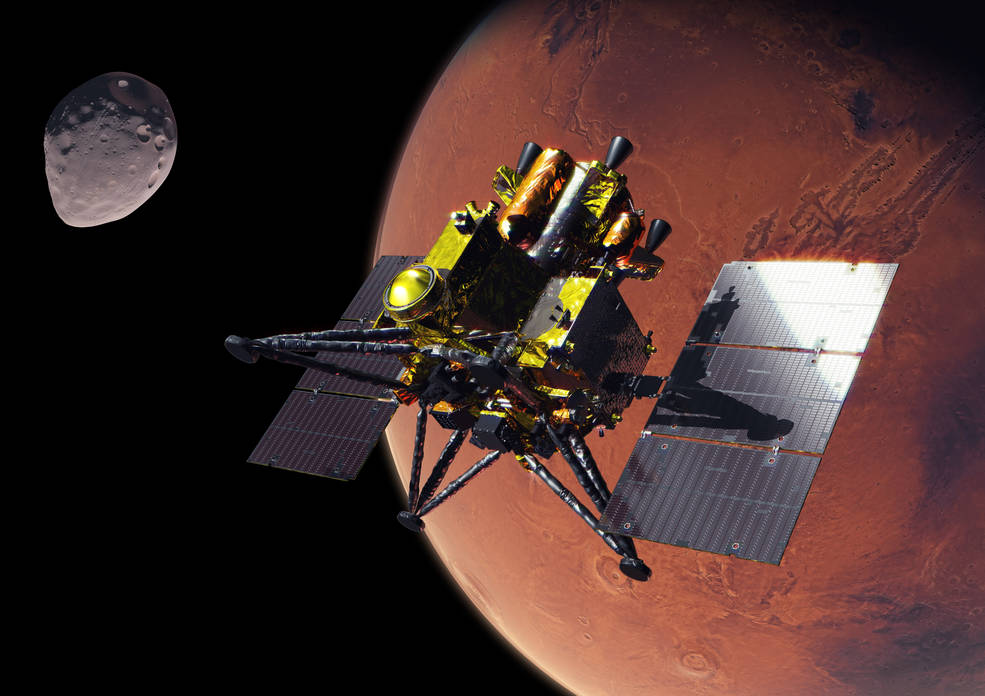
We are seeing a fundamental shift in how large-scale exploration is handled, and it looks a lot like the open-source movement in software. NASA recently announced a briefing regarding its supporting role in the Martian Moons eXploration (MMX) mission, led by the Japan Aerospace Exploration Agency (JAXA). The mission, slated for a mid-October launch from Tanegashima, isn't a NASA-first project. It is a collaborative build where NASA is providing specific, high-value components rather than owning the entire stack.
The Multi-Vendor Architecture of Space
For a long time, space agencies operated like closed-source enterprise software companies. They built everything in-house, maintained proprietary control, and rarely played well with others. The MMX mission represents the modern architecture: modular and collaborative. NASA is contributing a neutron and gamma-ray spectrometer, which is essentially a high-precision sensor for detecting the chemical composition of Phobos. They are also providing a pneumatically-driven sampling device.
Think of this as a founder building a new platform. You don't build your own payment processor or your own hosting servers from scratch anymore. You plug into Stripe or AWS. NASA is becoming a high-tier service provider for JAXA’s platform. This is the only way to scale deep-tech exploration without going bankrupt or getting bogged down in twenty-year development cycles. It allows agencies to specialize in what they do best and leverage the hardware strengths of their partners.
Why Phobos Matters to Builders
The target of this mission is Phobos, one of Mars’ two moons. The big question is whether Phobos is a captured asteroid or a piece of Mars that got knocked off during a prehistoric impact. For those of us focused on the long-term utility of crypto and AI in decentralized infrastructure, the source of these materials matters. If we are ever going to talk about space-based manufacturing or resource extraction, we need the data that these spectrometers provide.
Builders should look at this as a data-gathering exercise for the next frontier of physical infrastructure. We are moving past the era of just taking pictures. MMX aims to bring a sample back to Earth. This is a supply chain challenge on a planetary scale. If JAXA and NASA succeed, they prove that a multi-national, multi-agency hardware stack can execute a complex round-trip operation. This is the proof of concept for the decentralized logistics we often talk about in theoretical terms.
The Skeptic’s Take on Collaboration
It sounds great on paper, but collaboration at this level has massive friction. You have different engineering standards, different regulatory hurdles, and the sheer logistical nightmare of shipping sensitive hardware across the globe for a launch in Japan. However, the alternative is the old way: one agency spending ten billion dollars and fifteen years to do it alone. That model is dead. It’s too slow for the pace of modern technology.
I am naturally skeptical of government-led timelines. Launch windows are tight, and space is unforgiving. But the move toward NASA acting as a component contributor rather than a solo lead is a smart play. It spreads the risk and pools the expertise. If the spectrometer fails, the mission might still land. If the lander fails, the spectrometer team learns for the next iteration. It’s a resilient way to build.
Bridging the Gap Between AI and Hardware
Where does AI fit into this? Missions like MMX are generating massive amounts of spectrographic data that humans simply cannot parse in real-time. We are reaching a point where the bottleneck isn't the hardware; it's the interpretation of the sensor data. As NASA feeds this information back to Earth, the role of machine learning in identifying mineral patterns will be the deciding factor in whether the mission is a "success" or just a collection of noise.
For builders in the AI space, the takeaway is clear: the demand for edge processing and automated analysis in extreme environments is only going up. We are building the tools now that will eventually run on hardware orbiting other planets. This isn't science fiction; it’s the roadmap of the next decade of infrastructure development.
Founders’ Perspective on the Mission
If you are running a startup, look at the MMX mission as a case study in partnership. NASA isn't too proud to be a secondary contributor. They are providing the "API" (the spectrometer) for someone else's "app" (the JAXA mission). There is a lot of ego in the tech world that prevents founders from being a cog in a bigger, more successful machine. NASA is showing that being a vital component of a successful mission is better than being the lead of a failed one.
The mission is scheduled to depart soon, and the telemetry we get back will be a litmus test for international cooperation in an era that is becoming increasingly siloed. If the data flows correctly and the samples eventually return, it validates the modular approach to heavy engineering.
What to Watch Next
- The precision of the NASA spectrometer during the initial orbit of Phobos.
- How the pneumatic sampling device handles the low-gravity environment, which is a massive engineering hurdle.
- The speed at which the preliminary data is shared across international research networks.
This isn't just about a moon orbiting Mars; it's about whether we can actually build complex systems across borders and agencies without the whole thing collapsing under its own weight.
We need to move away from the hype of "space races" and toward the reality of "space stacks." The MMX mission is a significant brick in that wall. It’s not flashy, it’s not a billionaire’s vanity project, and it’s not a solo sprint. It is a calculated, collaborative piece of infrastructure work that will tell us what the neighborhood is actually made of.
Read the original at NASA Breaking News →