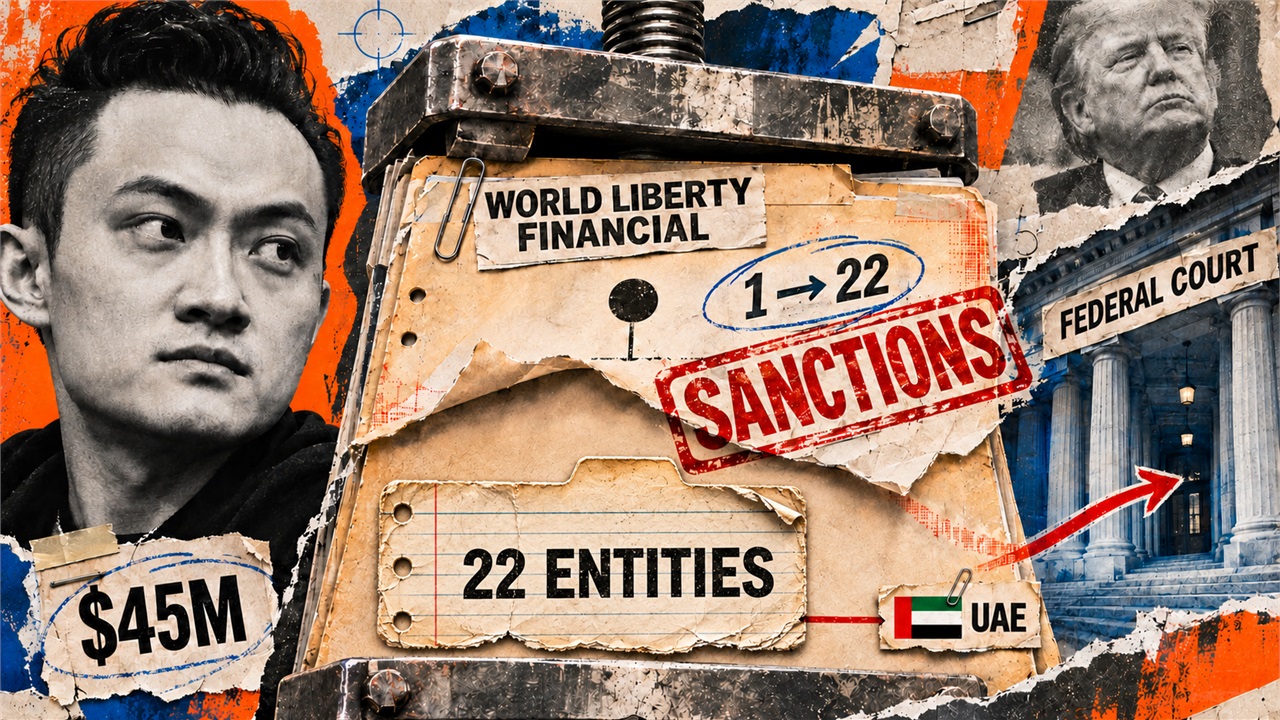
When you have been in crypto as long as I have, you develop a sixth sense for when a legal fight is less about the money and more about the mechanics of jurisdiction. The latest drama involving Justin Sun and World Liberty Financial—a project famously linked to Donald Trump’s family—is a perfect example of this. It isn't just a dispute over a $45 million loan; it is a masterclass in the shell games that define modern crypto corporate structures.
The Core Dispute
The history here is messy, but the mechanics are simple. Justin Sun, the founder of Tron, is chasing a debt he claims is owed to him. He originally filed a lawsuit in federal court to recover $45 million. However, that case was recently dismissed, not because the judge ruled Sun was wrong, but because of a technicality involving where the defendants actually "live" in a legal sense.
Sun is now swinging back. He is asking for sanctions, alleging that World Liberty Financial (WLF) intentionally misled the court about its ties to the United Arab Emirates. According to Sun's legal team, WLF hid the citizenship status of its members to strip the federal court of jurisdiction, essentially forcing the case into a stalemate or a venue change. Now, Sun plans to take the fight to California state court, where those specific jurisdictional hurdles might not apply.
Jurisdictional Arbitrage as a Defense
For builders, this is the part you need to pay attention to. In the U.S. legal system, federal courts often require "diversity of citizenship" to hear a case. If a plaintiff and a defendant share a citizenship or a legal residency, the federal court might lose its authority to hear the case, pushing it down to the state level. Sun claims WLF manipulated this by obscuring the fact that key figures or entities were tied to the UAE.
This isn't just lawyer talk. It is a common tactic for high-stakes projects to keep their corporate structure opaque. By having entities in the British Virgin Islands, Delaware, and the UAE, a project can create a labyrinth that makes it incredibly expensive and time-consuming for a creditor to actually get a day in court. Sun’s allegation is that WLF used this opacity as a weapon to dodge federal oversight.
The Trump Factor
We cannot ignore the elephant in the room. World Liberty Financial is the project that brought the Trump family into the decentralized finance space. For many of us in the builder community, this project was already a lightning rod for skepticism. It launched with massive hype and a promise to revolutionize finance, but the underlying tech and governance structures felt like a throwback to the 2017 ICO era.
When a project with this much political baggage gets hit with a $45 million lawsuit, it creates a ripple effect. It reinforces the narrative that crypto is still a "wild west" where even the biggest players are constantly suing each other over broken promises. If WLF is indeed hiding international ties to avoid U.S. federal courts, it suggests that the project was designed with litigation defense as a primary architectural feature, rather than an afterthought.
What This Means for the Industry
This situation highlights a growing trend of "lawfare" in the crypto space. We are moving past the era where disputes were settled by code or by community consensus. Now, the biggest battles are happening in chambers, centered on where an LLC was filed and who holds a passport from Dubai.
- Transparency is a double-edged sword: While builders want to protect their privacy, these lawsuits show that lack of clarity regarding ownership can be used as a stalling tactic in court.
- State vs. Federal: Moving the case to California state court changes the stakes. California courts are often more aggressive regarding consumer protections and contract disputes, which could be bad news for WLF.
- The Cost of Reputation: Sun is a polarizing figure, but in this instance, he is acting as a high-stakes creditor. If a project linked to a sitting or former president can’t settle a debt without a multi-year jurisdictional brawl, it doesn't bode well for institutional trust in the sector.
The Founder’s Perspective
As a founder, I look at this and see a massive waste of energy. $45 million is a lot of money, but the legal fees and the reputational damage being done to both parties probably exceed the value of the original dispute. Sun is known for his persistence, and if he believes he was misled about WLF’s corporate structure, he will likely spend double the debt just to prove a point.
The takeaway here is that your corporate structure is your first line of defense, but it can also be your biggest liability. If you build a project that relies on jurisdictional fog to operate, eventually someone with deeper pockets than you—like Justin Sun—will come along and try to blow that fog away. WLF may have escaped federal court for now, but the move to California state court suggests this fight is only getting started.
"If you're building in this space, assume your corporate structure will be audited by your enemies before it's ever audited by your friends."
We are watching a shift from "code is law" to "jurisdiction is everything." Whether you like Justin Sun or not, his pursuit of WLF is exposing the seams of how these high-profile crypto projects are stitched together. It isn't pretty, and it definitely isn't decentralized.
Read the original at The Block →