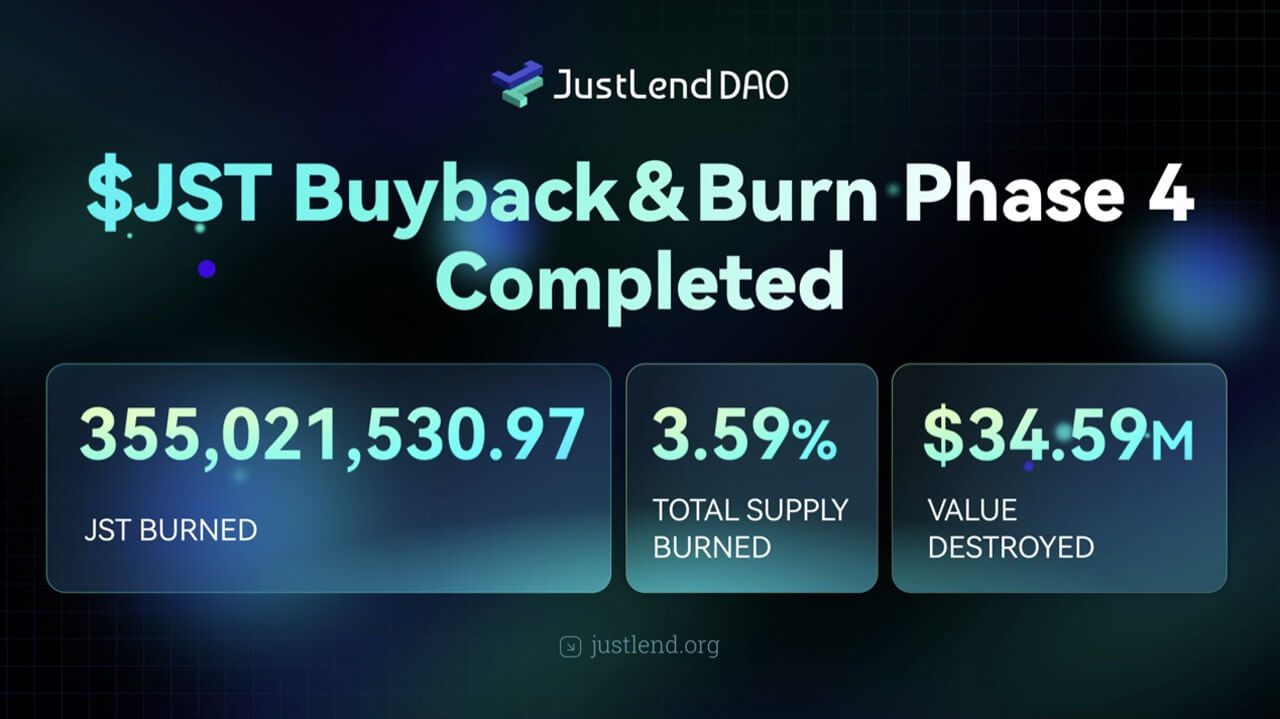
When we talk about decentralized finance, the conversation usually drifts toward the newest shiny object on Ethereum or a high-speed Solana fork. We often overlook the plumbing being built on TRON. Whether you like the ecosystem's leadership or not, the numbers coming out of their lending protocols are starting to demand a different kind of attention. Recently, JustLend DAO wrapped up its fourth round of JST buybacks, and the scale of the burn was significant enough to make any founder rethink how they handle protocol revenue.
The headline figure is 355 million JST tokens permanently removed from circulation. At current market rates, that represents about $34.59 million in value effectively set on fire for the benefit of remaining holders. This isn't just a marketing stunt; it is a mechanical reflection of how much volume is actually moving through the JUST ecosystem. For those of us building in the space, this milestone offers a masterclass in how to transition a project from the growth-at-all-costs phase into a sustainable, deflationary cycle.
The Mechanics of the Burn
In the early days of DeFi, "burns" were often just developers sending unsold treasury tokens to a dead address. It didn't mean much because those tokens were never truly in the market to begin with. What JustLend is doing here is fundamentally different. They are taking actual revenue generated from protocol fees—the interest paid by borrowers and the costs of using their lending infrastructure—and using that capital to buy JST off the open market before destroying it.
This is the fourth time they have done this, and it is by far the largest single-round burn they have recorded. When a protocol starts burning eight figures worth of its own native token in one go, it tells you that the underlying product isn't just a whitepaper or a promise. It is a utility that people are paying to use. In a market where most governance tokens are essentially "farm and dump" assets, seeing a buyback mechanism that actually has teeth is refreshing.
Why Deflation Matters to Builders
If you are a founder, your biggest headache is often tokenomics. You balance the need to incentivize early users with the need to prevent a total price collapse once those incentives vest. The JustLend model suggests that the solution isn't just better vesting schedules; it is aggressive revenue recycling. By removing over 355 million tokens from the total supply, the DAO is effectively increasing the scarcity of every remaining token without needing to rely on speculative hype.
- Revenue Proof: A burn of this size provides tangible proof of protocol usage. You cannot burn $34 million if you haven't earned it.
- Holder Alignment: It rewards long-term holders by reducing the overall diluted valuation, making the "pie" smaller so each slice is worth more.
- Sustainability: It shifts the narrative from "when will the team sell?" to "how much will the protocol buy?"
For those of us observing from the builder's perspective, this is a clear signal that the TRON DeFi ecosystem is maturing. It’s no longer just about stablecoin transfers; it’s about a circular economy where the platform’s success is directly mathematically linked to the token’s supply side.
The TRON Ecosystem Context
It is easy to be skeptical of TRON’s long-term viability if you only hang out in Western developer circles. However, the data persists. JustLend has become a cornerstone of liquidity in the region, providing a bridge for users who need access to capital without the high gas fees that plague Ethereum during periods of volatility. The JST token serves as the governance and incentive layer for this entire suite of tools, which includes everything from stablecoin minting to decentralized lending.
This record-breaking burn didn't happen in a vacuum. It happened because the demand for on-chain credit remains high. When the market is volatile, people leverage their assets. When the market is quiet, people earn yield. Both activities generate fees for JustLend, and those fees are now being funneled into a mechanism that makes the JST token more scarce by the day. This is the goal for any DAO: to reach a point where the protocol is a self-sustaining engine that buys back its own equity.
The real test for any DeFi protocol isn't how much it can raise in a seed round, but how much value it can systematically return to its ecosystem through its own operations.
The Skeptic’s Corner
While the $34.59 million burn is impressive, we have to stay grounded. Deflationary pressure is great, but it isn't a silver bullet. If the underlying utility of the JUST ecosystem stalls, no amount of token burning will save the price in a sustained bear market. A smaller supply of a token nobody wants is still a token nobody wants. The challenge for the JustLend team now is to ensure that the demand side of the equation—the actual borrowers and liquidity providers—continues to grow at a pace that justifies this level of buyback.
Furthermore, as builders, we should be asking about the concentration of governance. When a protocol burns this many tokens, it can sometimes consolidate power among the remaining largest holders. It’s a trade-off between price appreciation and decentralization that many founders are still trying to navigate. JustLend seems to be leaning heavily into the former to maintain investor confidence.
The Long-Term Takeaway
This latest milestone for JST is more than just another crypto news headline. It is an indicator of where the industry is heading. We are moving away from the era of "infinite supply" and toward an era of "protocol profitability." The protocols that survive the next few years will be the ones that can prove they have a business model that produces enough excess capital to actually reduce their own token supply.
For developers, the takeaway is simple: design your systems with a clear path to revenue from day one. If you can't imagine a scenario where your protocol is earning enough to buy back its own tokens, you might be building a house of cards. JustLend’s 355 million token burn is a loud, expensive reminder that in the world of DeFi, math eventually beats marketing every single time.
Read the original at CryptoSlate →