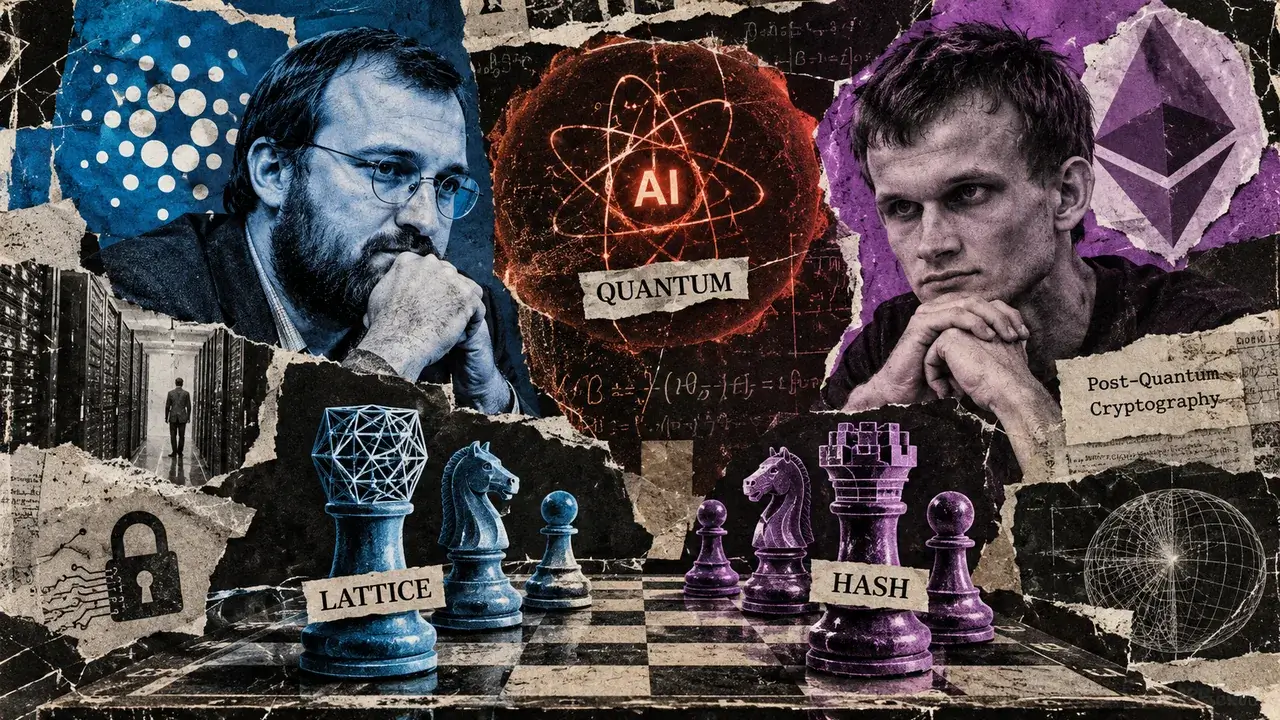
When the two biggest personalities in the blockchain space start arguing about the end of the world, builders should pay attention. Not because the apocalypse is coming, but because the outcome of this debate dictates which libraries you’ll be using and which encryption standards will govern your stack for the next decade.
The Quantum Shadow and AI Acceleration
For years, the looming threat of quantum computing has been the “someday” problem. We know that eventually, a powerful enough quantum computer will be able to tear through current ECDSA and RSA encryption like a hot knife through butter. To counter this, the cryptographic community has spent decades hardening something called lattice-based cryptography.
Lattice-based systems are essentially the gold standard for quantum resistance. They are complex, math-heavy, and built to withstand the brute-force capabilities of a post-classical computing world. But recently, Vitalik Buterin threw a wrench into the gears. He suggested that AI might find a way to solve the underlying mathematical problems of these lattices faster than we anticipated. Essentially, he’s worried that AI will “crack” the quantum shield before we even finish building it.
Charles Hoskinson, the founder of Cardano, isn't having it. He recently went on the offensive, claiming that Vitalik’s warnings aren't just speculative—they are dangerous to the progress of the entire internet’s security infrastructure.
The Argument for Stability
Hoskinson’s stance is rooted in pragmatism. As someone who has built a top-tier chain with a heavy focus on formal methods and peer-reviewed research, he views the current lattice-based standards as the result of decades of intense scrutiny. To him, Vitalik’s AI-doomsday warning feels like a distraction that could lead developers to abandon solid ground for unproven alternatives.
If you are a founder or an engineer, you know the cost of shifting gears mid-stream. If we start questioning the fundamental math behind our security protocols every time a new AI model drops, we never actually ship anything secure. Hoskinson argues that the cryptographic community has already accounted for the weaknesses Vitalik is pointing to. By sowing doubt now, we risk delaying the implementation of quantum-resistant defenses while we wait for a “perfect” solution that might not exist.
Why Vitalik is Hesitant
To be fair to the Ethereum camp, Vitalik’s concern isn’t entirely baseless. AI is proving to be exceptionally good at pattern recognition in mathematical structures. If a specific type of lattice has a hidden symmetry or a weakness that humans missed, a specialized AI model might exploit it. Vitalik is advocating for a “diversity of defense” approach—not putting all our eggs in the lattice basket.
The Founder's Dilemma
From where I sit, this is a classic case of different founder philosophies. Vitalik is the visionary who is always looking at the 50-year horizon, worried about the “unknown unknowns.” Hoskinson is the structuralist who wants to lock in the best available science today so we can actually build a functional system.
As builders, we have to navigate between these two poles. If you’re building a dApp or a protocol today, you can’t afford to wait for a consensus on AI's ability to solve lattices. You have to use what works. However, you also have to design your systems to be cryptographically agile. If the math changes, your code shouldn't be so rigid that you can't swap out the underlying signature schemes.
What This Means for the Roadmap
The real danger Hoskinson is highlighting is a slowdown in standardization. We are already behind the curve on quantum defense. The migration from classical cryptography to post-quantum standards will take years, if not a decade. If the major voices in the space start bickering over the validity of the math, that timeline gets pushed back further.
We saw this with the move to Proof of Stake. We saw it with the adoption of ZK-proofs. When the industry leaders can't agree on the path forward, the builders in the middle get stuck in analysis paralysis. Hoskinson’s critique is essentially a call for the industry to stick to the plan and trust the decades of research that got us here.
- Focus on what is peer-reviewed: Don't abandon standard libraries because of a tweet or a theoretical AI breakthrough.
- Build for agility: Ensure your smart contracts and protocols aren't hard-coded to a single cryptographic primitive.
- Ignore the noise: The AI hype cycle is leaking into every corner of tech; keep your security decisions grounded in hard math, not speculation.
The Bottom Line
Vitalik thinks AI is a wildcard that changes the rules of the game. Hoskinson thinks the rules are the rules for a reason and changing them now is a recipe for disaster. For the rest of us, the takeaway is simple: trust the math that has been tested, but keep your architecture flexible enough to move when the evidence shifts.
We don’t need more doomsday warnings; we need more implementation. If we spend the next five years debating the hypothetical capabilities of AI, we’ll be sitting ducks when the first real quantum computer comes online. Hoskinson is right to be skeptical of the skepticism. It's time to stop theorizing about the end of the world and start building the walls that will prevent it.
Read the original at CryptoSlate →