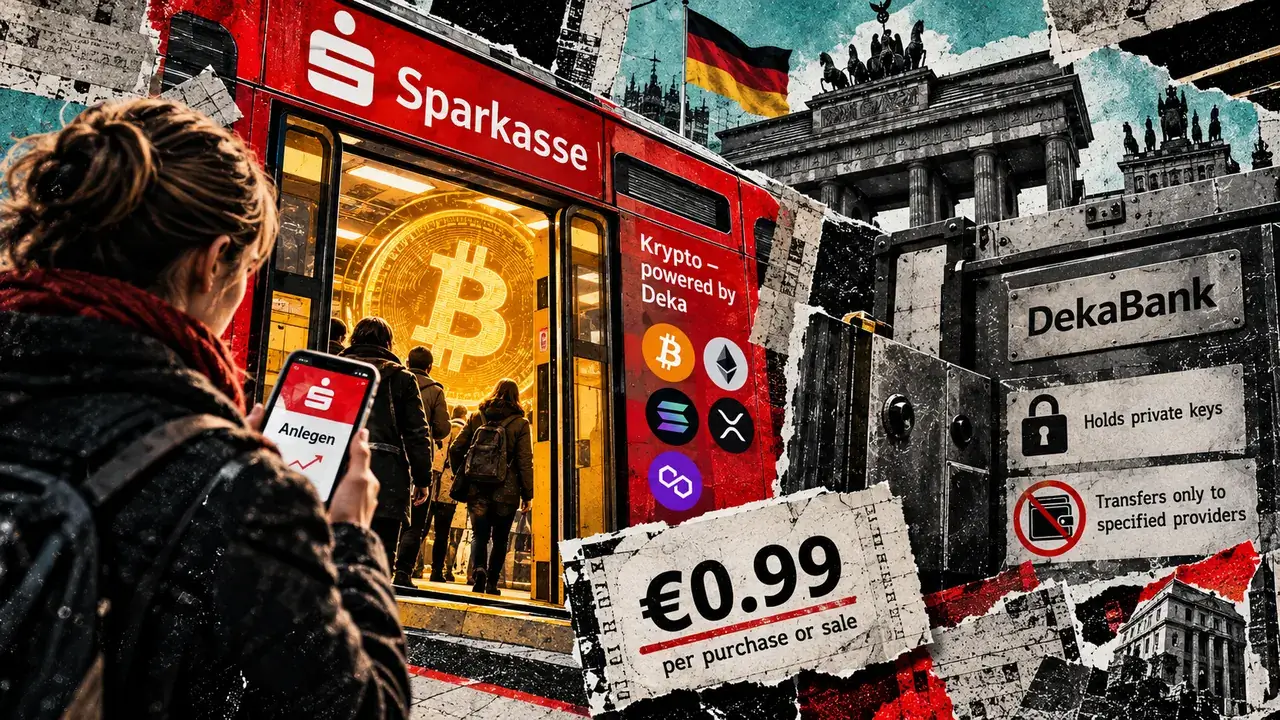
The wall between legacy European finance and the digital asset economy just took another hit, but it’s not exactly the breakthrough some enthusiasts were hoping for. Deka, the central asset manager for Germany’s Sparkassen-Finanzgruppe, has officially flipped the switch on Bitcoin trading. This means millions of conservative German savers now have a regulated path to buy crypto directly through their local bank branch interfaces.
For those outside Europe, the Sparkassen network is a titan. It is a massive group of public savings banks that essentially serves as the financial backbone for the German middle class. When a network this size moves, it isn’t just a headline; it is a structural shift in how a major economy interacts with capital. However, as with most things in the banking world, the implementation comes with a heavy dose of friction and some very old-school strings attached.
The Cost of Convenience
The entry price for these German retail investors is fixed at a 0.99 Euro order fee. On the surface, that sounds competitive, especially when compared to the predatory fees some legacy brokerages charge for traditional stocks. But the fine print reveals the catch: there is an additional spread layered on top. This is the classic banking playbook—marketing a low flat fee while capturing the real margin in the gap between the buy and sell price.
For builders in the decentralized finance space, this is a clear signal. The demand for Bitcoin is so high that even the most conservative institutions can no longer ignore it, but they are still trying to rent-seek on the underlying technology. They are providing a service that many people could do themselves for far less if the onboarding process wasn't so intimidating. The banking industry is betting that users will pay a premium for the comfort of a familiar mobile app and a regulated entity they trust.
The Walled Garden Problem
Perhaps the most significant detail in this rollout is the restriction on transfers. In this initial phase, users can buy and sell Bitcoin, but they can't necessarily move it out to a hardware wallet or a self-custody solution with ease. It is a closed loop. This is Bitcoin in name only for many purists—a financial instrument that tracks price action but lacks the utility of the actual network.
From a founder’s perspective, this highlights the massive gap in the market. We have successfully built the technology for decentralized money, but we haven't yet built the trust layer that competes with a 200-year-old savings bank. The Sparkassen customers aren't buying Bitcoin because they want to escape the central banking system; they are buying it because they want a piece of the upside in an asset class that has outperformed everything else in their portfolio. They are willing to trade away their keys for the perceived safety of a bank vault.
What This Means for the Crypto Ecosystem
We need to be honest about what this does to the market. On one hand, it brings massive liquidity and legitimacy. When the local bank of a small-town German merchant offers Bitcoin, the "scam" narrative dies a little more. It becomes a legitimate line item on a balance sheet. This is the ultimate top-of-funnel for crypto adoption.
On the other hand, it risks diluting the core value proposition of the technology. If the majority of the world’s Bitcoin is held in bank-controlled silos, we haven't actually decentralized anything. We have just replaced the old central banks with new ones that hold digital gold instead of paper. For developers, the mission should be building tools that make self-custody so intuitive that using a bank like Deka feels like an unnecessary and expensive middleman.
The Regulatory Safe Haven
Germany has been surprisingly forward-thinking regarding crypto regulation compared to its neighbors. By providing a clear framework, they allowed Deka to move forward without the constant threat of a sudden crackdown. This stability is why we are seeing these types of institutional rollouts in Europe before we see them at a similar scale in other jurisdictions.
For builders, this is a reminder that jurisdiction matters. If you are building a product that touches traditional finance, you go where the rules are clear. The German banks are moving because they know exactly what the boundaries are. They aren't guessing, and they aren't waiting for a court case to settle the law. They are executing on a roadmap that has been years in the making.
The Founder's Takeaway
The Deka launch is a bittersweet milestone. It proves that Bitcoin has won the battle for institutional recognition, but it also shows that the banking industry is successfully co-opting the technology to maintain its grip on user capital. The 0.99 Euro fee is the bait; the lack of portability is the hook.
- Focus on UX: If a bank can charge a premium for a subpar crypto experience, it means our current decentralized tools are still too hard to use.
- Bridges, Not Islands: We need to build better ways for people to move their assets out of these walled gardens and into the real crypto economy.
- Watch the Spread: Transparent pricing is our biggest competitive advantage against legacy finance.
We shouldn't celebrate the banks for letting us in. We should be watching how they attempt to change the rules of the game to suit their existing business models. The German savings bank network is a massive win for Bitcoin's price, but it's a cautionary tale for those of us who believe in the original ethos of the whitepaper. The banks aren't here to help us; they are here because they can no longer afford to leave our money on the table.
Read the original at CryptoSlate →